E-Paper



Three-cornered fight for leadership of Nepali Congress
Three senior leaders – Ram Chandra Poudel, Krishna Prasad Sitaula and former prime minister Sher Bahadur Deuba – are in the race for the post of president of the Nepali Congress.

 Prefer HTon Google


Three senior leaders – Ram Chandra Poudel, Krishna Prasad Sitaula and former prime minister Sher Bahadur Deuba – are in the race for the post of president of the Nepali Congress following the death of Sushil Koirala last month.
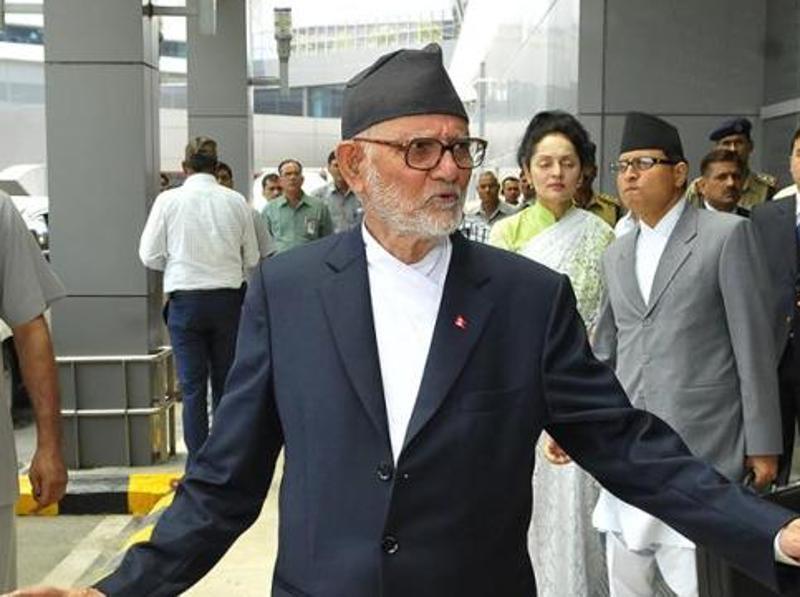
Nepal’s oldest political party began its 13th general convention in Kathmandu on Thursday to elect a new president. The opening ceremony was attended by several senior leaders from Indian parties, including Bihar chief minister Nitish Kumar.
Former deputy prime minister Sujata Koirala, the daughter of late Girija Prasad Koirala, has opted out of the race and the party will get a chief from outside the Koirala clan for the first time in more than two decades.
Sujata, who had announced her candidacy on Wednesday, decided against contesting less than 24 hours later and instead extended support for Poudel.
Read | Koirala’s death sparks leadership tussle in Nepali Congress
Poudel, the acting president of the party, and general secretary Sitaula are from the so-called establishment faction within the party to which Koirala belonged. Deuba, who had left the party earlier, belongs to the rival unit.
Efforts at putting up a unified panel from the establishment faction failed when Sitaula, a former home minister, decided to file his candidature. This could divide votes and help Deuba.
A survey by Nagarik newspaper, published on Thursday, gave Deuba 39% chances of winning, followed by Poudel with 26%.
The Nepali Congress is the largest party in parliament, but it is not part of the ruling coalition headed by the Communist Party of Nepal-Unified Marxist Leninist, which has the second highest number of lawmakers.
Read | Nepali Congress looks at future without a Koirala at its helm
Amid speculation about the formation of a national consensus government, including the Nepali Congress, after the general convention is over, there is intense lobbying and politicking for the top post.
The Maoists, who are part of the government, have been mentioning the need for a Nepali Congress-led consensus government and some senior leaders within the CPN-UML are making similar noises.
They feel the new Constitution can be implemented only when the Nepali Congress and Madhesi parties, who have rejected the statute and are seeking fresh demarcation of federal boundaries, are brought on board.
The Nepali Congress has adopted the implementation of the Constitution under the party’s leadership as the agenda for the general convention and beyond.
The battle for the general secretary’s post is also generating a lot of attention, with close relatives contesting from different camps. Senior leader Arjun Narsingh KC is in the Deuba camp while his son-in-law Gagan Thapa got the nod for the post from Sitaula’s panel.
Poudel’s group has Shashank Koirala, the son of former leader Bisheswar Prasad Koirala, contesting for the post.
Voting for the posts of president, general secretary, treasurer and 61 members of the central committee will take place on Sunday. A candidate must secure at least 51% of the votes to become president.
Established seven decades ago, the Nepali Congress led several protests to overthrow the hereditary rule of Rana prime ministers and usher in democracy.
The party has for the most part been led by members of the Koirala family, who were its founders. Three brothers Matrika Prasad, Bisheswar Prasad and Girija Prasad and their cousin Sushil Koirala headed it and went on to become prime ministers.