
 E-Paper



UK: Ancient Telugu palm leaf folios transcribed
Ancient palm leaf folios in Telugu held in the British Library since 1942 have been transcribed after a three-year effort, providing new insight into the life and work of the twelfth century theologian and philosopher, Acharya Ramanuja.


Ancient palm leaf folios in Telugu held in the British Library since 1942 have been transcribed after a three-year effort, providing new insight into the life and work of the twelfth century theologian and philosopher, Acharya Ramanuja.
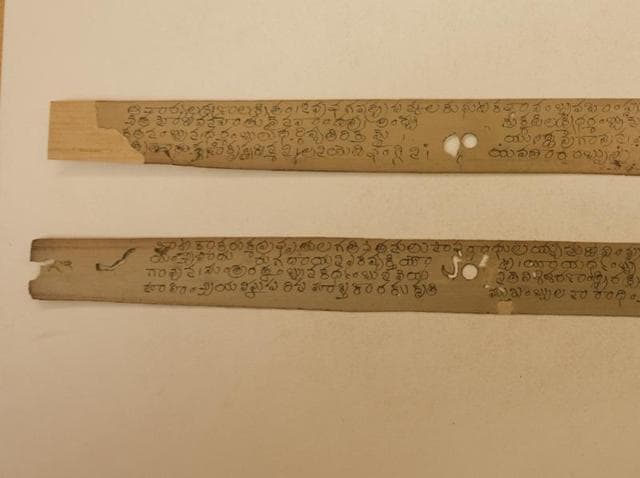
The folios were transcribed by London-based writer and academic Ragasudha Vinjamuri, whose work is scheduled to be released in the print form at an event in the British parliament in May to mark the beginning of Ramanuja Sahasrabdi (1000th birthday) celebrations.
Born in Sriperumbudur in Tamil Nadu, Acharya Ramanuja was the leading expounder of Vishishtadvaita, one of the sub-schools of the Vendanta school of philosphy. The sub-school has a large number of followers in parts of Maharashtra, Tamil Nadu, Gujarat and Karnataka.
Vinjamuri told Hindustan Times: “As the first two folios and some bits and pieces were damaged, initially the author was unknown. After researching and inquiring from different archival collections in India in Chennai, Tanjavur and Hyderabad, and after consulting scholars and historians, we could trace the author and his composition to be around 300 years old belonging to the Tirupathi area”.
The folios, which were acquired by the British Library from one Mack Cobban, were found to be written by Illindala Paravastu Ramanujacharya (17th-18th century). The text is in the form of Shataka (100 verses) in praise of Acharya Ramanuja and his life.
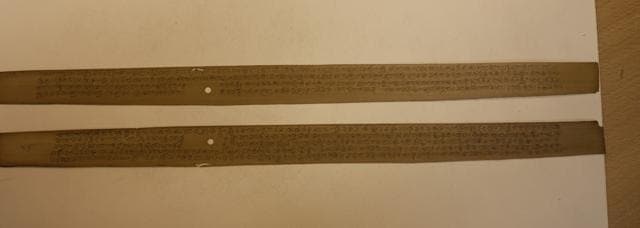
Vinjamuri said: “The journey was not so easy. Some folios were very light and reading the content was difficult even under a powerful magnifying lens. Some sections were damaged. It took several months to ascertain the author of this work”.
She added: “The Telugu script and the verse used in the work was slightly different to the one that I am used to reading and writing. I had a baby when I began transcribing; after nearly three years now, I feel I have delivered a second baby”.
Delighted at gaining a better understanding of Acharya Ramanuja’s life and work, Vinjamuri highlighted Verse 13 that praises him as one who received the attention of Yamunacharya and narrates the episode of his childhood Guru Yadava Prakasha in Kanchipuram.
“Ramanuja fearlessly points out the errors in his Guru’s interpretation of the Advaita vedanta. The verse also mentions the desire of Alavandar to see Ramanuja”, Vinjamuri said.


