
 E-Paper



Lack of coordination between police, govt reason for Delhi’s high road fatalities
In Part 3 of our series Say Yes To Helmets, we look at why Delhi’s road fatalities are so high and what can be done to bring down the accidents.

 Prefer HTon Google


Delhi recorded its lowest road accident fatality in 25 years this year, but there is very little reason to celebrate.
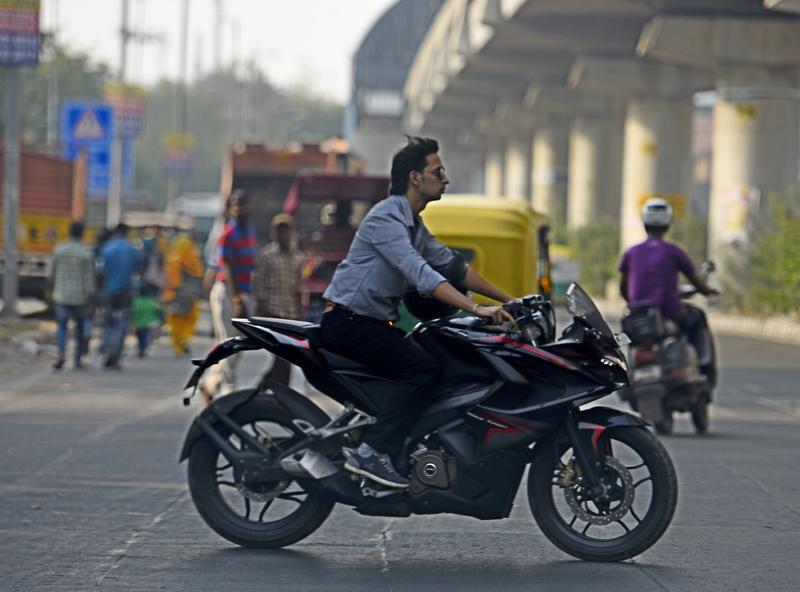
Experts say that with 1,622 people losing their life last year, Delhi still tops the list of maximum road deaths, compared to all other metro cities in the country. Out of these deaths, two-wheeler riders constitute the third most vulnerable category, after pedestrians and cyclists.
A major cause for this high fatality, they say, is the lack of coordination between the central government-controlled Delhi Police and the Aam Aadmi Party government in Delhi.
“The Delhi Traffic Police, which is the primary traffic enforcement agency in the city, is not answerable to the state government. In such a case, problems are likely to arise. The Delhi government’s transport department and the traffic police are working independently,” said a senior Delhi police official, on condition of anonymity.
He said this was the main reason why no major traffic awareness programmes were launched in the city in the last few years.
In every other state, the police is under the state government and so the implementation of awareness drives becomes easy. Kerala and Ranchi recently distributed free helmets to those travelling without it, and Maharashtra implemented the‘no helmet no fuel’ policy.
No such major drives are possible in Delhi because the traffic police which is the primary enforcement agency, is not under the Delhi government.
The roles of the transport department and the traffic police are also not completely demarcated.
The lack of coordination was clear during the Delhi government’s odd-even road rationing scheme and also during the car-free days, which were introduced every month at different locations in the capital, to discourage people from using private vehicles.
“These schemes would have worked much better with the police and the government working hand-in-hand. The attempt was commendable but there was a half-hearted effort from the enforcement teams, mainly because they do not report to the state government,” said Dr Nilanjan Bhaskar, road safety and policy expert.
Senior officials from Delhi traffic police have often said that lack of ample staff has held the department back. At present, the department has a total staff strength of just over 5,000 personnel.
The same problem is also plaguing the transport department’s enforcement wing. Lack of enough personnel and resources have slowed down operations.
The traffic unit of the Delhi Police has, however, conducted several drives to encourage two-wheeler riders to wear helmets. One of the most successful of these is the operation Chakravyuh, which was launched in 2015.
“We target a location and our personnel surround it from all sides. When violators are spotted, our men form a ring and do not allow them to escape. These violators are also penalised. We have been conducting the operation in different locations. Along with penalties, our teams also educate riders on the effects of not wearing helmets,” said joint commissioner of police (traffic) Garima Bhatnagar.
The Supreme Court’s intervention has also helped enforce traffic rules better. The apex court ordered that all traffic violations likely to cause fatalities will lead to the suspension of the offender’s driving license for at least three months, along with the usual penalty.
Since December last year, over 1.5 lakh licenses were suspended, and a major chunk of this comprises two-wheeler riders.
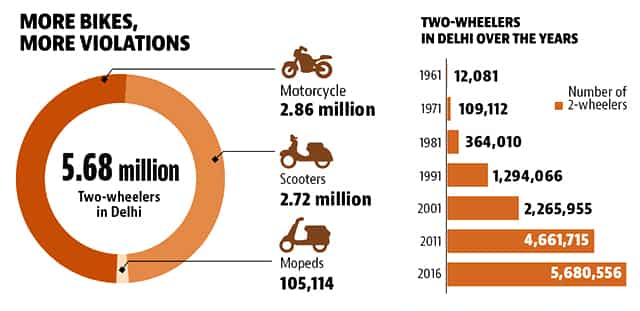
Delhi has a vehicle population of 8.9 million, of which 5.68 million are just two-wheelers and their number is increasing rapidly.
In 2001, Delhi had just 2.26 million two-wheelers, while in 1991, the number stood at just 1.29 million.
“Delhi has seen a major spike in the number of two wheeler registrations. When you compare it to the numbers in 1971, people had lower incomes and could not afford to buy their own vehicles. But now, the standard of life has improved and the availability of finance is also easy. Delhi also does not have vehicles from the city alone. Vehicles from NCR and other neighbouring states also travel on its roads almost every day,” said a senior transport department official.
According to section 129 of the Motor Vehicle Act 1988, wearing a helmet by both—driver and pillion rider— is mandatory.Today, 27 years later, the number of people following this rule is still a minority.
Although adherence to this helmet rule is almost 80-90% within city limits, riders from neighbouring states, where the rule is not so strictly enforced, do not care to wear helmets.
Dr Nianjan Bhaskar said it will take time for people to internalise the importance of the helmet and other safety gear while riding a bike. The lack of strict enforcement of rules, along with the lethargic approach of enforcing agencies, a lack of public awareness and no fear of the law among the public, have all resulted in pulling back the system. When it will finally fall into place, only time will tell, he added.
This is the concluding part of our series, Say Yes To Helmets. Join the conversation and tell @htTweets what can be done to reduce road fatalities in Delhi.


