
 E-Paper



After the bypolls, the political landscape in Bihar
Both the RJD and the Janata Dal (United) put a lot into the elections, with the RJD hoping that wresting both seats would indicate a momentum shift away from the Nitish Kumar government. However, the JD(U) emerged victorious in both seats, cementing its numbers in the state

 Prefer HTon Google


Last week’s bypoll results in Bihar may not have much of an impact on the health of the Nitish Kumar-led National Democratic Alliance (NDA) government in Bihar, but the return of Rashtriya Janata Dal (RJD) leader Lalu Prasad to the state to campaign after a four-year hiatus had raised the stakes.
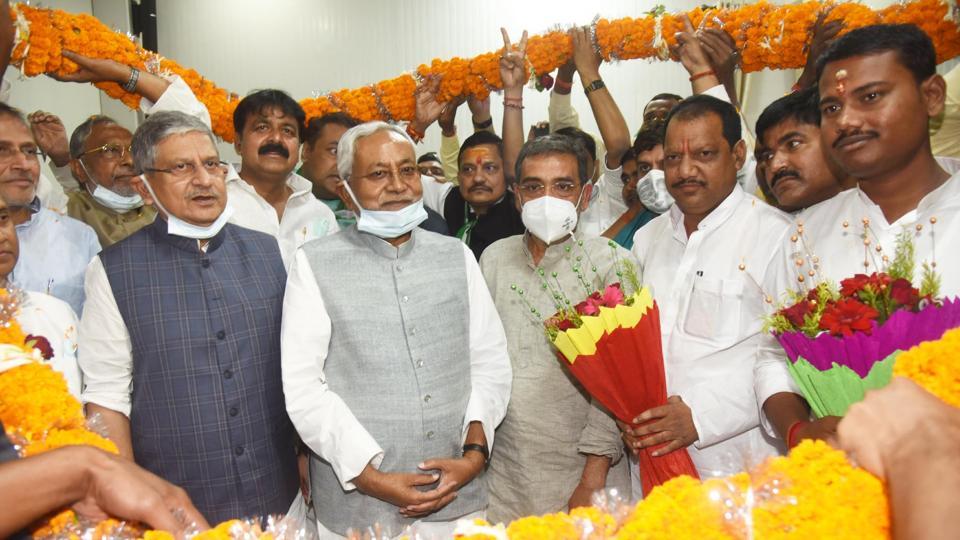
Both the RJD and the Janata Dal (United) put a lot into the elections, with the RJD hoping that wresting both seats would indicate a momentum shift away from the Nitish Kumar government. However, the JD(U) emerged victorious in both seats, cementing its numbers in the state.
In Bihar, every election is important. Unsurprisingly, this one too had a variety of subplots, including the RJD-Congress break, the performance of Chirag Paswan, and the continuing decimation of the Congress in the state. As parties internalise the results, and draw their revised strategies, here are the big takeaways.
Morale booster for JD(U)
The victory is a morale booster for the JD(U), which, despite Nitish Kumar being the chief minister (CM), has had to live with the taunt of being the third-largest party in the state after the RJD and the Bharatiya Janata Party (BJP).
In that matrix, it was essential to hold on to the Kusheshwar Sthan and Tarapur seats, both it had won in the assembly elections. Hence, the JD(U) is viewing the results as a validation of the CM’s development plank.
“It’s a validation of Nitish Kumar’s policies and programmes. The RJD tried hard to discredit us after the JD(U)’s poor showing in the 2020 assembly election and often accused us of stealing the mandate,” said water resources minister Sanjay Kumar Jha.
In Kusheshwar Sthan, Dalit voters and women appeared to have supported the JD(U). In the 2020 assembly elections, Nitish Kumar’s party got 39.55% of votes, which increased by around 6% in the bypoll.
It was not that easy. JD(U) candidate Aman Hazari was not popular because people were not pleased with his father’s work. The ruling alliance leaders were quick to realise this, and several ministers camped there and did door-to-door campaigning for Hazari.
The ministers had to convince the voters to forget about Aman Hazari and keep faith in Nitish Kumar. The ₹6,000 direct transfer to people’s account, the relief distribution during floods, and building of roads also tilted voter’s opinion in JD(U)’s favour,” said a senior NDA leader. The CM visited flood-hit areas of the constituency on a boat, and that show of sensitivity worked as well.
“The results speak about the trust people have reposed in Nitish Kumar and his development politics as the victory margin in Kusheshwar Asthan almost doubled from 2020,” said Gyanendra Yadav, associate professor of sociology, College of Commerce, Patna.
In Tarapur too, the JD(U) increased its votes share from 36.93% to 46.62%, enabling it to eke out a slim victory.
The success has also fuelled talk in the JD(U) that it is now in a better position to bargain for seats in the Uttar Pradesh (UP) assembly election. “The JD(U) needs to win at least 13 assembly seats in UP to get recognition as a national party,” said a JD(U) functionary.
The RJD comes up short
For the RJD, the loss puts the brakes on the thought that a win would herald the beginning of the end of the incumbent government. The hope for the RJD was that if they won both seats, despite the NDA’s stronger caste matrix, it would indicate a genuine antipathy with the ruling party and force defections from the JD(U).
The importance it attached to the seats was evident in the return of Lalu Prasad to Bihar. He campaigned in both seats despite his illness and professed confidence before the counting day. The RJD’s focus on both seats also seemed to sour its relationship with the Congress, which had earlier fought the Kusheshwar Sthan seat.
For the RJD, these bypolls too were a test of whether it could challenge the caste split of the NDA, and go beyond the traditional Muslim-Yadav vote-base.
In Tarapur, the RJD also nominated a Vaishya, even though they knew the community voted for the BJP. The experiment came up short, but in a seat where it had not even contested in 2020, it won more than 44% of the votes polled. Some in the RJD see this as progress.
“Lalu is still a charismatic leader and his presence in Patna did provide a fillip to the party in performing better,” said DM Diwakar, former director, AN Sinha Institute of Social Sciences.
“Lalu’s decision to field a Vaishya candidate who have been traditionally backing BJP or JD (U) is indeed a bold step and Vaishya’s shifting base doesn’t augur well for the BJP,” accepted Santosh Pathak, a BJP leader.
The NDA, however, said that Lalu Prasad was a fused bulb, and that his return confused the party, with Tejashwi Yadav leading the charge in the 2020 assembly election. “His party is in confused hands. Voters rejected his tricks,” felt former deputy CM and Rajya Sabha MP, Sushil Kumar Modi.
What this election says for Chirag Paswan
The fate of Chirag Paswan, much like that of his father, the late Ram Vilas Paswan, has been an intriguing subplot in the elections. In the 2020 assembly elections, the Lok Janshakti Party (LJP) separated from the NDA, fighting the JD(U) in most seats, but not the BJP.
In the aftermath of the elections, the LJP split, and the BJP backed the faction of Pashupati Paras, Chirag’s uncle, who became Union minister in place of the late Ram Vilas Paswan. Chirag then went into these elections alone, but the numbers have not been encouraging.
In Kusheshwarsthan, the LJP (Ram Vilas) got 5,623 votes (4.29%) while in Tarapur, the LJP (Ram Vilas) got 5,364 votes (3.16%). In 2020, these numbers were 13,362 or 9.79% votes in Kusheshwarsthan and 112,64 or 6.45% votes in Tarapur, respectively.
In 2020, the LJP affected JD(U)’s prospect in at least 35 seats, but this time it failed to harm the ruling party.
For Chirag Paswan, these elections were key that a sign that he had emerged as a leader of the Paswans in his own right and would hold the bargaining power in the caste arithmetic in the Lok Sabha or the assembly elections.
However, these results seem to reiterate that in Bihar’s politics bigger national parties have benefitted when they have tied with regional parties. But whenever a party enters the election field alone, it incurs a loss.
Chirag Paswan, however, said he was not disheartened.
“This is just the beginning. People of Bihar have appreciated a new party and a new symbol. Contesting under adverse circumstances, we finished third,” tweeted Chirag.
The decimation of the Congress
For the Congress, these results brought another round of darkness.
It fought Kusheshwarsthan in 2020, in alliance with the Left and the RJD, winning 34.26% of the vote.
In the run-up to the bypolls, the Congress took an aggressive stance, going solo with Bhakt Charan Das leading the charge. But its support dropped drastically in the bypolls. In Kusheshwarsthan, the Congress got 5,603 votes (4.28%). In Tarapur, Rajesh Kumar Mishra of the Congress got 3,590 votes (2.12%).
The defeat has increased the demand for a change in guard in the state Congress, already set in motion with the induction of Kanhaiya Kumar.
However, the question for both the RJD and the Congress is whether these results are proof that they need to fight elections together to beat the NDA’s caste combination, particularly in the short term.
For now, though, the Congress seems to be keen to test the waters on its own.
“We gave a message, loud and clear to the people of Bihar, that the Congress has the courage to fight elections without any support. We lost, but succeeded in our mission to prove the wrong decision taken by the RJD. They have also lost both seats,” said Anand Madhab, spokesperson, BPCC & chairman, Research Department and Manifesto Committee, BPCC. “The RJD played a dirty game just a day before the election by circulating rumours that Laluji had spoken with Soniaji and the Congress has withdrawn their candidates from both seats. This had an adverse impact on the electorate and affected voting behaviour. The Congress is ready to take on any forthcoming elections on its own.”


