
 E-Paper



Faiz Ahmad Faiz could be 20th century’s most relevant poet, here are a few shayaris that will tug at your heart strings

 Prefer HTon Google


He was best known for his progressive writings which were as popular in pre-Partition India as he was appreciated across the world for his ghazals and shers.
One of the most celebrated and popular shayars of the 20th century, Faiz Ahmad Faiz was a versatile creative mind. Faiz was also the poet’s takhallus (a pen name). He is credited with countless couplets (shers), radio plays, children’s stories, letters to his wife and children from jail apart from a number of travelogues.
He was best-known for his progressive writings which were as popular in pre-Partition India as he was appreciated across the world for his ghazals and shers.
In 1951, Faiz was arrested with a group of army officers under the Safety Act, and charged with a failed coup attempt that became known as the Rawalpindi Conspiracy Case. He was jailed for four years and released on amnesty.
The first major translation Faiz’s work was released in 1971. It won’t be incorrect to say that Faiz’s everlasting appeal, that connects with the youth today as well, was to Urdu poetry in the 20th century, what Mirza Ghalib and Mir Taqi Mir were in the 19th and 18th centuries respectively. According to Faiz, the usage of words such as zulf, paimana and mohabbat to ensure a poem got a high reach.
Some renowned writers and poets from the sub-continent namely Khushwant Singh, Shiv K Kumar, Vikram Seth, Shoaib Hashmi, among others have all translated Faiz’s impactful poetry.
ALSO READ: Translating Faiz over and again
Hum Dekhenge written by Faiz in reference to military dictator Zia-ul-Haq in 1979, became a point of contention in the recent protests against the CAA bill. IIT-Kanpur students had taken out a peaceful march on the campus on December 17, 2019 in support of the students of Jamia Millia Islamia and during the march, the students sang the Faiz poem. The Indian Institute of Technology, Kanpur has formed a panel to decide whether the poem has an ‘anti-Hindu’ context. The complaint was based on two lines of the poem, which read: “Sab takht giraye jayenge. Bas naam rahega Allah ka. Hum dekhenge. (When thrones will vanish, only Allah’s name will remain)”, which triggered the professor who filed this complaint.
Speaking to ANI about Faiz and the recent controversy, the writer told ANI, “Calling Faiz Ahmed Faiz ‘anti-Hindu’ is so absurd and funny that it’s difficult to seriously talk about it.”
“He lived half his life outside Pakistan, he was called anti-Pakistan there. Hum Dekhenge he wrote against Zia ul Haq’s government which was a communal regressive and fundamentalist government,” Akhtar told ANI.
This poem’s verses have also been used by Coke Studio in a song that piqued many a listeners’ interest in the legendary poet’s work.
For readers who are yet to be initiated into Faiz’s poetry, his work isn’t one to leave you once you’ve read it. It might even have different meanings for every reader at the point in life when they’ve read Faiz’s work. For a die-hard romantic, his lines on matters of the heart, heartbreak and longing is sure to leave you with a feeling one can hardly describe in words. From translations to various pop culture references, there’s a lot of depth one can delve into with Faiz’s beautiful poetry. Here’s a list of some of his popular shers:
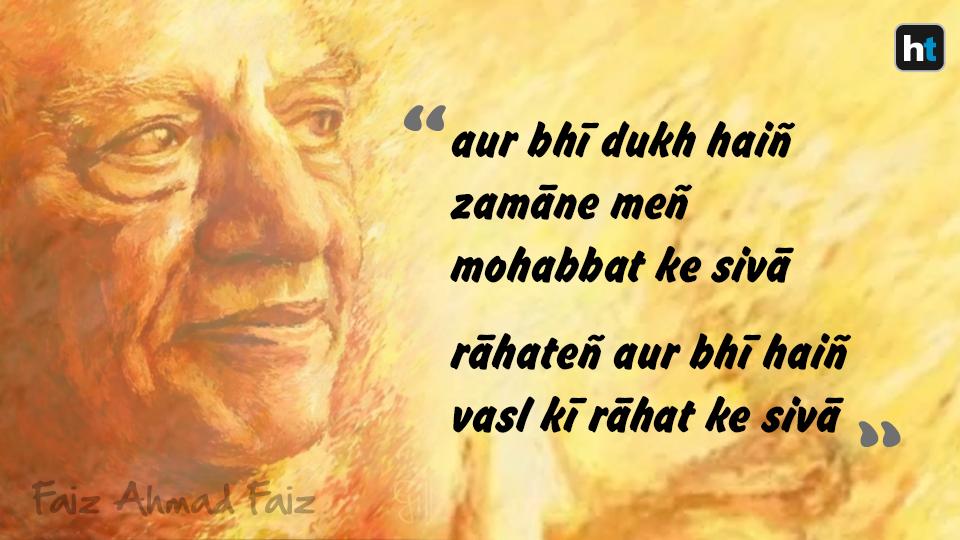
1) Aur bhi dukh haiñ zamane meñ mohabbat ke siva
rahateñ aur bhi haiñ vasl ki rahat ke siva
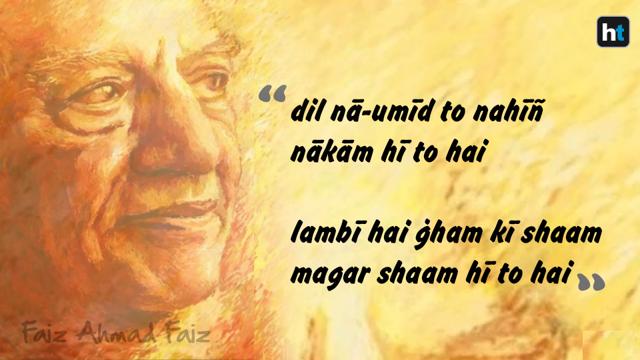
2) Dil na-umid to nahiñ nakam hi to hai
lambi hai gham ki shaam magar shaam hi to hai
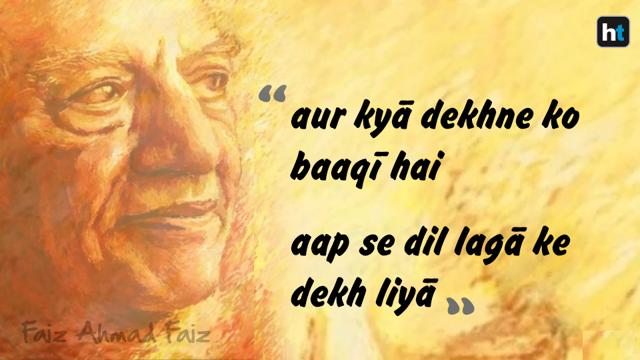
3) Aur kya dekhne ko baaqi hai
aap se dil laga ke dekh liya
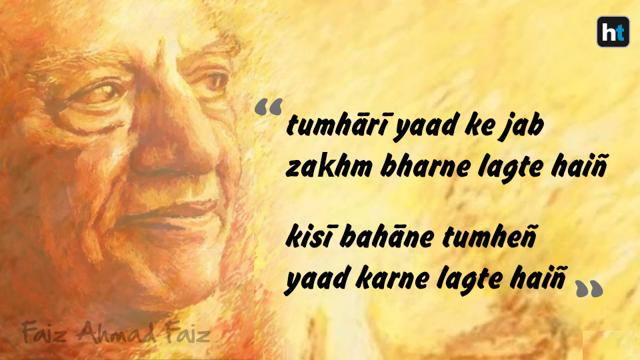
4) Tumhari yaad ke jab zakhm bharne lagte haiñ
kisi bahane tumheñ yaad karne lagte haiñ
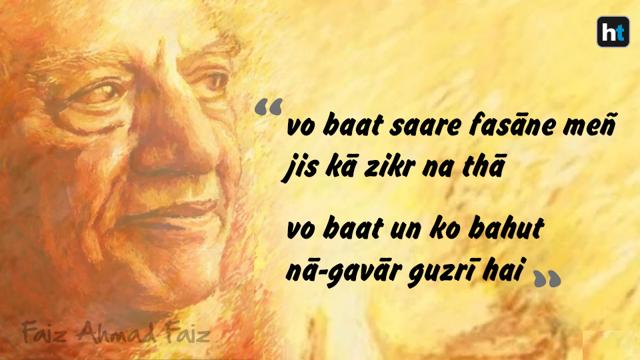
5) Vo baat saare fasane meñ jis ka zikr na tha
vo baat un ko bahut na-gavar guzri hai
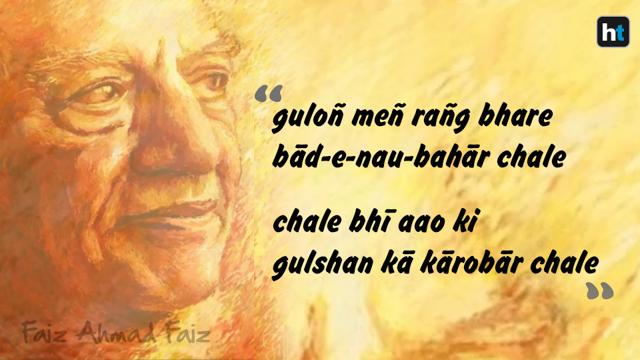
6) Guloñ meñ rañg bhare bad-e-nau-bahar chale
chale bhi aao ki gulshan ka karobar chale
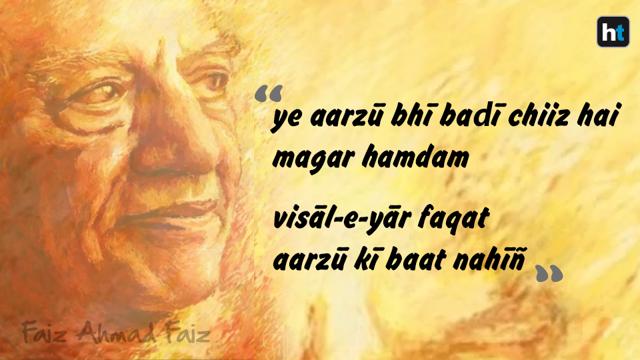
7) Ye aarzu bhi badi chiiz hai magar hamdam
visal-e-yar faqat aarzu ki baat nahiñ
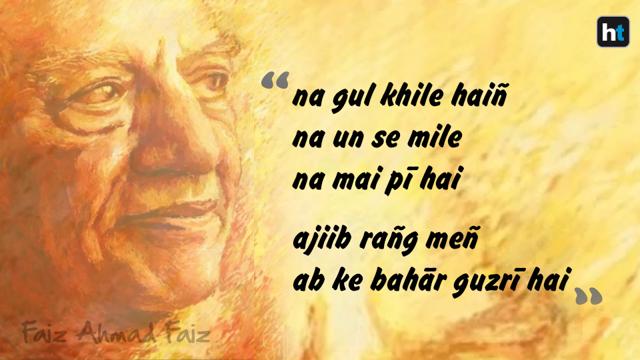
8) Na gul khile haiñ na un se mile na mai pi hai
ajiib rañg meñ ab ke bahar guzri hai
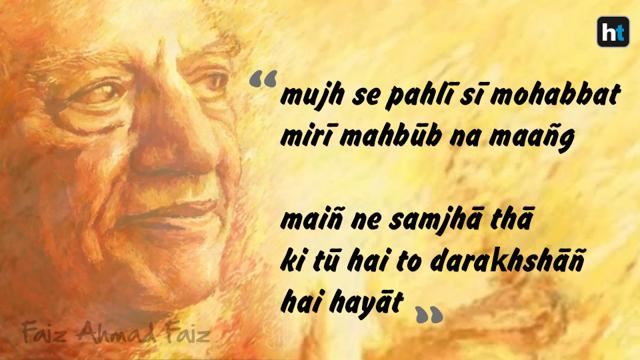
9) Mujh se pahli si mohabbat miri mahbub na maañg
maiñ ne samjha tha ki tu hai to darakhshañ hai hayat
Sher credits: Rekhta.org


