
 E-Paper



American translations of Rumi’s works are obscure: Farrukh Dhondy
Author Farrukh Dhondy on discovering Rumi for the first time and what makes his poetry a gift that keeps on giving.


For writer and playwright Farrukh Dhondy, discovering Rumi, like it is for everyone else, was a moment of revelation. “I never knew him but the family had copies of his translations of Omar Khayyam,” he says, adding, “I became aware that he had translated several Persian poets among them Rumi.” Dhondy’s latest work, Rumi: A New Collection, is a collection of translations, which he calls “an ocean of verse”.

When Farrukh first read Rumi, it was on a long flight. “The only writer in my family or among my ancestors was my great grandfather Jamshedji Saklatwala. I became aware that Khayyam had translated several Persian poets among them Rumi, though the family only had a surviving copy of his Rubaiyat of Omar Khayyam. I had read no Rumi till a friend gave me a book of Rumi translations to occupy me on a flight to Australia. I settled into the flight and started to read. The verses were obscure, without rhyme or rhythm and full of mixed metaphors, contemporary American idiom which rendered them clumsy and weren’t satisfactory, in any sense, as poetry.” This made him put the book aside and watch a film instead, he quips.
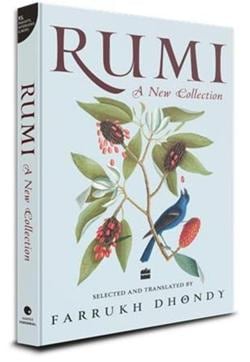
The author adds that it is not surprising that the poet’s works have survived for centuries. “His Masnavi (a poem) is known as the ‘Koran in verse’ and wherever the ‘Sufi’ tradition survives, his work does,” says Dhondy. The author adds that in the American translations of his work, one can easily spot pretentious spirituality that the world is currently obsessed with. He says, “The American translations that I have read are, with gobbledegook syntax, their mixed metaphors and the complete absence of the felicity of Rumi’s rhythmic and rhyming poetry open to ridicule and caricature. In fact they caricature themselves.”
He adds, “The Sufi idea of ‘love’ in all his verses, is a love of God, a passion for the ultimate spirit and not a hankering lust for a wished for or achieved mortal partner. There are certainly instances in which Rumi uses human love and sex as a pathway to the ultimate ‘love’ celebrated in his work. To mistake the metaphor for the end is idiotic, if not sacrilege.”
At Hindustan Times, we help you stay up-to-date with latest trends and products. Hindustan Times has affiliate partnership, so we may get a part of the revenue when you make a purchase.


