
 E-Paper



Book Box: My best non-fiction of 2025
From AI empires to Himalayan silences: a personal shortlist

 Prefer HTon Google


Dear Reader,
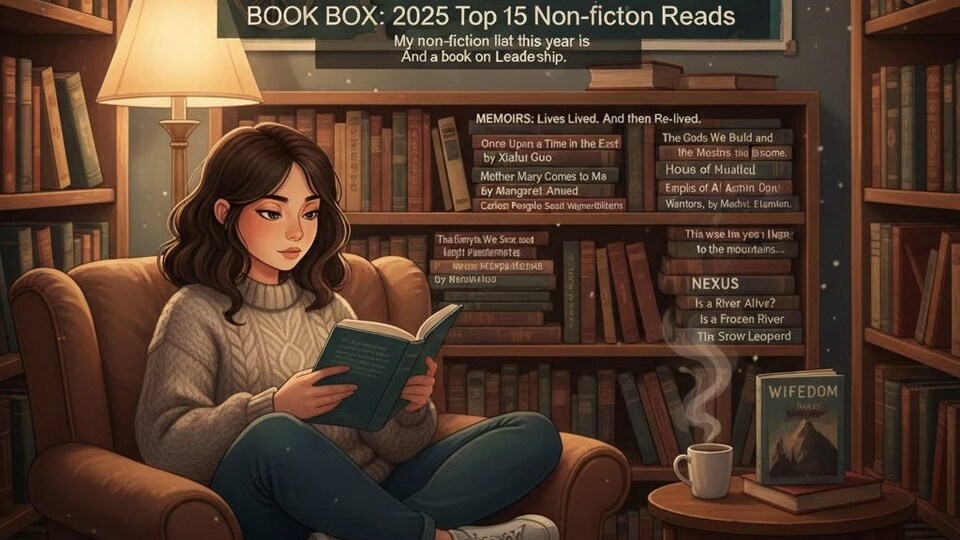
My nonfiction list this year is wildly skewed—half tech dystopia, half mountain mysticism, with a multitude of memoirists weaving through the middle. It feels chaotic, but perhaps it mirrors the moment we’re living in: caught between the future we’re building and the primal truths we can’t escape.
Through it all though, some books stand out. Here they are. Books that shaped my year. Books that changed how I think. Books that made me slow down. Books that consoled me. Books I wanted to discuss with fellow readers the moment I finished them. These are the ones worth stealing hours of your life for.
Memoirs : Lives Lived. And then Re-lived.

Every year autobiographies get more raw and reflective. It feels like everyone decided to stop being polite and start getting real, in the most artful, devastating ways.
Once Upon a Time in the East by Xialuo Guo -The daughter of a Red Guard, Guo excavates family history to tell a story that is at once personal and national. Pair it with this year’s best selling Mother Mary Comes to Me—two cultures, two writers, two mother–daughter narratives, each startlingly different in the lens they employ.
Mother Mary Comes to Me by Arundhati Roy - What can you say about a memoir that bridges the haunting and heartbreaking spaces between mothers and daughters ? Not enough, it appears, as readers and critics all over the world react emotionally to Roy’s tell-all. In the end, all you need is two words - read it.
Book of Lives by Margaret Atwood: Atwood turns her fierce, mischievous intelligence inward, exploring her childhood, her creative awakenings, and the roots of her imagination. Read this in print—better still, listen to Atwood narrate it in her beautiful, gravelly, writer’s voice.
Careless People: A Story of Where I Used to Work by Sarah Wynn- Williams : The author has us rooting for her early on, with her story of surviving a childhood shark attack, early training it appears for her days at Facebook. Her whistle-blowing account of Facebook’s internal failures makes this memoir gripping and necessary.
The Architects: Power, Prophecy, and the New World Order

I devoured these books with a kind of horrific fascination, as each lays bare the new, invisible cages being built around us.
The Everything Store by Dana Mattioli : Essential reading if you want to understand the architecture of modern commerce. We know many of these monopoly stories, especially those in the first half of the book, but to see them all together makes this disquieting and disturbing, revealing patterns about modern e-commerce that we need to know.
House of Huawei by Eva Dou: A thriller about a company, yes, but really about the new, invisible cold war. It is a global narrative, yet it conveys the peculiar intimacy of this new cold war, fought with signals in the ether, touching us all in our most private pockets of life.
Empire of AI by Karen Hao -From the limitations of large language models to the hidden costs of AI on workers and the environment, Hao’s account is damning and eye-opening. A necessary interrogation of the empire we are sleepwalking into.
Warriors, Rebels and Saints by Moshik Temkin - A vital companion to the tech narratives, this book asks: what kind of leadership can possibly navigate this new world? Temkin, with a storyteller’s flair, draws lessons from history and literature on wielding power—whether you have too much, too little, or none at all. My favorite chapter, on the suffragettes, is a masterclass in building power from the ground up.
The Antidote: Geographies of Silence and Soul.

This was the year I kept returning to the mountains — both in real life and on the page. Here are my three favorites of the year -
Is a River Alive? by Robert Macfarlane A thoughtful, poetic inquiry into ecological consciousness, spread over three continents, this question becomes the answer. Macfarlane is a nature writer whose powerful, immersive prose makes you forget everything but the primal language of water and stone.
The Frozen River by James Crowther: Walking the mountain paths of Manali, I was immediately drawn to this stark, luminous account of life in Zanskar. “Silence, snow and solitude have got hold of me and will not let me go,” Crowther writes—perfectly capturing the book’s hold on me.
The Snow Leopard by Peter Matthiessen: A bereaved man’s search for meaning in the Himalayas, this classic drew me in again with its lyrical beauty—a story where the physical journey across mountains and the inner, spiritual search become one.
And finally, a book that doesn’t fit: Wifedom by Anna Funder, a work of quiet and terrible fury. With the sensitivity of a saint and the precision of a historian, Funder exhumes the buried life of the gifted Eileen O’Shaughnessy, rescuing it from the grand narrative of her Great Man husband - the writer George Orwell. Wifedom weaves memoir, biography and moral indictment into a blazing counter-narrative that will forever change how you look at Orwell.
Looking back, one thing all the books have in common is an interrogation of boundaries: between mind and machine, between the body and the mountain, between the lived moment and the remembered one, between the constructed curated moment and the ‘real’ one.
What about you, dear Reader ? What has your non-fiction reading here been like?Here’s to the books that find you exactly where you are. And to following your fixations, no matter how embarrassingly specific or disconnected they may be.
Sonya Dutta Choudhury is a Mumbai-based journalist and the founder of Sonya’s Book Box, a bespoke book service. Each week, she brings you specially curated books to give you an immersive understanding of people and places. If you have any reading recommendations or suggestions, write to her at sonyasbookbox@gmail.com.
The views expressed are personal.


