
 E-Paper



Excerpt: Jikoni; Proudly Inauthentic Recipes from an Immigrant Kitchen by Ravinder Bhogal
In the introduction to her cookbook reproduced here, the author writes of her childhood in Kenya, of the secret language of cooks, and of fusing new ingredients with old traditions to come up recipes that span geography, ethnicity and history


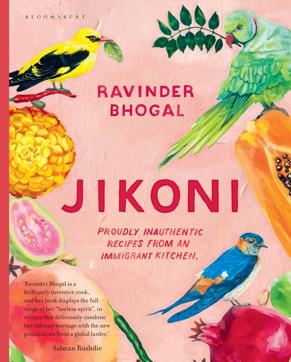
Jikoni means ‘kitchen’ in Kiswahili, the spirited language spoken in Kenya, the country where I was born. I grew up in Nairobi, in a whitewashed house built by my bhaji (grandfather). Like many Indians before him, he left his native Punjab in the 1940s in search of work. Most of them worked as labourers building the railways – lines of neat-as-needlework stitches across wild terrain – to link Kenya with Uganda. Many later settled in Uganda, only to be expelled in the 1970s under the bloody regime of Idi Amin.
Bhaji spent much of his time constructing properties in Kenya, but he also spent a great deal of it falling in love with the red-earthed, blossoming landscape of this tropical East African clime, so much so that he decided to lay down roots.
Our family was neither small nor quiet – there were six just in my nuclear clan, but the tradition of living with extended relations meant that there was anywhere between 15 and 25 people in our house at any one time – a source of both cosiness and chaos. Mealtimes for a tribe that never seemed to stop breeding had to be handled with military precision, and every woman and girl was recruited to the cause, willingly or otherwise.
I was a reluctant assistant to my mother, who had a stern approach to all domestic duties. Taking pity on me, my grandfather would let me hop onto his strong broad shoulders, and take me off for a weekly treat.
We would drive into town in his rickety Volkswagen and head straight for Sno Cream, a kitsch ice-cream parlour where gelatos like dreamy sherbet-hued clouds came in cut-glass dishes. It was over our love of the naughty-but nice stuff that we bonded, and I think this was where my association of food with pleasure began. One day, in the season of the long rains, when the garden bloomed madly and insects seemed to congregate in every corner of it, bhaji bought me a little aluminium stove that could actually be lit with crumpled-up newspaper. I took to making towers of chapattis that were singed and bitter, but he would praise and encourage me, eating them with relish. This made me realise that feeding someone made love expand, and so I decided to embrace my kitchen duties.
After that I spent most of my time making a nuisance of myself, squeezed into a small jikoni full of women confidently throwing a series of fragrant seeds and pods into pots, gossiping in a unique patois made up of several inherited tongues including Swahili, Punjabi, Gujarati, Urdu, Hindi and English.
This was also my initiation into the secret language of cooks – where recipes were never recorded in ink on paper, but sung down the generations like feminine gospels, until every daughter knew them off by heart. It was here that I felt truly alive, my every sense awake to the subtleties of the kitchen: the cheery whistle of a pressure cooker; the cloud of steam rising from an ochre broth gilded with turmeric, its sweet, sour, hot, salty and deeply, deeply spicy flavours all expertly balanced. My nose was acutely attuned to the potency of each spice my mother crushed in her crude stone pestle and mortar. Everything was safe. Everything was familiar. When I was seven, we made an abrupt voyage to England. Our usual trips to visit family in London had always been a merry-go-round of Fortnum & Mason, Hamleys and shiny biscuit tins, but after several weeks of living in a frigidly cold flat above a shambolic shop that was very much in need of a woman’s touch, it became clear that this trip was different, and we were not going back.

Homesickness was an ordeal I found difficult to shake off. I felt displaced and alienated, bullied at school for my foreign accent and NHS specs. I existed in a strange sort of suspended animation, carrying the burden of living between two worlds. I had been accustomed to creepers, colossal jamun trees and rugged, open terrain – my new landscape was barren, the horizon heavy with haggard buildings set against a terrifying Milky Way of artificial lights. I longed for the familiar, and for the foods that signified the familiar for me.
I developed a sensual nostalgia for the smell of wet, red Kenyan earth, for the scent of guavas warming on the trees in the garden.
I can’t remember exactly how long it took me to settle – and even when I did, the dream of returning endured. Nostalgia makes the things you hastily leave behind feel more precious than ever: the favourite dolls, the language, the neat and beloved grandmother, the culture. But for me it was the distinctive taste and smell of home I missed the most.
Eventually, the hole in my stomach and soul led me into our modest English kitchen with my mother, where we learnt to merge our old and new worlds. We occupied a hinterland where we fused new ingredients with our old traditions, unwittingly creating a new cuisine. Our recipes displayed a rebellious spirit – lawless concoctions that drew their influences from one nation and then another. We took the traditions of our ancestors and their regional home cooking and overlaid them with the reality of our new home and whatever its various food markets, delis, canteens and multicultural supermarkets had to offer on any given day. This is what I suppose could be loosely termed ‘immigrant cuisine’, proudly inauthentic recipes that span geography, ethnicity and history.
Listen: The Books & Authors podcast where Ravinder Bhogal talks about Jikoni and immigrant cuisine
It was in the kitchen that I found my sanctuary and made peace with my new nation. As I grew up and graduated to cooking alone, unaided by my mother, I realised that a kitchen might provide a little bout of perfection, disappearance and luxury, amid the stresses of constantly trying to fit in. I relished every opportunity to cook and, more importantly, to feed, quickly identifying that the happy stability of mealtimes – from breakfast to the very last titbit before bedtime – was just the tonic for an uprooted family. Even now, a day punctuated by great meals still really matters to me.
You could say that it was cooking that liberated me. In fact having a kitchen of one’s own could be considered, in the Virginia Woolf mode, a matter of personal freedom. Growing up in a patriarchal Punjabi family as daughter number four was at times stifling. I chafed at the constraints of what was permissible (embroidery, crochet, cooking for family, the oompah of the creaking harmonium at prayer ceremonies) and what was verboten (discos, climbing trees, boys, and dreaming of cooking for anyone other than your future husband and children).
Cooking is a highly skilled and often selfless endeavour, especially when it is women who are doing the feeding. As I watched my grandmother, mother, aunts and sisters join the cult of domesticity, I felt restless, and inwardly rebelled at the drudgery of it all. At the same time, I found solace in cookery books and cookery shows – powerful female role models like Madhur Jaffrey and Nigella Lawson gave me the faith that cookery could be a career prospect, rather than just a feminine duty.
Many years later, after graduating and working as a journalist, opportunity finally knocked and, unexpectedly, the career I had been daydreaming about all my life became a reality. I began writing about food, cooking at pop ups and doing private catering – until, finally, after a decade, I plucked up the courage to join the cohort of brilliant women at the helm of their own food establishments and opened Jikoni in 2016. Even now, in the restaurant kitchen, the maternal figures who shared their culinary wisdom with me stand alongside me, in spirit, at the pass. I feel immensely grateful to them for giving me the best education they knew. Instead of a brood of children, however, it is my guests I feed with the same love and affection they taught me when I was little.
It’s sustaining, it’s precious, and it’s what keeps me coming back to my jikoni.
RECIPES
MANGO DOUGHNUTS WITH LIME LEAF SHERBET
MAKES AROUND 15 DOUGHNUTS
¾ tsp dried yeast
75ml warm water
300g plain flour, plus extra for dusting
30g caster sugar, plus extra for dusting
1 tsp sea salt
2 eggs
Finely grated zest of 1 lime
130g butter, softened
Rapeseed oil (or any neutralflavoured oil), for deep-frying
For the filling
3 egg yolks
50g caster sugar
25g plain flour
25g cornflour
350ml whole milk
150g Alphonso mango pulp
(around 3 mangoes)
Squeeze of lime juice
For the sherbet
45g icing sugar
35g citric acid
½ tbsp bicarbonate of soda
5g dried kaffir lime leaves

I make these doughnuts every time Alphonso mango season comes around but you can make them any time you have a good ripe mango or two to hand. The lime leaf sherbet is unrestrained and fun, the mango filling sweet and rich, and the doughnut over-inflated and puffy. Anyone who cares about doughnuts should make these immediately! You should be able to get the citric acid from health food shops or online – and you’ll need to make the dough the day before, so it can rest overnight. The filling can also be made in advance and kept in the fridge.
• Sprinkle the yeast into the warm water and stir until the yeast has dissolved, then set aside for 10 minutes or until frothy. Put the flour, sugar, salt, eggs and lime zest into the bowl of an electric mixer fitted with the dough hook. Pour in the yeast mixture and knead on low speed for 10 minutes until you have a smooth and elastic dough. Add the butter, a quarter at a time, mixing well between additions.
• Transfer the dough to a lightly floured bowl, cover with cling film or a clean, damp tea towel and set aside in a warm place for 2 hours, or until doubled in size. Punch the dough down, cover again and refrigerate overnight.
For the filling, whisk together the egg yolks and sugar in a heatproof bowl until the sugar has dissolved, then sift in both flours and mix to a smooth paste. Pour the milk into a small saucepan and bring to a simmer, then slowly add to the egg mixture, a little at a time, whisking as you go, until you have a smooth custard. Pour the custard back into the pan and bring to the boil, whisking constantly. Keep whisking until it thickens, then take off the heat. Leave to cool, then stir in the mango pulp and lime juice. Refrigerate until needed.
• Next day, lightly butter a baking tray. Divide the dough into 15 golfballsized (45g) pieces and roll each one into a ball, then place on the baking tray, leaving space between them for proving. Cover with a clean, damp tea towel and set aside in a warm place for an hour, or until doubled in size.
• For the sherbet, sift the icing sugar, citric acid and bicarbonate of soda into a clean and perfectly dry bowl. Put the dried lime leaves into a blender and whizz to a powder, then add to the bowl and mix well.
• Fill a large, heavy-based saucepan a third full with the deep-frying oil. Heat the oil to 180°C – if you don’t have a thermometer you will know the oil is ready when a cube of bread turns golden brown in 20 seconds.
Fry the doughnuts in batches until golden and cooked through, turning so they become golden all over. Drain on kitchen paper and set aside to cool.
• Meanwhile, take a piping bag fitted with a small metal nozzle and fold down the top to make a cuff. Use a spatula to transfer the filling into it – pop the piping bag, nozzle down, in a tall glass or jug to hold it steady while you do this. Fold the cuff up again, then twist the bag at the top.
• Pierce each doughnut with a skewer and push around the crumb on the inside to make room for the filling. Carefully insert the nozzle of the piping bag into the centre and pipe in as much mango creme patissiere as you can, until it oozes out at you. Sprinkle sparingly with the sherbet – it is mouth-puckeringly sharp.
OYSTER PANI PURIS
SERVES 5 (MAKES 20)
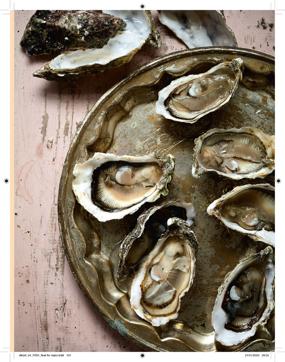
20 oysters
1 quantity tamarind chutney
½ banana shallot, very finely chopped
100g sev mamra (puffed rice and crisp noodles)
For the puris
125g plain flour, plus extra
for dusting
75g fine semolina
Groundnut oil, for deep-frying
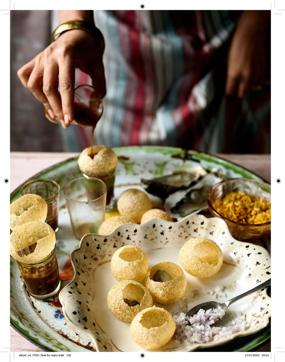
A pani puri is a crisp cracker made from flour and semolina that puffs up into a crisp orb when deep-fried. Normally served stuffed with chickpeas and potatoes before tamarind water is poured in, it is then downed in one in an undignified, dribbling euphoria. In this recipe I have replaced the traditional filling with briny nuggets of fresh oyster meat for a slurp with a difference.
• Start by checking your oysters over. The shells should be tightly shut – discard any that have even the smallest opening.
• Whisk the tamarind chutney with 500ml of water in a large bowl and refrigerate. This tamarind water can be made up to a week in advance and stored in a screwtop bottle or airtight jar.
• To make the puris, mix together the flour and semolina, then start adding water a little at a time, kneading as you go, until you have a springy and pliable dough. Divide into 6 balls and, on a lightly floured surface, use a rolling pin to roll out to a 2mm thickness. Use a 4cm round pastry cutter to cut out 30 circles (it’s always good to have a few extra because there may be some rogue ones that don’t puff up).
• Fill a large, heavy-based saucepan a third full with the deep-frying oil. Heat the oil to 180°C – if you don’t have a thermometer, you will know the oil is ready when a cube of bread turns golden brown in 20 seconds.
Fry the puris in batches for about 2 minutes, or until golden and crisp, allowing the oil to return to temperature between batches. Drain on kitchen paper and leave to cool. The puris can be made in advance and stored in an airtight container for up to a week.
• Shuck the oysters (or ask your fishmonger to do this for you, saving the juices). Crack an opening on one side of a puri and pop in a piece of oyster meat and some of its juices. Sprinkle with some chopped shallot and sev mamra and serve on top of a shot glass filled with tamarind water. To eat, pour some tamarind water into the crack in the puri, then put the whole puri in your mouth and chase with more tamarind water.


