
 E-Paper



Louis Glück and the Self at the Centre of the World
The winner of the 2020 Nobel Prize for Literature dwells on the despair and the agony of the self sifted through personal, passionate and emotional experiences


“I am large, I contain multitudes.” Walt Whitman, the most influential figure in the canon of American poetry, laid out the core of his poetic vision, marked by a certain exhibitionism and bravura surrounding the self, in the poem The Song of Myself that featured in his seminal collection, Leaves of Grass (1855). As a poet, Whitman tried to be one with his readers and went ahead to think of them as companions. The consciousness of the self, according to him, was the first stage in the poet’s journey to embracing the universe. A poet was one of many, yes, but he was still the one on his own journey. For his self to be in harmony with the universe, the poet’s sense of the self must merge into the souls of all men and, subsequently, dissolve into the divine, he seemed to suggest.
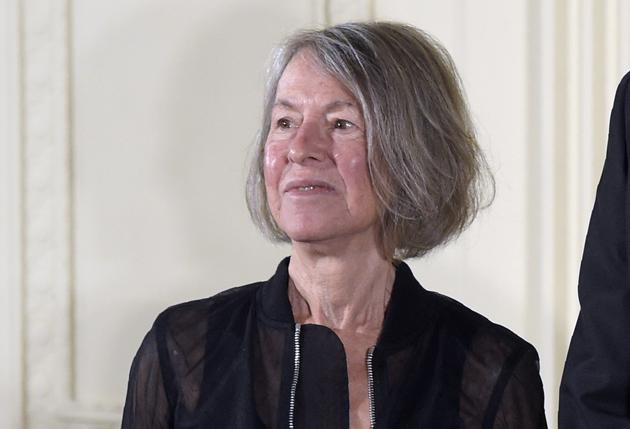
Whitman’s vision of the self has been central to the American cultural values of individualism and self assertion. “He is America,” Ezra Pound famously gushed. Many saw Leaves of Grass as the summation of American civilization and argued that one couldn’t understand America without understanding Whitman. It is this quest to transcend the self and transform the individual experience into the universal that finds an echo in the works of Louis Glück, the American poet and essayist, who has been awarded the 2020 Nobel Prize for Literature for “her unmistakable poetic voice that with austere beauty makes individual existence universal”, according to the Swedish Academy.
As a poet, Glück, writer-in-residence at Yale University who lives in Cambridge, Massachusetts, dwells on the realities of the personal, the passionate and the emotional experiences in her vast and varied oeuvre — 12 odd books of poetry, by constructing poetic personas or exploring classical myths of Gretel or Joan of Arc. Her poems are the celebrations of her distinct sensitivity. They are as much attuned to technical precision as they are to lyricism, which seems Rilke-like to me. They illustrate the many ways an individual deals with loneliness, and negotiates failed relationships or the absences left in the wake of divorce or death. Glück, who won the Pulitzer Prize for The Wild Iris (1993) and the National Book Awards for Faithful and Virtuous Night (2014), is not afraid to confront the horrors of our existence. She gazes at what’s difficult or painful, without so much as flinching. She seems determine to illuminate the universal human nature and condition — the indelible trails of our trauma, the inscrutable alleys of our desire. In her first collection of poetry, Firstborn (1968), which uses rhyme and metre delightfully, she uses a mish-mash of disparate, first-person personae — all desperate, all disaffected, all with ire in their soul. In one of the poems, Silverpoint, she writes:
My sister, by the chiming kinks
Of the Atlantic Ocean, takes in light.
Beyond her, wreathed in algae, links on links
Of breakers meet and disconnect, foam through bracelets
Of seabirds. The wind sinks. She does not feel the change
At once. It will take time. My sister,
Stirring briefly to arrange
Her towel, browns like a chicken, under fire.
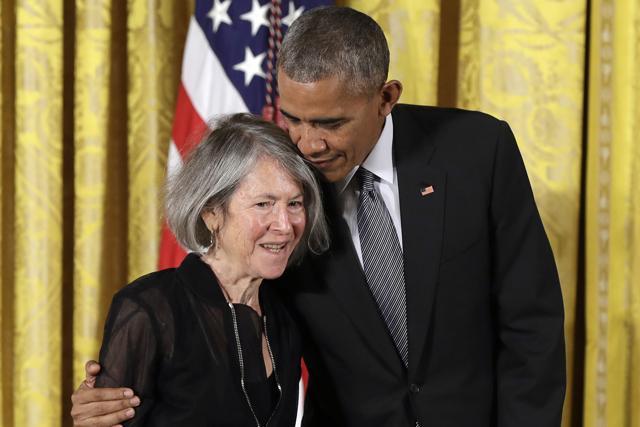
While existential despair forms the arc of much of her early work, Glück’s later work, too, doesn’t deviate too far from it and continue to evoke the agony of the self. In the eponymous poem in the Faithful and Virtuous Night, she writes:
My story begins very simply: I could speak and I was happy.
Or: I could speak, thus I was happy.
Or: I was happy, thus speaking.
I was like a bright light passing through a dark room.
If it is so difficult to begin, imagine what it will be to end —
On my bed, sheets printed with colored sailboats
conveying, simultaneously, visions of adventure (in the form of exploration)
and sensations of gentle rocking, as of a cradle.
Glück, 77, is a poet who revels in the suffering of the selfhood, eager to strike up a conversation with its veracities and vicissitudes. She lets the many selves she creates through various personae in her poetry express their anger and resentment with the facts of living. “Original work, in our literature, must seem somehow to break trails, to found dynasties. That is, it has to be capable of replication. What we call original must serve as a model or template, binding the future into coherence and, simultaneously, though less crucially, affirming the coherence of the outstripped past,” writes Glück in American Originality: Essays on Poetry (2017). Glück’s canvas as a poet is a palimpsest; as an inheritor of the American tradition of poetry, she does not so much reject tradition (of Whitman’s idea of the self, for instance,) as project it into the future. Glück does not endorse or identify with what she calls Whitman’s “narcissism” and her craft is more close to the “periodic hermetic coyness” of Emily Dickinson, which is like a “spinster’s sad stab at grooming: an attempt to attract love”, and her “veiled disclosures”. But her poetry is, to a great degree, a literature of the self examining its responses, like much of contemporary literature. In the works of someone like Whitman, “whole nations, whole torn civilisations turn out to be waiting to be given voice,” writes Glück in American Originality. “What occurs, in such work, isn’t the poet seeing the world but rather the poet projecting himself outward so that he returns to us on the page, in costume and in multiple,” she writes. Glück would rather emerge on the page in moments of solitude, sparse and austere, shorn of artifice. However, in her work, as much as it is in Whitman’s, the self remains the progenitor.
Nawaid Anjum is a Delhi-based freelance feature writer, translator and poet.


