
 E-Paper



Report: Bhashavaad 3.0
Everything from AI in translation to linguistic hegemony and the hierarchy of languages was discussed at the national translation conference

 Prefer HTon Google


The third edition of Bhashavaad, the national translation conference organized by the Ashoka Centre for Translation (ACT), was held on 29–30 August at the India International Centre in New Delhi in partnership with the New India Foundation (NIF). It featured panels, presentations, a keynote address and a musical performance. Established in 2024 to “foster conversations among Indian languages across reading, writing, publishing, and policy-making”, the conference is a fertile ground for discussions and debates around translation and translation practices. “Being a beginner translator, I wanted to be a part of spaces where I could meet and interact with fellow translators. It was a rewarding experience to listen to the creatives and understand their process of approaching a text. There were several instances where I was left with food for thought. It was close to walking out of a lecture having much to look up and engage with further,” said Addhaya Anil, an editor.
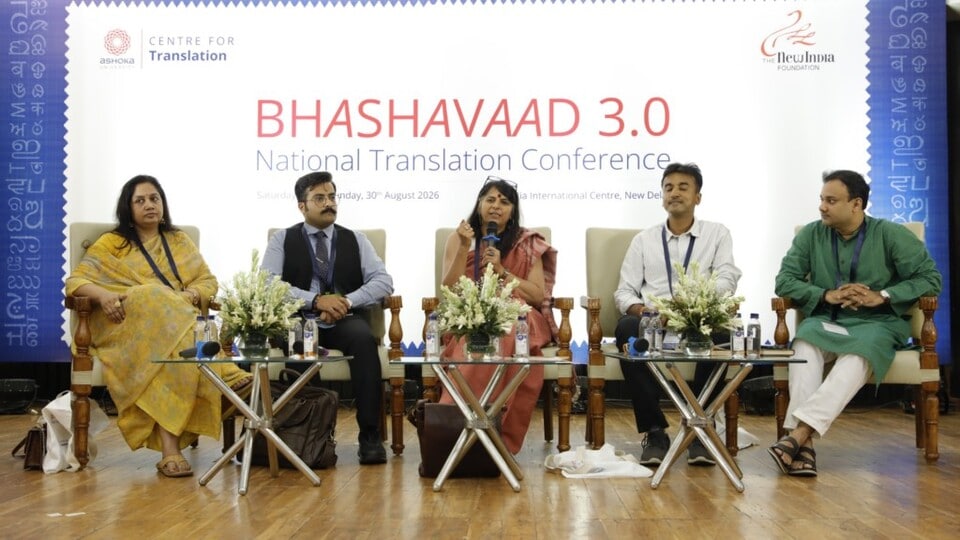
Given the increasing proliferation of AI in our daily lives, it came as no surprise that discussions across panels revolved around generative AI, creativity and literary pursuits. The very first panel, “Are Translators Redundant?”, sought to examine the role and place of a translator in a shifting publishing economy. While panellists agreed that AI can sometimes do a decent job and will only get better, they also asserted that it can in no way match a human translator. “The job of a translator is to keep refining the work and AI undermines the creative process,” said translator Poonam Saxena. Translator Murali Ranganathan quipped that AI-written books should only be read by AI readers. Editor Moutushi Mukherjee brought up the difficulties of detecting AI use and highlighted legal ramifications.
The issue of AI translation vs human translation was further explored in a presentation by three pairs of fellows from ACT and the Indic Digital Archive Foundation. They used PF Mathews’ Malayalam short story Muzhakkam and compared translations into English done by human translators and different AI models, such as ChatGPT and Gemini. While the AI was overall competent and treated it as a problem to solve, there were a lot of disjunctures in the process, especially in rendering cultural-specific terms, kinship relationships and general abstractions. Accurate translations required repeated human intervention and prompts. After all, AI cannot “think” and does not possess any critical judgement or literary discernment of its own. All fellows made the case for the superiority of human intuition.
This point was emphasized in another panel, “Writing and Publishing in the Age of AI”, with two publishers, a translator and a computer science professor. Chiki Sarkar, the publisher at Juggernaut, plainly stated that there is no conflict between AI and creativity. She freely admitted that Juggernaut uses AI for writing and editing books as well as for cover design and illustrations but emphasized that humans will always be instrumental and involved in the process. Karthika VK, the publisher at Westland, said that her company is at the negotiation stage with AI, which has proven helpful in terms of market research and plugging gaps. She, however, was clear that she didn’t want authorship from AI. From the audience, the writer Peggy Mohan said that AI is better-placed to make technical and science-heavy texts accessible rather than literary works, while another member brought up issues of plagiarism in terms of the use of AI in the academic world.
Linguistic hegemony and the hierarchy of languages were other important themes that came up during the two days. Bhavyansh, a doctoral candidate at the Centre for Historical Studies, Jawaharlal Nehru University, told me, “Appreciation of multilingual spaces can only happen when we are able to understand, or rather when we are able to reject, this whole idea of categorizing languages . . .” He was also a part of a panel called “Bhasha Ki Garima: A Dialogue”, which brought together scholars from Bhojpuri, Rajasthani, Maithili and Haryanvi to “unsettle the hierarchies between bhasha and boli”, language and dialect. Apart from how languages are perceived, their upkeep and survival also depend on institutional support for work being done in/on those languages and government recognition through inclusion in the Constitution. Languages can shrink without support and promotion.
Another panel, “‘An Unanswered People’”, attacked the artificial divide between language and dialect, emphasising how such distinctions lead to deep-seated hierarchies. This panel centred on a poetry anthology by the same name, which gathers 365 poems from 350 poets writing in 126 Adivasi languages. Put together by Kanji Patel, who is passionate about giving a platform to marginalized peoples and letting their languages shine, it is a work that was years in the making. Contributors Ramesh Karthik Nayak, Parwati Tirkey and Malsawmi Jacob spoke at length about their engagement with Banjara, Kuduk and Mizo respectively. Patel’s decisive words — “We keep hearing that there is a need to civilize the tribals. In my view, we need to tribalize the country” — drew applause.
When asked about her experience of Bhashavaad, Eesha Roy Chowdhury, an alumna of Ashoka University, said, “[It] was an enriching and illuminating couple of days that forced me to think deeply about how language actively shapes our subjectivities, and how the act of translation is deeply political.” Sure enough, the politics of identity was another running topic at the conference. In a panel titled “The Writer and Her Translator”, the Tamil writer Salma and the Telugu writer Volga sat down with the translators of their latest books, GJV Prasad (The Dark Hours of the Night) and Purnima Tammireddy (On the Banks of the Pampa). Both writers use pseudonyms to publish. Agreeing with the adage that the personal is political, they spoke about how that decision gave them agency and allowed them to depict the full complexity of women’s lives without fear of censure. The panel also brought up issues of identity politics and who can (or should) write about what subject.
Issues of temporal and national identity were also brought up during a discussion on “Being Indian, Being Modern”. The panellists, who work within languages or on subjects that are sidelined to various degrees, emphasised that modernity and Indianness are neither single nor singular narratives. Who is considered an Indian and who is not? Who is allowed to be modern and who isn’t? What are the commonalities and points of departure between the two? The panel focused on gender politics, caste issues and linguistic perceptions. Ultimately, all the panellists encouraged multiplicity of identities and fluidity.
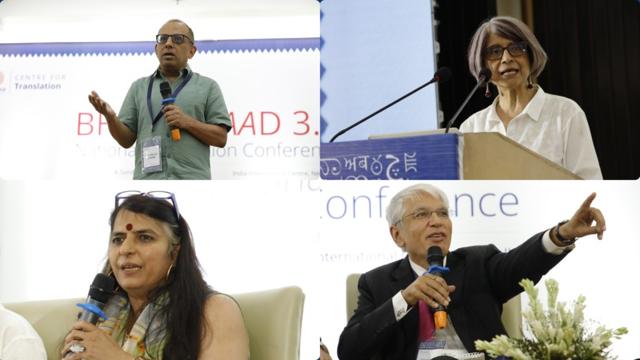
Bhashavaad 3.0 had more in store. “What Is India Reading?” was a discussion on the state of the press and media in both print and digital forms, especially in the context of regional-language journalism. “Languages Pasts and Futures” looked at how technology was aiding archival and literary initiatives, helping create continuity. “Between Word and God” explored what it means to translate and adapt Bhakti and Sufi texts into other languages and mediums. The keynote address by Simona Sawhney, professor at IIT Delhi, titled “Translation, Mimesis, Aphasia”, talked about how speechlessness is figuratively and literally a fundamental part of language, and it was a definite highlight of the conference. As someone who was attending the conference for a second time, it was all the more refreshing to see how conversations have evolved since the previous edition in 2025 and that none of the programming rehashed the same subjects (or even speakers).
A presentation by Sanchit Toor, head of projects of the Ashoka Centre for Translation provided an overview of the ACT’s work including the running of a comprehensive search engine (www.bhashavaad.in) that operates as a directory of translated books. The database already has 35,000 entries, and the centre has plans to continuously increase the number as well as expand the recorded information about each title. ACT is also working with publishers and funding organisations to publish translations on a scale never seen before. Books are already out in collaboration with Penguin Random House India, Zubaan Books, Westland and Vani Prakashan. Many more are planned with HarperCollins India, Bloomsbury India, Comma Press and Aleph Book Co.
While opening the conference, Rita Kothari and Arunava Sinha — both professors at Ashoka and co-directors of ACT — had, respectively, deemed translation to be the foundation of civilization and termed it a means for centres of literature to exert influence. Nandini Nair, the associate director of NIF said, “Translation makes you a citizen of the world. It takes you to places without moving.” Just a few weeks before the conference, in the very same room, Bahuvachana Trust had launched Hyphen. Founded by Vivek Shanbag, Hyphen will work as a literary journal, a publishing house and a digital platform to “carry the voices of India’s many languages across borders”. These developments reinforce a growing interest in translations in India as a celebration of the multiplicity of languages and cultures. The turnout and interactions at both events made one thing clear: there is a great appetite for them. It will be exciting to see how translations continue to shape India’s literary scene.
Areeb Ahmad is a Delhi-based freelance writer and literary critic. He is @Bankrupt_Bookworm on Instagram.


