
 E-Paper



Report: The Journeying Across the Himalayas festival
On at the Travancore Palace, New Delhi, the event features several inspiring installations that effectively bring to the capital the myriad cultures of those who live in the Himalayan region

 Prefer HTon Google


A cutesy catlike installation perched on the roof of the Travancore Palace in New Delhi is the first unmissable highlight of Journeying Across the Himalayas, the Royal Enfield Social Mission festival that’s on at this venue until December 10.
On entering the exhibition space, the visitor sees several monks drawing a sand mandala with great precision. Bidisha Dey of the Eicher Group Foundation reveals that the monks are from the Namgyal Monastery in Dharamshala and adds that they will be creating the mandala for all seven days of the festival.
The fruit of a partnership between the Royal Enfield Social Mission and UNESCO, the show aims to celebrate, protect, and nurture the diverse communities of the Himalayas.
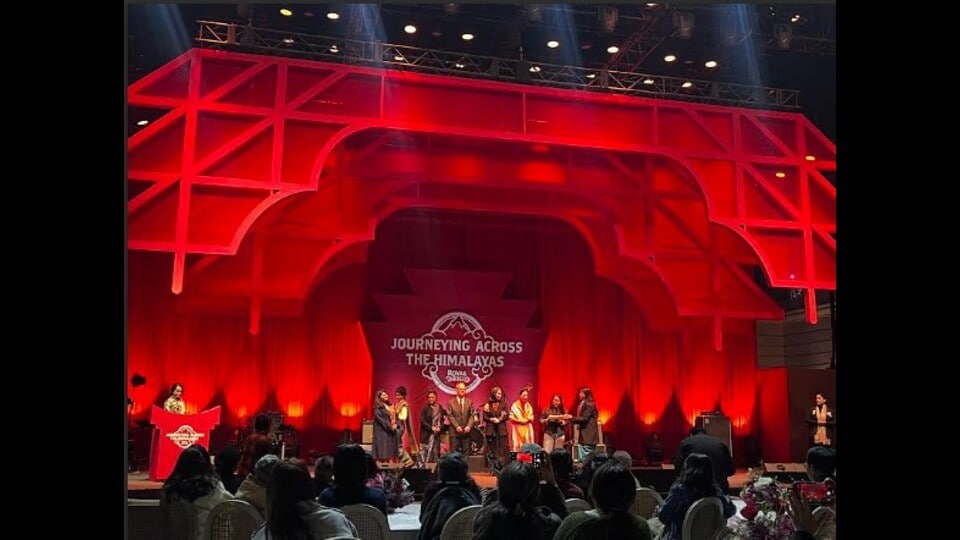
This intention is visible across the venue with the main stage being a contemporary realisation of Himachal Pradesh’s Kath Kuni tradition, and original artwork by Ladakh’s celebrated Jigmet Angmo and Vishal K Dar’s reinterpretation of “Adi community’s traditional communal structure from Arunachal Pradesh” also being displayed.
Echoes of the East by Julie Kagti features multiple interactive sections including It’s a Wrap: Drapes, Layers and Living Textiles, which demonstrates how the everyday experience defines what people choose to wear.
Wind Song: Intangible Oral Practices includes five different sound traditions presented by Dorjee Khandu Jebisow, Rostina Khonsit, Tahor Muang, Namgyal Lepcha, and Kalicharan Toto. Himalayan soundscapes are both soothing and awe inspiring, a result, no doubt of “every child born [in the region] being given a tune” according to Dey.
Then there are the five rooms featuring The Breath of Pashmina: A 360° Immersive Journey Through Ladakh by Avani Rai. A 360-degree immersive experience whose contributors include Lena Ladakh, Looma of Ladakh, Nikhil D, Suket Dhir, and Marianne Chaud, this is a truly significant work. It is here that you are drawn into the landscape in which Ladakhi Pashmina is cultivated; a space that makes you feel like you are literally listening to the nomadic lives of the Changpa people of the Changthang plateau play out.
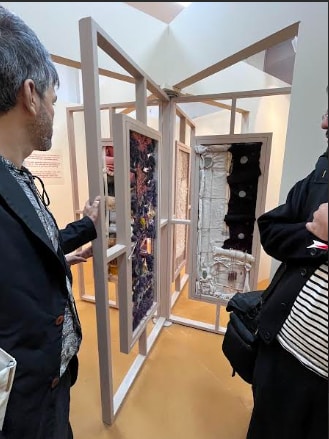
In The Door to Return, creators Nikhil D and Lena Ladakh help you explore the various textures of Pashmina fibre through a revolving door, where several ancestral weaving practices can be seen. Towards the end of this section, you can watch The Nomadic Night, a film by Marianne Chaud, which explores the declining numbers of nomadic families, from 120 to 20, in the Karnak region. The work is suffused with emotion, signalling helplessness, a lack of care, and collective failure.
In many ways, each installation here is a “memory keeper” that displays how traditions can be kept alive but also demonstrates how these very traditions can be further transferred, thus inspiring others to tell their stories.
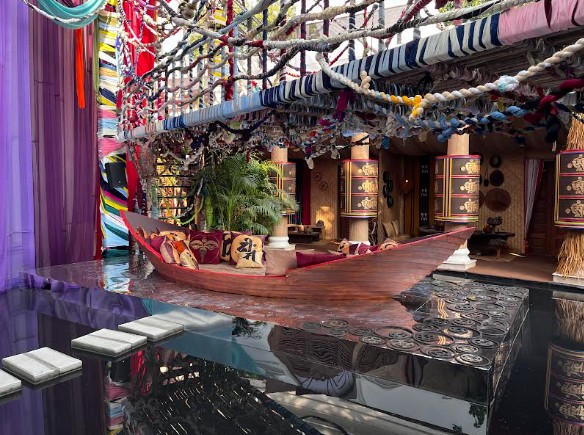
One of the most breath taking works is Sumant Jayakrishnan’s Bridging Spaces; Living Roots! about the living root bridges of Meghalaya, “one of the world’s most biologically important regions with several endemic species”. The bridge made out of a tapestry of clothes and fabrics makes the visitor feel as though they are watching Meghalaya being magically recreated in the capital city.
Burhan Ud Din Khateeb, founder of Studio Kilab, aims to “revitalise the dwindling craft industry in Kashmir”. He shows how pulp makers at the Kashmir Paper Machine Industrial Cooperative are preserving sakhta, “the traditional craft of creating papier-mâché moulds”.
Ri Gyancha (Jewels of the Mountain), the snow leopard installation, signals not only magnificence but also rarity. Then there is The Right to Be Seen: Reframing the Passport Photo in Craft, conceptualised by The Voice of Fashion and curated by Juhi Pandey, that features weaving traditions across regions and shows how remembering aspects of one’s culture can be an antidote against marginalisation and erasure.
The festival also featured the launch of The Great Himalayan Exploration — The Intangible Cultural Heritage of the Eastern Himalayas, a volume that commemorates “the living cultural traditions of the region.”
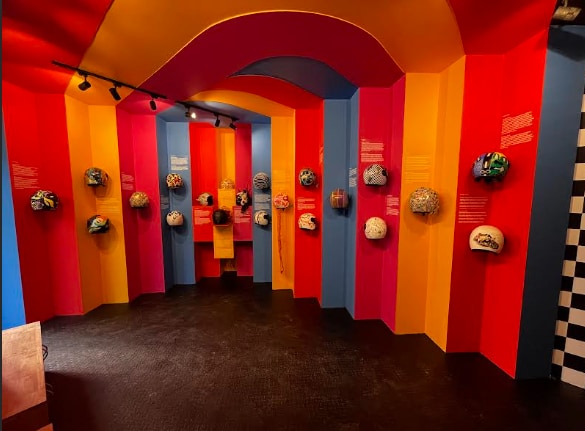
Outside the exhibition space, artist Dhruvi Acharya’s Crown promotes rider safety. To the left of this is the Helmet Odyssey Travelling Exhibition. Finally, exceptional culinary delights are to be had at Chouka – Mizo for “kitchen” – and you can engage in a spot of retail therapy too at the Himalayan Bazaar curated by Puneeta Chadha Khanna.
A show that’s not to be missed, Journeying Across the Himalayas, is a great experience.
Saurabh Sharma is a Delhi-based writer and freelance journalist. They can be found on Instagram/X: @writerly_life.


