
 E-Paper



Report: The Shillong Literary Festival
After the welcome address by festival curator Malavika Banerjee, things moved quickly into litfest mode.

 Prefer HTon Google


The Shillong Literary Festival was held at a venue surrounded by cherry blossoms alongside Ward’s Lake in the capital of Meghalaya from 20 to 22 November, 2025. After the welcome address by festival curator Malavika Banerjee, things moved quickly into litfest mode. Spanish writer Francesc Miralles had a conversation with Desmond Kharmawphland about his book Ikigai, which is based upon the Japanese way of life. The launch of Khamnu Khah A Var Im? Is She Wise? followed. Author Anthony Durpui said that communities are coming together “to abolish practices which harm our environment.” About the importance of documentation of the realities of people in the hills, editor Monica Thomas said, “While documentation is an important way, we can also use fiction to preserve diverse narratives.”
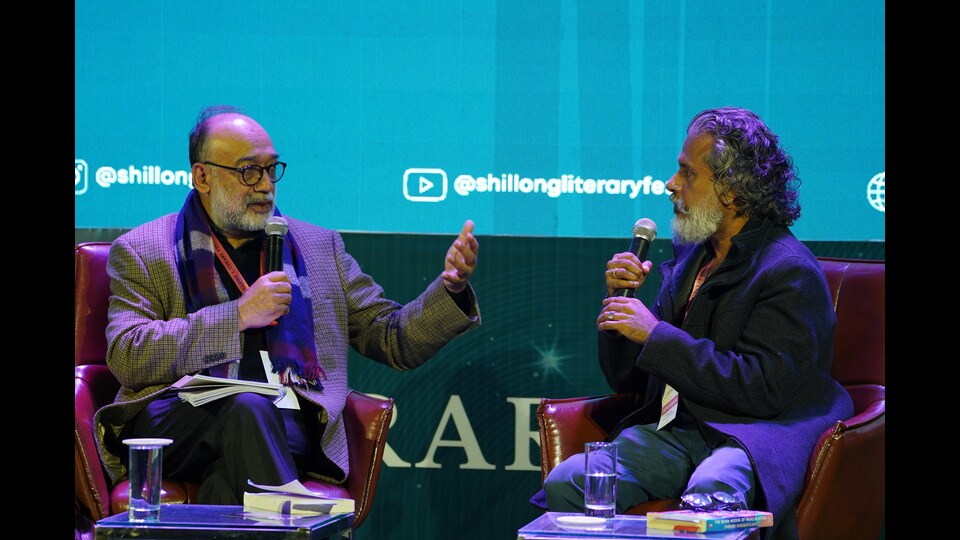
The next session titled Heal the World had authors Jerry Pinto and Neena Verma talking about grief, care, and mental health. “Resilience is something we all need and have. It is something to be kindled… My book is my way to help with that,” said Verma, author, Rise. Pinto stressed the need for palliative care. “Pain is a response by your body to explain the problem, but we need to be with each other to deal with the suffering that comes with it,” he said.

Later, Sam Dalrymple while talking about his debut book Shattered Lands with Cyril Diengdoh, revealed that Burma was once one of the richest provinces of British India, which is why early Hindi cinema featured songs like Mere piya gaye Rangoon. The first day ended with winner of the International Booker Award Banu Mushtaq in conversation with journalist Patricia Mukhim. The Kannada writer spoke about how her stories are about the universality of patriarchy and about the unique experiences of Muslim women from her area.
Day two began with a special session on movies with actor Vinay Pathak and directors Dominic Sangma and Rajat Kapoor. Kapoor spoke about a film maker’s uncertainty regarding their own art while Sangma spoke of his last project, Rapture, how the memory of his village connects him to his work, and about the need to start telling stories of the spaces we occupy. This was followed by a brilliant session of poetry recitation by Rhinkle Mrong, Prince Marak, Sengsime Sangma, Jakmatchi Sangma, and Fivebilson Marak. Later, Sandip Roy sat down with Anita Agnihotri, author, Mahanadi; The Tale of a River and Sanjoy Hazarika, author, River Traveller; Journeys on the Tsangpo-Brahmaputra... to talk about using rivers as a muse. “People from the West like to say that they’ve ‘discovered’ something but the locals of that area knew about it for a much longer time,” Hazarika said. “When people travel alongside a river, they pray to a local deity irrespective of their own religious identity. People who live by the river have a certain connection with it,” he added. “Women experience rivers differently as they create kinships and when they have to move, they take their entire culture with them,” said Agnihotri.
The focus in the following session was on history. Narayani Basu, author, A Man for All Seasons; A Life of KM Panikkar, spoke about her subject’s unconventional life and the mistakes he made while dealing with China. Jyotsna Mohan, author of Pratap; A Defiant Newspaper, spoke about the important role that journalism played during the freedom struggle. In the afternoon, authors Prayaag Akbar, Rahul Bhattacharya and Keshava Guha discussed writing their second novels. Bhattacharya said that his latest book, Railsong, had taken him a decade to write. “If your first book is a success then publishers expect you to write something similar” Guha said, critiquing publishing in India.
Next, Sri Lankan author Shehan Karunatilaka spoke to Sanjoy Hazarika about his Booker prize winning The Seven Moons of Mali Almeida. “Growing up many Sri Lankan writers wrote like they wanted to prove that they can also write like the western writers but now they write for their own self,” Karunatilaka said.
The session with Upamanyu Chatterjee in conversation with Sandip Roy was a laugh riot. “Nobody reads me hence I face no danger. I’m still embarrassed to say that I’m a full-time writer, maybe it’s a Bengal famine thing,” Chatterjee quipped.

On the concluding day, poets Paul Lyngdoh, Lalnunsanga Ralte and Dorothy Marak kept the audience hooked during the session titled The Power of a Poem. Another unique session on how to crack the UPSC with civil servants Sajjan Yadav, NR Marak, Cyril Diengdoh and Ankur Das in conversation with Teidorlang Lyngdoh had the young crowd clearing their doubts about the competitive exams.
The festival’s last session was on the dynamics of books as they’re transformed for OTTs. “You shouldn’t write a book solely because you want it to be adapted for the screen,” said Prayaag Akbar. “The problem is that those responsible for choosing stories don’t read at all and if we rub their faces on a good story, even then they wouldn’t understand its importance,” said Pinto. Ankush Saikia spoke about his helplessness when parts of his book were plagiarised.
The event had spaces where children could try their hand at pottery and painting. There were also interesting stalls selling food, beverages, books and more. Each day ended with energetic performances by young artists from the Meghalaya Grassroots Music Project (MGMP).
All in all, the Shillong Literary Festival was both edifying and entertaining.
Chittajit Mitra (he/him) is a queer writer, translator and editor from Allahabad. He is co-founder of RAQS, an organization working on gender, sexuality and mental health.


