
 E-Paper



Report: Drukyul’s Literature and Arts Festival, Bhutan
With 70 speakers from 14 countries, the 13th edition of the festival in Thimphu showcased the Himalayan nation’s vibrant culture

 Prefer HTon Google


A year ago, standing at the Royal Bhutanese Monastery in Bodhgaya, I was struck by the magnificent statues of Shakyamuni Buddha, Guru Padmasambhava, and Bodhisattva Avalokiteshvara. A spontaneous wish to travel to Bhutan arose in me. My prayer was answered this August when I was invited to visit Thimphu, the capital of Bhutan, for the Drukyul’s Literature and Arts Festival. Held from August 3 to 5, it was organised by the non-profit Bhutan Echoes under the patronage of the Queen Mother of Bhutan, Gyalyum Ashi Dorji Wangmo Wangchuck, in partnership with the Indian Embassy in Thimphu and the India-Bhutan Foundation.
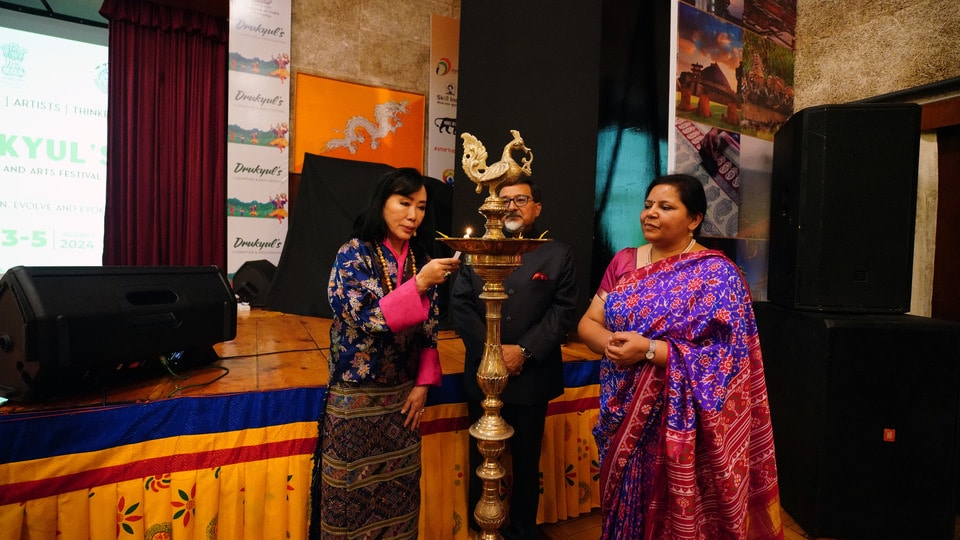
With 70 speakers from 14 countries, apart from literary sessions, the 13th edition of the festival had discussions on the mysteries of rebirth, yoga, navigating identity in the digital age, the mind-body connection in Tibetan medicine, balancing creativity and commercial success, a mindful approach to consumerism, sustainable practices to nurture biodiversity, preserving human intelligence in the age of artificial intelligence, the future of water, and the power of diplomacy.
With “Enlighten, Evolve, and Evoke” as the theme, the festival began on a sublime note at the Royal University of Bhutan’s auditorium with the lighting of a traditional butter lamp and father-daughter duo Pema Samdrup and Karma Sonam Demath’s musical performance dedicated to Yangchenma — the goddess of art, creativity and wisdom in Vajrayana Buddhism, the religion followed by the majority of the Bhutanese. The gentle rain falling outside felt like a blessing, and the fluffy clouds in the unpolluted sky made the whole landscape seem like a dream.
It was an ideal setting for the first session that had the Queen Mother in conversation with Meru Gokhale, former publisher at Penguin Random House India. Gokhale got the Queen Mother to talk about the experience of discovering that her grandson is a reincarnation of an 8th century Buddhist teacher, and taking him to Bodhgaya and Nalanda in Bihar as well as the Potala Palace in Tibet upon his insistence. Literature and art festivals usually stay away from such topics but talking about rebirth is not considered unusual in Bhutan. Aware of the international audience, the Queen Mother joked, “The audience must be thinking two cuckoos are in conversation.” She added that Bhutanese people devote a lot of time to after-death rituals, which are “far more elaborate than birthday parties and wedding celebrations”.
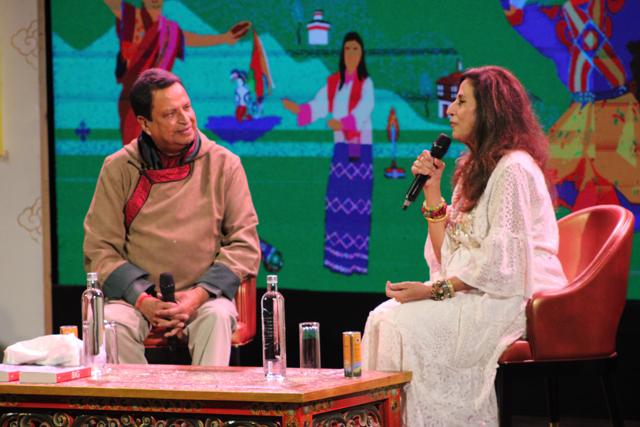
Next, author Shobhaa De grilled Nepalese businessman and politician Binod Chaudhary. “I hope I can call you Binod. I don’t know how to address billionaires, except in a familiar, irreverent way,” she said. Though Choudhary wanted to focus on talking about his book Making It Big, De wanted to deliver an entertaining session and asked him about the time he flunked his chartered accountancy examination, his experience of running a discotheque, his Marwari genes, and his relationship with his father. Quite funnily, the young audience, unknowingly speaking for their cohort in India too, thanked him for the Wai Wai noodles that his multinational conglomerate manufactures.
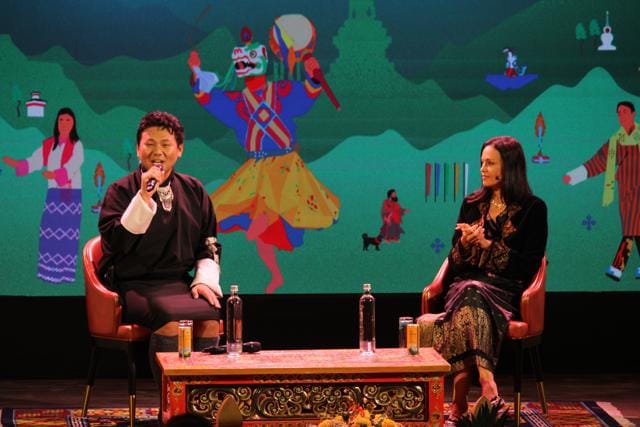
Dancer-poet Tishani Doshi and performance artist Sangay Loday, who is also an advocate for the rights of LGBTQIA+ people, had a thought-provoking discussion on gender, identity and expression. Apart from presenting her poems on stage, Doshi spoke about growing up in a Gujarati family in Chennai, studying business administration, and being mentored by dancer-choreographer Chandralekha. “As a writer, you need discipline,” she said. “It is easy to cheat, sit at your desk and just check email and fool around. As a dancer, I have learnt to practise every day for hours at the studio.”
Later, Tenzin Wangmo whose work is located at the intersection of climate action and food systems spoke with Mridula Ramesh, founder of the Sundaram Climate Institute, and author of Watershed: How We Destroyed India’s Water and How We Can Save It. Ramesh spoke about what India can learn from Bhutan. “Forests, especially on steep slopes, hold on to the soil when water falls ferociously. Bhutan shares the features of the summer monsoon with India, which means that they get a lot of water in a very short time. If we had kept our forests as well as they have, that would have been a good thing,” she said.
“What it means to be Bhutanese”, a conversation between academic Dorji Wangchuk and Phub Dorji (CEO of Nyingnor, a digital startup), shed light on the concerns of young people in Bhutan who struggle to balance tradition and modernity. The latter shared that living abroad made him worry about aspects of Bhutanese culture that might get lost if people like him do not carry them forward. “We have to turn culture into content if we want to save it,” he said. The former said that one of the assignments his students have to do is documenting stories of their grandparents. He noted, “There is no certainty in the universe at the smallest sub-atomic level. Find your heritage and your lineage. They will ground you.”
Thierry Mathou, Ambassador of France to India, who has a huge personal collection of books on Bhutan in French, English, Chinese, Japanese and Spanish, some of which he cannot read, said that while Bhutan is “a small country sandwiched between two giants”, its strength lies in its unique culture.
Micael Dahlen, Professor of Wellbeing, Welfare and Happiness, and Chair at the Stockholm School of Economics, spoke about how the anticipation of an occurrence often provides more happiness than the event itself, and stressed the importance of gratitude in being happy.
There were workshops on creative writing, paper play, flamenco, publishing, and telling stories through comics. American memoirist Will Schwalbe, who facilitated the creative writing workshop, advised participants to “read widely” to get better at writing because “we don’t grow if we read only the things that we are interested in”. He drew attention to the importance of fact-checking, the difference between emotional truth and physical details, and maintaining a writing journal. “It can seem very daunting to write every single day but that is how you get your raw material. Simply write down what happened and how you felt. Creativity can come in later,” he said.
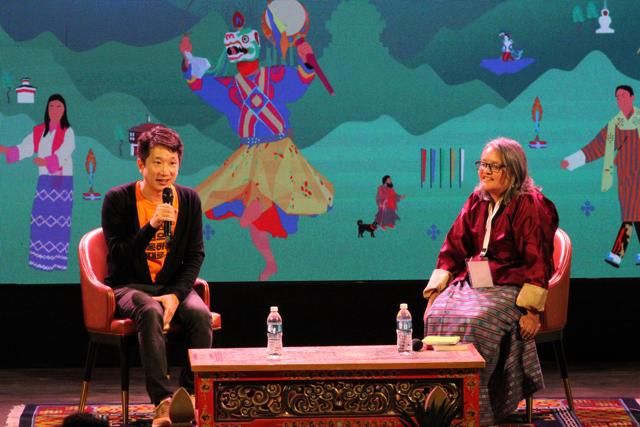
Before Korean translator Anton Hur could hold forth on how translated works of literature can broaden readers’ perspectives about cultures that are misrepresented and misunderstood, he had the audience in splits: “I just have to remember not to cross my legs in front of royalty. I mean, my legs are so short so I don’t know what there is to cross,” he said.
Bhutanese architect Thinley Jamtsho Tsering got artist Zimbiri to talk about her practice as a contemporary Bhutanese artist who engages closely with traditional Bhutanese art. Zimbiri said that, when she was studying in the United States, she dissociated from her Bhutanese identity because she did not want her art to be tied to her nationality. “Bhutan was viewed as this mythical, mystical land, the last Shangri-La. I did not want to lean into that. I wanted to discover my own mettle as an artist,” she said. However, her views changed on returning. “I decided to let go of these insecurities and allowed myself to pursue whatever inspired me.” Today, traditional Bhutanese iconography abounds in her work.
Poet and educator Pooja Nansi, who lives in Singapore where poems are written in Malay, Mandarin, English, Tamil and other languages, spoke about the influence of Gujarati folk songs and Hindi films on her own poetry. Her poem dedicated to Pakistani singer Nusrat Fateh Ali Khan began with “Yours is the music of quiet 4am” and ended with “Yours a wild animal wail from before words, the sound of the soul freed from the ribcage, from some ancient deep forgotten history, yours every exuberant end, yours every troubled beginning.” Nansi also spoke about the Singapore government’s support for artists and cultural initiatives contributing to the country’s vibrant literary scene.
Shefalee Vasudev, author of Powder Room: The Untold Story of Indian Fashion, spoke about issues related to cultural appropriation, caste dynamics, lack of pay parity, and worker welfare in her talk titled “Textile, Attire and Identity: Cultural Intersections in Fashion”. Her insights on the semiotics of attire that touched on the significance of Indian actor Kani Kusruti holding a watermelon clutch at the Cannes Film Festival in solidarity with the people of Palestine, were also interesting.
All in all, Drukyul’s Literature and Arts Festival was intellectually stimulating even as it showcased the Himalayan nation’s vibrant culture and impressive soft power.
Chintan Girish Modi is a freelance writer, journalist and book reviewer.


