
 E-Paper



Review: Dream Count by Chimamanda Ngozi Adichie
In her long awaited return to literary fiction, the author critiques the Anglophone publishing world and Western academia’s fetishization of Africa and Africans

 Prefer HTon Google


It is clear that we live in uncertain times what with the climate crisis, an ongoing genocide, and expansionist warfare. And that’s just the daily news cycle. This note of utter uncertainty characterises the opening of Chimamanda Ngozi Adichie’s Dream Count too. The US-based Nigerian writer’s long-awaited return to literary fiction comes more than a decade after the widely acclaimed Americanah (2013). It begins with the pandemic and a “new suspended life” in the midst of what her protagonist Chiamaka terms as the “communal unknown”. Here, Zoom calls with family and friends become “a melange of hallucinatory images” and one is constantly reminded of how even the innocent act of talking “was to remember all that was lost”. Faced with a seeping hopelessness, Chiamaka begins to look up the men from her past, and the ‘what could have been’ scenarios, the dreams that never became a reality, the futures that never truly were. Thus, begins her ‘dream count’.

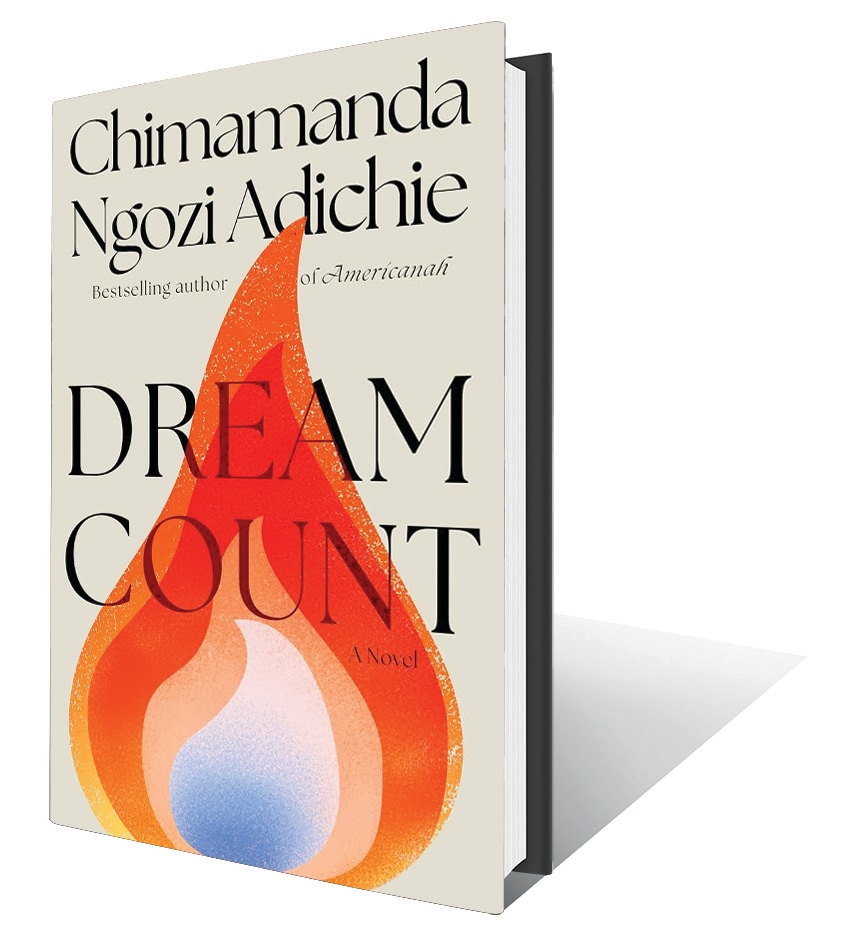
In the face of a “freewheeling apocalypse”, Adichie’s protagonist is holding onto that which makes us all human -- the need to be heard and seen through the eyes of another sans judgement.
The novel is divided into four main sections with each representing the perspective of one of the story’s four central women characters: Chiamaka, her closest friend Zikora, her cousin Omelogor, and her housekeeper Kadiatou. The lives of these four women and all that they have loved and lost is the focus of a narrative that embeds political critique in this representation of desire. What begins as an examination of love in its various shapes and forms, takes on the tone of a social commentary on the 21st century woman’s (over)reliance on romantic love.
The first partner that Chiamaka’s ruminates over is Darnell, whom she calls “the Denzel Washington of academia”. As Adichie’s protagonist comes from a wealthy family, Darnell consistently makes her aware of her privilege vis a vis the poor African migrant struggling for survival in the urban landscapes of the ‘Global North’. What follows is a biting satirical portrait of Western academia with Chiamaka calling out its tribal ways and liberal posturing. While meeting Darnell’s friends, she notes how they are unable “to feel admiration” and liberally overuse terms and phrases such as ‘problematic’ and ‘the ways in which’. One of them, Charlotte, “spoke of Africa as a place where her friends” presumably all white had “worked”. An Africa “full of white people all toiling unthanked in the blazing sun”. In a famous TED talk, Adichie had once shared how her “roommate had a single story of Africa: a single story of catastrophe. In this single story, there was no possibility of Africans being similar to her in any way, no possibility of feelings more complex than pity, no possibility of a connection as human equals.” It would seem that Adichie is responding to this single story throughout Dream Count. A publisher tells Chiamaka, an aspiring author, to work on something on the Congo before starting her travel memoir, adding that “Somalia and Sudan could work too”. Chiamaka grasps that the publishing world is viewing her, a woman of African descent, as an “interpreter of struggles”. Adichie has long contended with the Western gaze on the African diaspora and its ‘single story of Africa’. Here too, she critiques the Anglophone publishing world and Western academia’s fetishization of Africa and Africans.
However, as the narrative progresses, her critique of American ‘woke’ culture actually does come off as problematic – to use the term that Chiamaka accuses Darnell and his academic circle of overusing. It is through the brash and independent Omelogor that Adichie voices her disdain for liberal America’s sense of entitlement and the “provincial certainty” with which its members operate. Her experience as a graduate student in the US is fraught with encounters that make her wary of expressing any opinion that runs contrary to that which is perceived as ideologically acceptable. It might be useful to note here that Adichie has, in the past, been called out for TERF adjacent remarks and that she has also previously strongly condemned cancel culture in her writing.
While the strength of Adichie’s narrative lies in how she blends social and political critique through a multi-layered story, it is precisely this which also causes the book to lag in parts. For instance, the arc of Kadiatou’s narrative is not entirely convincing. In her Author’s Note Adichie shares how this part of the novel was inspired by real life events, in particular, the case of Nafissatou Diallo – a Guinean immigrant, like Kadiatou – who had accused a guest of sexual assault at the hotel where she worked. The accused was IMF head Dominique Strauss-Kahn. Adichie notes that she wished to “right a wrong” through this story. She also shifts to a third person narrative voice here from the first person that she used for both Chiamaka and Omelogor. This creates a distance that doesn’t quite work. Indeed, Kadiatou’s section and Zikora’s too come across as superficial interludes.

Dream Count begins with an examination of romantic love as perhaps an extension of the capitalist world view offset by community ties, such as that of sisterhood that may seem to fray at times but remain steady when the need arises. American liberal academia and the publishing world’s “incivility of quiet evil” is explicitly critiqued. “We are all defining our worlds with words from America,” says Omelogor. There is no arguing with that.
Adichie’s return to literary fiction does have its moments. In the end, though, it has to be said that, unlike her earlier works, Dream Count suffers from a sad lack of nuance.
Simar Bhasin is a literary critic and research scholar who lives in Delhi. Her essay ‘A Qissa of Resistance: Desire and Dissent in Selma Dabbagh’s Short Fiction’ was awarded ‘Highly Commended’ by the Wasafiri Essay Prize 2024.


