
 E-Paper



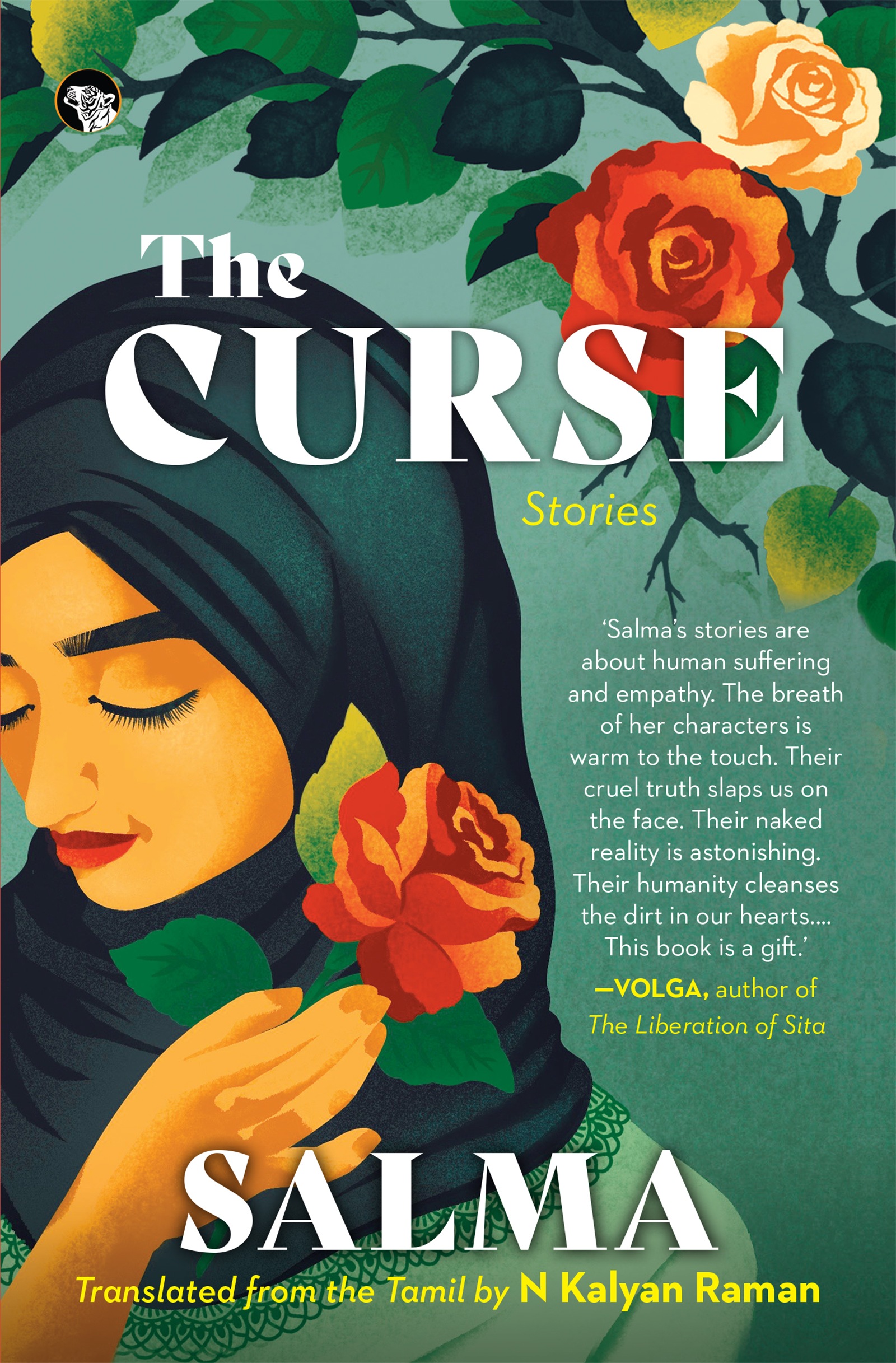
Review: The Curse; Stories by Salma
The author’s fictional universe revolves around the lives of Muslim women in rural Tamil Nadu and how they navigate patriarchal constraints



Fear, trembling, terror, anguish and enmity. One wouldn’t have imagined that lavatories could evoke such intense reactions. But for Shamim, the middle-aged protagonist of Toilets, they seem to be a fount of misfortune throughout her life.
We get graphic details of how she dealt with different kinds of toilets, her excretions and her attempts to conceal them – for as her mother would scold her, “How can a girl make noise while peeing?” The “supreme convenience of a toilet inside her bedroom” at a hotel bore promise, but that too turned out to be a nightmare. As she recounts various incidents from her life, she touches upon manual scavenging, sexual harassment, and the hostility of public spaces to women.
An account of the intricacies of shit, piss and periods might seem odd, but Salma’s keen, matter-of-fact observations make even the scatological fascinating. Interestingly, Salma wrote many of her early poems in the bathroom to hide them from her husband and in-laws.
Toilets is one of the eight short stories in her latest collection, The Curse: Stories, translated from Tamil to English by N Kalyan Raman. Her fictional universe revolves around the lives of Muslim women in rural Tamil Nadu and how they navigate patriarchal constraints. She fleshes engrossing narratives around the barebones of domestic drudgeries and squabbles. While some stories have supernatural elements, like a dead husband appearing in a woman’s dreams or a curse manifesting across generations, these are also rooted in reality – in the daily travails of their characters.
In Black Beads and Television, Shaukat Ali gets a colour TV from Dubai to his village that soon turns into an obsession for his neighbour Zakiramma, a 58-year-old cinephile, much to the consternation of her husband Sultan. In The Orbit of Confusion, a woman writes a letter to her illiterate mother to cope with the conflicting emotions of love, hate and anger she evokes. The mother, servile to her husband and doting on her children, harassed her daughter-in-law to the extent of driving her out of the house. In the letter, she tries to make sense of this unwarranted hostility, but can barely fathom her actions.
While intensely political, Salma’s stories are not simplistic. She painstakingly delineates the skeins of patriarchy coiled around women’s personhood, but does not resort to facile explanations or resolutions. Oppression does not necessarily stem from a few villainous individuals, rather it is enmeshed in the milieu her characters inhabit. Even if her protagonists do not always have the means to resist patriarchal norms, they are hardly passive. They assert their personhood with the resources available to them, occasionally by flouting the very strictures they are enjoined to follow.
Although delving into the everyday lives of women, the stories are anything but mundane. The petty conflicts they present could have easily been a soap opera, but Salma’s restrained prose and breadth of perspective ensure that is not the case. A sense of foreboding haunts her storytelling, but even when those expectations come true, there is invariably a pithy observation accompanying the climax that makes her fictional universe linger in the reader’s mind.
The stories in The Curse were written over many years – some are from Saabam, an anthology published in 2012, and some featured in magazines later. They thus present a trajectory of her growth as a writer. While stories such as The Trap and On the Edge are infused with her keen observations of people and their preoccupations, they lack the finesse and force of Toilets and Black Beads and Television.
The Trap, the shortest story in the collection, explores the anxiety gripping a woman after a knock on the door late at night. Her husband keeps chastising her as she gets lost in a vortex of thoughts. The reason for her anguish is left to the reader’s imagination and the tale comes across as a mere description of a quarrel rather than the exploration of the protagonist’s interiority that Salma does effortlessly in some of the other stories.
Like all her writings, however, it forges a space for women in a world that does not allow them to go to the toilet when there are men around or dry menstrual rags in public, let alone pursue passions or make life decisions.
Syed Saad Ahmed is a Delhi-based writer, photographer and filmmaker.


