
 E-Paper



Review: Islands in Flux; The Andaman and Nicobar Story
First published in 2017 and updated this year in the context of the Indian government’s push to build a shipping terminal, airport, and power plant in the ecologically sensitive region, Pankaj Sekhsaria’s Islands in Flux: The Andaman and Nicobar Story, comprising essays, academic papers, obituaries, court orders and a historical timeline, highlights misguided government policies and their deleterious impact on the archipelago’s indigenous communities, forests, and wildlife

 Prefer HTon Google


The edible-nest swiftlet builds its nest entirely with its saliva. Regarded as a delicacy and prized in Chinese cuisine and pharmacy, the nest is one of the most expensive animal products in the world. In India, one can find them in the Andaman and Nicobar Islands. In the late 1990s, the ornithologist Ravi Sankaran estimated that the nests’ over harvesting had led to an 80 per cent decline in the bird’s population in the islands, putting it at risk of extinction.

However, stopping the nests’ harvest and sale was not the solution. Rather, commercially farming and selling the in-demand commodity could help conserve the species. It could also yield economic benefits in a region where livelihood options were limited. In 2003, however, the Indian government increased legal protections for the swiftlet. The scientist and author Pankaj Sekhsaria dubs this “extinction by protection” in his collection of essays Islands in Flux: The Andaman and Nicobar Story. Six years later, the government reversed its decision, but the nest’s proposed commercialisation never took off.
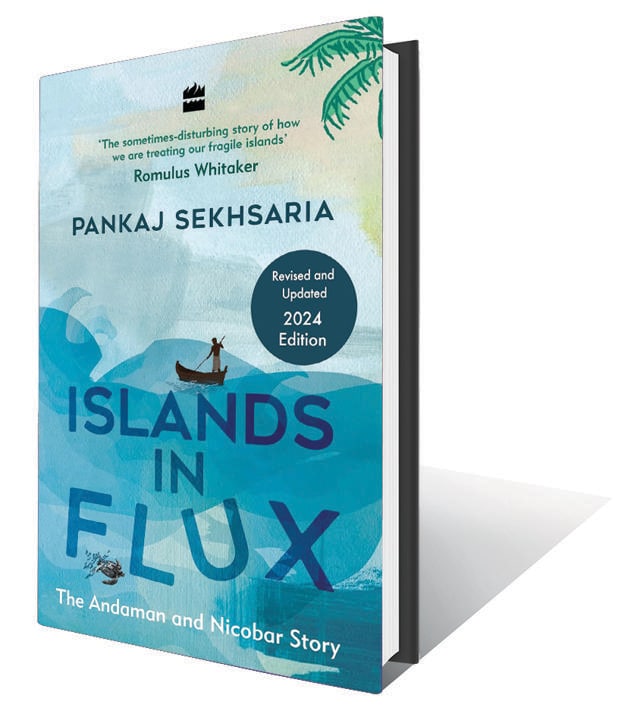
Sekhsaria’s book highlights misguided policies like these and their deleterious impact on the archipelago’s indigenous communities, forests, and wildlife. It comprises essays from the late 1990s onwards, academic papers, and obituaries, along with resources such as court orders and a historical timeline. First published in 2017, an updated edition of the anthology was released earlier this year in light of the Indian government’s push to build a shipping terminal, airport, and power plant, among other infrastructure projects in the ecologically sensitive region.
The author demonstrates how mainland India’s treatment of the islands has been akin to that of a settler-coloniser. This quasi-colonial relationship between the mainland and the islands is not unique to Andaman and Nicobar. Whether it is the United States and Hawaii, Japan and Okinawa, or France and its overseas territories, the mainland’s hegemony has caused a lot of discontent in islands.
What makes the Andaman and Nicobar Islands different from them is that many native communities have disappeared completely and those that survive are severely endangered. The British colonial government and the independent Indian one are both responsible for this. The latter’s attitudes are evident in a 1965 report, which describes part of the Middle Andamans as a “Jarawa-infested area”.
The Jarawas, a tribe whose population is under 400, were hostile to both the British and mainland Indians for decades and sometimes attacked outsiders. However, in the late 1990s, they shed their antagonism and sought out interactions with settlers from mainland India.
Communities that have been isolated for centuries often do not have the immunity to diseases that others might have evolved. Across the world, exposure to new diseases has decimated aboriginal populations. Thus, interactions with outsiders are rife with danger, as was evident in a measles outbreak that led to the hospitalisation of many Jarawas.
Sekhsaria has researched and reported on the islands for decades. His passionate engagement with the islands’ ecology and native communities shines through in his essays. He also makes a meticulous case for why and how the archipelago should be conserved. For these reasons, his work is one of the most authoritative contemporary accounts of the islands.
However, the anthology fails to harmoniously collate his essays published over the years in various media outlets. One expects much more comprehensiveness from a book vis-a-vis snappy news updates. While each essay is interesting as a standalone read, they seem all over the place when read together. They repeat the context and details discussed in earlier essays and swing back and forth in their chronology. The result is a patchy overview of the archipelago, with a flood of information that muddles the storytelling.
In many instances, however, Sekhsaria is both comprehensive and compelling, such as in the academic papers on bird conservation and how the devastating 2004 tsunami catalysed military expansionism in the islands. Thus, the book is best read in bits and pieces rather than as a unitary whole.
Along with the problems besetting the archipelago, Sekhsaria also dwells on the solutions. For example, he mentions how the reduced connectivity from the closure of the Andaman Trunk Road, which cuts through Jarawa territory, can be overcome through ferry routes. However, often, there is no straightforward solution. In the decades after independence, the government settled people on the islands to log timber. With bans on logging to conserve forests, how can one ensure they remain gainfully employed?

But rather than exploring ways to rectify past missteps, the government is repeating them by pushing for large infrastructure projects in the islands. Its focus is lately on Great Nicobar Island, the territory of the Shompen and Great Nicobarese tribes. By replacing its old-growth jungle with a concrete one, the government plans to turn Great Nicobar into a Singapore. But given the island’s limited carrying capacity — the number of people a region’s resources can support — and the likelihood of devastation from climate impacts or a repeat of the 2004 tsunami, the touted economic benefits might never materialise.
LISTEN MORE: The Great Nicobar Island Project: Staring at Certain Disaster
For not far from the island, one can find the devastation wrought by misguided plans to build castles in the sea. In 2014, the UNESCO World Heritage City of Melaka in Malaysia sought to reclaim more than a thousand acres of land along the coast. The project aimed to turn the city into an economic powerhouse, with many invoking comparisons to Dubai and Singapore. Over the years, it was abandoned and then revived, but largely remains a ghost town. The reclamation not only wrought devastation on the environment and fisherfolks’ livelihoods, but has also been an economic drain without any returns.
Instead of repeating its mistakes in the Great Nicobar Island, the government would do well to follow the policy it has adopted in the North Sentinel Island. While it had attempted to reach out to its inhabitants a couple of times in the past, it has had a strict no-contact policy for decades now. This is one of the rare instances where a community has been allowed to pursue their traditional lifestyle largely without interference from modern civilisation.
Syed Saad Ahmed is a writer and communications professional.


