
 E-Paper



Ruthvika Rao: “I find myself drawn to contradictions”
Saurabh Sharma discusses a 1990s Hyderabad novel exploring memory, gender, class, queerness and the cost of defying social expectations.

 Prefer HTon Google


Your novel could have easily been titled The Red House. Anyone who grew up in the 1990s in an Indian city would have known of such abandoned bungalows full of rich stories. What inspired you to feature this ghostly house in your novel?

Years ago, I wrote a few pages centred around a small neighbourhood in Hyderabad. It began with a few lines of prose that drew its eye towards a landmark in the neighbourhood, an abandoned house. In that same opening, alongside the intriguing and atmospheric mystery of its appearance and neighbourhood lore, the perfectly banal reason for its abandonment is also revealed: that it fell into an inheritance fight, and became a ‘litigation building.’
It isn’t so much about the whys or hows of such buildings existing in the 1990s, more that they throw light on contradictions that exist in our society, and contradictions are always intriguing.
Owing to where he comes from and why he’ll be forgotten by others except by Ruhee and Arjun, Ganesh meets a fate that’s particularly designed for him. Did you have a different narrative arc for him, or was it how he emerged while working on this novel?
We know from the opening pages what happened that summer, but not really. Again, it’s the contradictions, a play on psychological suspense. The suspense isn’t on the mechanics of plot, but more so about the way the characters remembered and retained events. Who can truthfully say that their memory is perfect? Even a photograph is an accurate depiction of an event, but not the perception of it. Only the person perceiving it knows how it felt like. I do write linearly, page after page, and the story is revealed to me at the same pace it is to a reader.
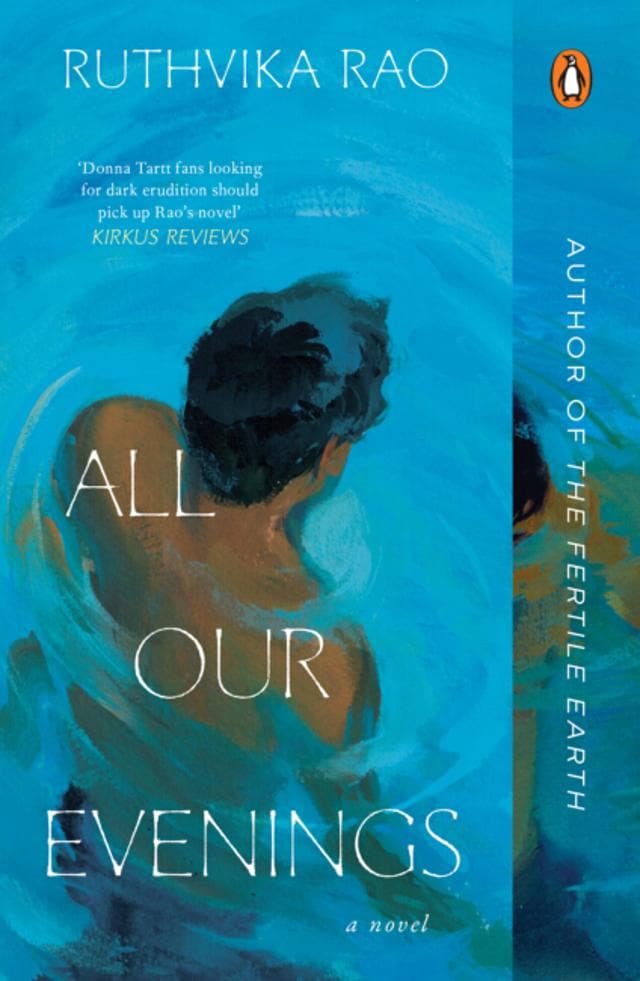
The novel explores how a person’s gender affects how their ‘leaving’ is perceived. So, the father, Prashant, leaving the family invites shame on everyone except himself. Also, a woman walking about in a city attracts lecherous comments and rejecting advances could result in an acid attack.
The book doesn’t deal with an acid attack, but more so on consequences of breaking against society’s expectations, for men and for women.
There is always a price to choosing one’s own path in life. It is never without consequence to break with the rules of society, and the repercussions are particularly harsh for women. That is universal, irrespective of geography, and I would say even timeless. The novel is set in a time before access to the internet [became commonplace], before we can safely assume everyone had a landline connection, much less a cell phone. But in many ways that would make those same consequences much harsher today.
Besides gender dynamics, the novel’s inherent queerness transgresses boundaries of class and caste. How crucial was it for you to centralise it?
Artistically, I find myself drawn to contradictions. And class lines are the biggest contradiction of all. We value people who are self-made. Which would imply that there is absolutely no merit to a person’s inherited class position at birth, and that it is absolutely random. After all it isn’t like we can choose the family into which we are born. This randomness applies to wealth, gender, and to even beauty. Yet, as a society, we value these very things as if they were earned, despite knowing [they aren’t].
Other than the principal characters, Priya’s resistance in the face of events is well-positioned in the novel. Then, Gita Miss, who despite all odds chose to be with someone, pays a price for it. Tell us about developing these characters.
I love Priya. She is propulsive, with a big personality, and she is a great foil to Arjun. She doesn’t belong to her parent’s generation, or even her brother’s generation, because things change so rapidly in India. I love that she has loud opinions, at a time when even that was provocative, and it sounds silly now, but even considered as a mark against someone’s character. But she is a genuine person who is aware of her own feelings, and has particular interests, and greatly values human labour. She is separated from Gita Miss by a generation, and it goes to show how times have changed.
Let’s talk about how, in the 1990s, condom and AIDS advertisements provided safe-sex education in a society where even speaking those words out loud invited suspicion?
It is a lived experience in the 1990s, to have that kind of exposure to things that were unsaid in society. We live in different times now, though I’m not sure that’s always true.
When the papaya tree is cut, Arjun sees how Ganesh and his father are the same man. “They were people in whose nature it was to do as they willed.” They “weren’t afraid of life.” Or perhaps even death. Prashant’s position, however, could save himself from becoming a “nobody”, while Arjun desired to be one, but it was only Ganesh who really was one.
It is Arjun’s perception that they are the same. To him, his father is a larger-than-life character, and Ganesh is too. Ganesh is brash and strong-willed, and in his own perception, Arjun is not. They are young, and the rules of the world haven’t descended on them yet; Ganesh isn’t aware of himself as being a ‘nobody’ and clearly neither is Arjun. That’s the experience of being young and impressionable with their entire lives ahead of them.
While Ganesh does not go to school, school is where humiliation is directed at Arjun because of his father’s affair with Gita Miss. In between all this, these characters learn something about love, life, and meaning. Would you say education is a key concern of this novel?
We do not have a robust public education system in India. If you do have access to education, the quality of that education will depend on your financial status; that is, how much you can afford to pay for it. It is absolutely unfair. And this same unfairness applies to access to an art education. The novel looks at this aspect from a teenager’s point of view. They aren’t adults, and neither are they children. They don’t understand unfairness, but they are learning the rules of society, while also attempting to grasp the intrinsic value of someone the way a child does.
Saurabh Sharma (they) is a nonbinary, queer writer, essayist, and culture critic. On X: @writerly_life; Instagram: @writerlylife.


