
 E-Paper



The kingdom of Mahishmathi in my novels is darker and grimmer: Anand
Anand Neelakantan explains the challenges that arise when one is writing a prequel to a successful film franchise


Author Anand Neelakantan surely knew the stakes when he started writing a prequel to the mighty successful film series Bahubali. The pan-India fan following that the films enjoy and a personal connect that the audience feels with its characters already make for an interesting start. Now the second part of the prequel is out and is titled Chaturanga. It is also a follow-up to The Rise of Sivagami which was the first instalment of the prequel. The writer says, “Writing a prequel to a successful movie is much tougher than writing an independent novel. I should write with the sensibilities of the fans of a super hit film. It was a tough call, and I use several techniques to overcome this difficulty. Writing more cinematically was one of them.” Excerpts from an interview:
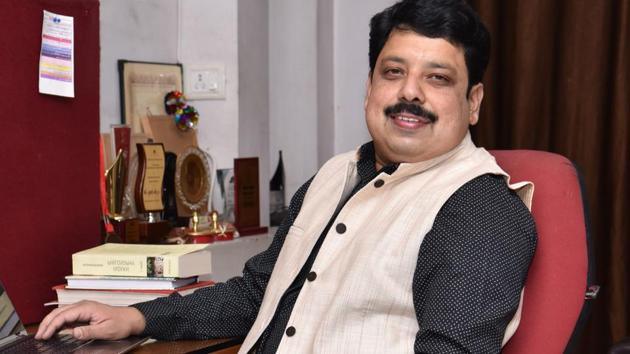
In a sense of reverse, characters like Kattappa and Sivagami were first seen on screen, unlike how it usually is with books. When one reads a book he/she’s imaginations sculpt a character. Here one already has a face for Kattappa. Is that good or bad according to you?
I wrote this as an official prequel to a successful movie franchise. I got into this with the full awareness that people will have Kattappa’s and Sivagami’s face in their mind. In the film, they were middle-aged characters whereas my story concerns their teenage and youth and that gave me the advantage to play around. Writing a prequel to a successful movie is much tougher than writing an independent Novel. I should write with the sensibilities of the fans of a super hit film. It was a tough call, and I use several techniques to overcome this difficulty. Writing more cinematically was one of them. My experience in straddling both the worlds of literature and visual medium came to my rescue. Though I have written six Novels including this, I also have written more than 500 hours of television screenplay.
When writing for such a successful franchise, how does one make sure that you don’t stick to a commercial populist storyline and write a story that stimulates thinking through a story and characters with layers?
Anyone who has read Rise of Sivagami, the first book in this Trilogy would know that it is darker and layered than the film. The second book Chaturanga delves deeper into this world. It is not the perfect Mahishmathi of the film, but a darker and grimmer one. One advantage of writing a novel is that the canvas is bigger and there are no budgetary constraints. A scene is limited only by the imagination of the reader. I also have more space to dwell in the lives of other characters, a luxury that a tightly woven screenplay could not afford. I could write a Novel that is Populist, commercially successful, and deeply satisfying at the same time.
What was the research process like for this book?
Ans:The research process of the book involved knowing the Bahubali world created in the film deeply. Apart from that, I had used a lot of historical texts for reference. I am fond of history and an avid reader of history books. I have taken inspiration from the Kakatiya Empire, the Chola Empire and the Vijayanagara Empire of the medieval period to create the story world of Bahubali. I have even gone into the research of Folk tales of this period in various languages to get the feel of society at that time. All these are the things that a Novel can handle well than a visual medium.
You’ve written previously about how women were liberated in ancient India in every way possible—morally, culturally, authoritatively, and sexually. Yet, today, people who call themselves devoutly religious consider a woman with these qualities as “influenced by the West”. How does one go about changing that?
Ans: The so-called Indian traditionalists are not defending the Indian tradition but the Victorian idea of an Indian tradition. Most of the moralities that many Indian traditionalists ascribe and enforce upon Indian women have no roots in the traditional Indian Society before the Victorian era. Ironically, a more sexually liberal society like ancient India got replaced by the rigid moralities of the Victorian era, and anyone who is talking against this enforced Victorian era morals is accused to be influenced by the West. Ancient and Medieval India is more closer to a modern Western Society than the stifling morality of British Era India. Perhaps, by knowing more about our ancient past, we may set ourselves free from the chains of Victorian morality.
You’ve written for television as well, it must be extremely liberating to write a novel. What do you make of the dramas that are on TV today? Is there enough research involved? Why can’t it still capture the interest of the youth?
I have written for television, but before that, I had written best-selling Novels like Asura and Ajaya series that said Ramayana and Mahabharata from the point of view of Ravana and Duryodhana, respectively. Even while writing for TV, I had ensured that I bring my expertise in writing books to the world of TV. The television serials like Sia Ke Ram, Chakravarthi Asoka, or Mahabali Hanuman, the ones I wrote owe to my books and those of many other outstanding writers and poets who went before me. Many of these serials have a There is huge viewership among youth, especially in smaller towns and villages, and television viewership triumphs over films and books many times, so it is a fallacy to say that TV does not capture the interest of the youth


