
 E-Paper



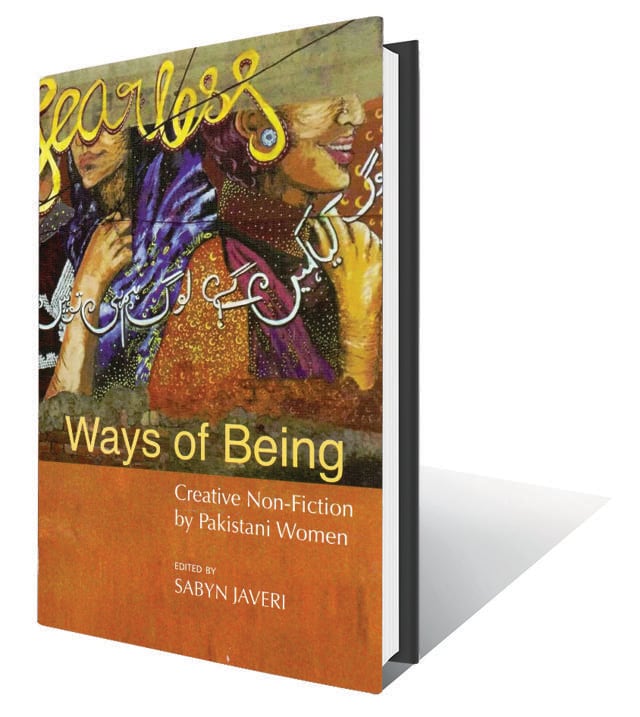
Review: Ways of Being: Creative Non-Fiction by Pakistani Women edited by Sabyn Javeri
A collection of compelling essays that explores distinctive threads of the political and cultural fabric of Pakistan

 Prefer HTon Google


“Who is a Pakistani writer?” Sabyn Javeri thought when asked to put together an anthology of essays by Pakistani women writers. She was thinking about who has the right to call herself a Pakistani writer “in this age of mass displacement.” Ways of Being: Creative Non-Fiction by Pakistani Women, a collection of 15 personal essays, has an impressive roster. Each woman responds to Javeri’s question beyond geography, delineating what it means to be a Pakistani writer. These are essays about writing and migration, yes, but what makes them most compelling is their personal explorations of distinctive threads of the political and cultural fabric of Pakistan.
In the finest essay in this anthology, Humera Afridi tells the story of her ancestral village in the province of Khyber Pakhtunkhwa, formerly the North West Frontier Province — and of her tattoo, a large dot on the back of her hand, which she got from an Afghan refugee.
During a visit to her grandmother’s in 1987, Afridi noticed that the Afghan pawinda (gypsy refugees) – who had a history of migrating temporarily to the Frontier to escape the harsh winters of Afghanistan – had now crossed the border and settled in camps in Babri Banda where most people were related by blood or marriage. The influx of the refugees, Afridi writes, “revived its fiercely proud warrior tradition as well as its aeons-old code of conduct – Pushtunwali – emphasizing honor, sanctuary and hospitality.” Afridi, who was 16 and growing up in the UAE, a “hungry teenager searching for an identity, I grasped at the story of their migration and read my own into it: warrior by blood, transplanted unwillingly, fighting obscurity.” But their stories have diverged over the years. After 9/11, the Pawinda and local men went to Afghanistan to fight the Americans. There’s a strong Taliban presence in the restive region. Afridi cannot visit. She lives in New York. In Babri Banda, she would be considered a traitor for straying “into the heart of the enemy.” “The romance of the lawless Frontier has turned sour,” she writes. This powerful essay, filled with evocative details, reads like a film.
Another excellent essay is a tender portrait of the mother-daughter relationship, Taymiya R Zaman pores over her mother’s diary from the 1960s. “A mother is the first archive, the most primary of sources,” Zaman, a historian, writes. It takes her years to go over the text — Riffat started keeping a diary at 16, and although the entries grew sparse, she kept it for a decade. But her mother, as mothers do, dismisses the whole project. She’s not Jinnah, she says, she’s just an ordinary person and her stories aren’t important. She does not like her daughter’s interpretation of who she was, she denies the blossoming feminism in the pages altogether. She does not think Zaman has the right to interpret words that do not belong to her. “I am caught between two archives, Riffat’s diary, and the living woman who disagrees with how I read her text. To her, the diary is a fragment of the past she would have thrown away,” Zaman writes. But she keeps asking questions and her mother tells her stories, and so she pieces together a short story of her mother’s life.
No two essays are alike really even when themes overlap, most are rooted in the specificity of their experiences. There is however, a recurring, surprisingly overt, name dropping — many of these writers make their family credentials very clear even when they have no bearing on the scope or subject of their essays. In her introduction, Javeri writes, “very few of us have the luxury to be rooted in one place,” but there was barely an acknowledgment of the rare privilege of feeling at home in multiple places, of holding two passports.
Kamila Shamsie writes about the anxiety of renewing her British visa and eventually gaining dual citizenship after the UK abolished the Writers, Artists and Composers visa category in 2011 — but it felt more about the irritation of it all. It was only at the citizenship ceremony, looking at an Iraqi man who did not appear affluent, did she realize the luxury of having another home to return to. Her mother, Muneeza Shamsie, writes about her time as a young student in a private boarding school in England in the 1950s. Last year, celebrating seven decades of Queen Elizabeth II’s reign, BBC Arts and The Reading Agency created a list of 70 books from the Commonwealth. Among them was Attia Hosain’s 1961 autobiographical Partition novel Sunlight on a Broken Column. Hosain was Muneeza’s aunt and when she shared this with her English teacher in Sussex, “She smirked, ‘What is this novel that you and your sister keep talking about? I’ve never heard of it!’” She writes about studying history in Britain, specifically 1857, and not telling anyone that her ancestors had been executed by the British. It’s a great essay but so filled with names of her famous family and friends, it’s hard to keep track.
Some of the essays are political acts. Sadia Khatri writes about reclaiming public spaces in Karachi, “mapping a city with my feet could undo my fear of it.” Uzma Aslam Khan writes about Sabeen Mahmud, a social activist who was murdered in 2015, and Balochistan, the largest and poorest province but the richest in natural resources, which sees itself more as a colony than part of Pakistan. Mahmud ran a cultural centre in Karachi where she hosted an event for Baloch activists. Mahmud’s friend Bina Shah (while mentioning her) writes about red lines, which is the term used by journalists and activists in “our lingo, in Pakistan, for things you don’t say, at least in writing.” In 1989, as a schoolgirl, she had sided with her classmates who thought Salman Rushdie’s Satanic Verses blasphemous. The students at the Karachi American School, she says, were overwhelmingly in favour of the fatwa (condemning Rushdie to death). She writes about the stifling she has experienced since then. When Rushdie was stabbed last year in New York, the shock had become familiar to her. “There’s always a sharp intake of breath, the bracing of the body against the news, and then an attempt to understand, intellectually, what feels viscerally like a personal assault.” She has confronted the feelings of her teenaged self and “engages with the red line every day, even in the writing of this essay… The red line, if you cross it, becomes the noose around your neck.”
Anthologies are tricky because a single poor-ish entry can put the reader off the whole thing. But when done well, they’re a portal to a whole world of literature and knowledge. Ways of Being — even though some of the essays meander, are underdeveloped, or show-offing — is an excellent collection.
Saudamini Jain is an independent journalist. She lives in New Delhi.


