
 E-Paper



Where books meet brewing history in Zurich
An industrial-age brewery in Switzerland’s largest city is an unexpected home for literature, local life, and the art of lingering.

 Prefer HTon Google


Sleepy and keen to crawl back under the covers as the morning temperature in Zurich plummeted, I decided to head for breakfast in the hope that a cup of coffee might do the trick.
It didn’t.
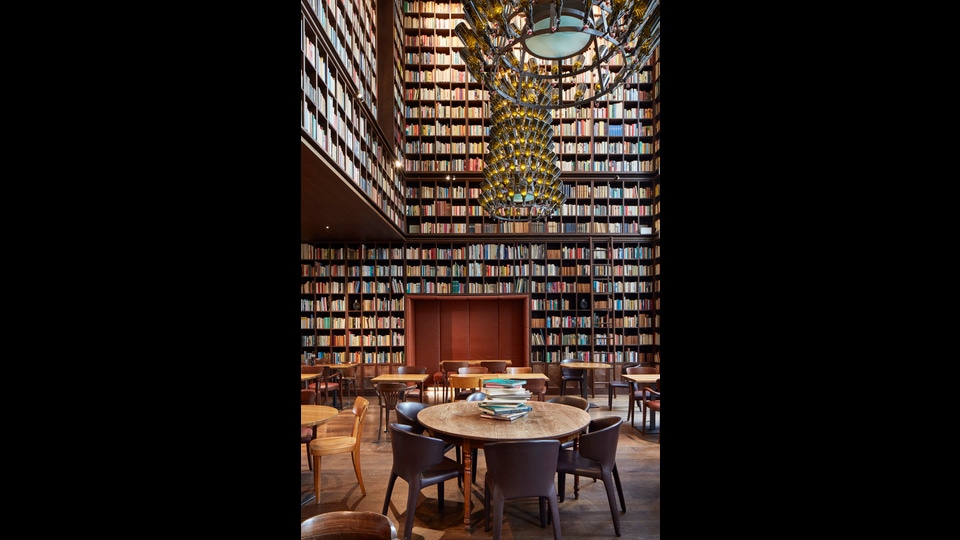
The moment I stepped into the breakfast space at the B2 Boutique Hotel, my senses snapped awake. The towering dark-wood bookshelves filled with more than 33,000 volumes, chandeliers crafted from Hürlimann beer bottles, and a cosy mix of chairs and tables made me feel like I had wandered into a dream library. This wasn’t any other hotel breakfast room; it was a living library, one that smelled faintly of coffee, old paper, and warm wood.
Nestled in Zurich’s historic Enge district, the Wine Library at B2 Hotel offers a rare convergence of literary romance, industrial heritage, and contemporary design. The building dates to 1867, when Albert Hürlimann founded what would become Switzerland’s largest brewery. For more than 130 years, the site and its surrounding neighbourhood revolved around beer, shaping Zurich’s social and industrial life. When brewing ceased in 1996 following a merger with Feldschlösschen, the vast complex became silent. But it was not forgotten.

“For over 130 years, this building was entirely focused on beer,” says Laura Storrer of B2 Hotel. “It was the former largest brewery in Switzerland, and that identity still defines the place.”
The site has since been reimagined as one of Zurich’s most distinctive urban redevelopments: part Google research hub, part Zurich’s first thermal spa, and part boutique hotel. At its heart sits the Wine Library, a space that connects every chapter of the building’s past to its present.
From industrial giant to cultural landmark
After beer production moved out of Zurich in the mid-1990s, the site’s future was uncertain. Nearly a decade of planning followed, led by architectural firm Althammer Hochuli, which approached the former industrial wasteland with restraint. Rather than erase the past, the architects chose to preserve it, retaining the brewery’s scale, brick vaults, and arched windows.
Almost simultaneously, Google moved into part of the site, establishing what would become its largest research and development centre outside the United States. Around the same time, Zurich’s first thermal spa, fed by an existing thermal spring beneath the brewery, opened within the old barrel vaults. The final piece of the puzzle was the hotel itself.
Interior designer Ushi Tamborriello conceived B2 as a “Bookmark + Boutique” hotel, an idea that places books at the centre of the guest experience.
Books, not branding
The Wine Library occupies the former brewhouse, where enormous fermentation tanks once stood. The space is now occupied with custom-built shelving that rises higher than nine metres.
The collection itself came from a single, serendipitous source. A friend of the hotel’s owner ran an antiquarian bookshop in Zurich’s old town and was preparing to retire just as plans for a book-focused hotel took shape. The entire inventory, more than 50,000 books, was purchased.
“In the end, about 33,000 books made it into the library,” Storrer says. “Every hotel room also has around seven books, and the rest are stored in our archive.”

The result is a library that feels organic rather than curated for effect. Literature, philosophy, art, travel, history and design sit side by side, in multiple languages and from multiple eras. Guests are encouraged to take books off the shelves, read them over breakfast, or carry them to a corner armchair with a glass of wine. Nothing is locked behind glass; nothing is labelled precious.
A living room for the city
Crucially, the Wine Library is not just for hotel guests. Locals use it as a workspace, a meeting point, or simply a place to read in peace. Weekends can be busy, but the energy of the space remains fluid.
“Once you discover the beauty and charm of the library, you’re hooked,” Storrer says. “We’re popular with locals as well as tourists, and the busiest moments are often unpredictable. It can be lively on a weekday just as easily as on a weekend.”
Lukas Meier, a Zurich-based architect who often uses the library as an informal workspace, tells me he prefers it to cafés or coworking offices. “It’s quieter, but also more inspiring,” he says. “You look up from your screen and there are thousands of books around you. It changes how you think.”
Breakfast plays a key role in drawing locals in. Known as B2 Z’Morge, the buffet showcases a roll call of Zurich producers: bread from St Jakob Bakery, cheeses from natürli Züri, and coffee from Miró manufactura de café. Guests and locals mingle beneath the shelves, paging through books as they eat.
“I booked the hotel for the spa but this room is what I’ll remember,” says Marie Lievens, a traveller from Belgium. “It feels less like a hotel breakfast and more like being in someone’s private library.”
The guest rooms continue the dialogue between old and new. 51 rooms and one suite are housed in the renovated mash house, while eight duplex suites occupy the former cold store.
Beneath the library lies the Hürlimannbad & Spa Zurich, set within the brewery’s former barrel-filling wing. Brick walls and vaulted ceilings create a hushed, monastic calm, while the rooftop infinity pool offers sweeping views over Zurich’s rooftops.
The spa and hotel operate as separate entities, but guests benefit from direct access to the rooftop pool, a privilege that turns a stay into something closer to a retreat. After hours of reading, guests drift down to soak; after soaking, they drift back up to the library.

Beer remains part of the experience. The original Hürlimann recipe is still brewed today (in Basel), and the beer is poured on tap at the hotel. “Our guests can enjoy it as a welcome drink,” Storrer says. “The recipe is the same; it’s another way the history lives on.”
A second life for Swiss brewing heritage
Switzerland rarely dominates conversations about European beer, yet it has one of the highest concentrations of breweries per capita on the continent. As tastes change and production consolidates, historic breweries are increasingly being repurposed rather than demolished. B2 Hotel Zurich stands as one of the most thoughtful examples of how such transitions can be handled.
What makes the Wine Library work is not novelty, but intention. The books are not props, and the space is not hushed or performative. Locals and travellers coexist naturally, drawn by the same impulse to linger.
As I finished breakfast, my coffee long gone cold, I realised I had been sitting there far longer than planned, leafing through a book I hadn’t intended to pick up at all. That, perhaps, is the library’s quiet triumph. It doesn’t just house books; it creates the conditions for reading to matter again.
Teja Lele is an independent editor and writes on books, travel and lifestyle.


