
 E-Paper



A treasure island called Taiwan
Smaller than NCR, tiny Taiwan is big on surprises. The moment you are there, you’ll notice Taiwan’s low-key, high-performance nature, so atypical of island cultures. And a warm-hearted and industrious population is the biggest draw.


Where is Taiwan anyway?
Don’t go looking for it at teatime, munching khari biscuits as you pore over the Reader’s Digest World Atlas as I did the summer I was 11. All it takes is one spilled crumb to cover the island just off the south-east coast of China, hiding it from view, making you wonder if it even exists.
Taiwan is seriously tiny. At 36,193 square kilometres, it is smaller than our NCR and less than four per cent the area of China. But the island once christened Formosa (Beautiful) by the Portuguese, is also seriously hard to figure out. It has its own constitution, president, armed forces, flag, anthem and currency. But the UN (including India) sees Taiwan as a part of China. Taiwan’s official name is Republic of China. And only 20-odd countries have diplomatic relations with it as a separate nation.

I visited Taiwan for only a week, but it was enough to tell the difference. If China is like a dramatic, sometimes disagreeable, monologue; Taiwan is like a well-crafted tweet – newer and as complex, but poetic in its brevity. And the Taiwanese are nothing like their insular (often sullen) cousins from the mainland.
SEE AND BE SEEN
Of course, if you’re young and female, you’re already at an advantage. In smaller cities like Puli, Nantou and Hualien, you’re as much a thing of wonder to Taiwan as Taiwan is to you. Octogenarian uncles will do a slow 180-degree turn to keep you in their line of sight as you walk past on the street. Middle-aged women at grocery stores in Kaohsiung who speak no English will eloquently gesture that you have a pretty face. Teens at trendy shops in Taipei’s Shilin market will smilingly check out what you’re wearing too.
In Kaohsiung, where we stopped at My Cofi café to watch a barista create intricate works of art on the foam of our beverages, a young hairdresser called Wing Lu offered to play interpreter. She helped me order a delicious green-tea brew, translated our questions to the owner and even shared that she liked Bollywood: 3 Idiots, Robot and “the sad one about the kid who can’t cope with school [Taare Zameen Par]”. Naturally, we bonded!
CLEAR AND PRESENT
Across the country, it’s easy to be a visitor. The towns are planned, the streets spotless and the locals cooperative. English-language signs are everywhere, though in the grand tradition of far-Eastern translation, some are a little odd – one plaque at a viewing platform at Taroko National Park simply said ‘Beware Of’. Advice, I suspect, you could sagely apply to anything, anywhere. Not that the Taiwanese are paranoid. Every hotel, domestic airport and train station we visited had password-free Wi-Fi. But when someone on our tour realised, minutes into a high-speed train journey, that they’d forgotten their DSLR at the platform, response was swift and effective. One phone call was all it took for the authorities to retrieve the camera and have it delivered to our destination.
Perhaps Taiwan’s low-key, high-performance nature, so atypical of island cultures elsewhere (think Jamaica, Sri Lanka or even Goa) comes from its history. Taiwan was the first overseas territory for the Japanese, who occupied it between 1895 and 1945. They brought in improved industry, public works, and modern culture. By 1949, when nationalists (under Chiang Kai-shek) fled Communist rule in China to establish a government in exile in Taiwan, it was no sleepy little coastal town.
HERE AND THERE
The Japanese legacy lingers in the older infrastructure, sushi at morning markets, Japanese cars, hot-spring resorts and a national obsession with Hello Kitty. At the lobby store of a posh hotel we stayed at, designer-clad women happily took selfies with a gigantic version of the iconic cat. The hotel also has Hello Kitty-themed suites, Taoyuan airport has a Hello Kitty waiting lounge, and a local airline operates themed international flights. Somewhere in Taiwan, there’s also a Hello Kitty maternity hospital.
Taiwan’s Chinese side shines brightly too. Its National Palace Museum ranks among the top five in the world and, at 696,000 ancient artefacts and artworks, holds more Chinese treasures than the mainland, because they were evacuated to the island to protect them from communists. Locals speak Mandarin (in a Taiwanese accent) and brew kettles of smoky-flavoured oolong tea. Older natives still follow the slow, ritualised Chinese tea-ceremony called kung-fu (pronounced gong-fu and quite the opposite of the fast-paced martial art).
| TRIBE AND TESTED |
 Taiwan’s 14 recognised indigenous tribes make up two per cent of the population. Some archaeologists believe Taiwan to be the northernmost boundary of Austronesia, considering its indigenous people share a bloodline and cultural similarities with native peoples in Hawaii, New Zealand, Malaysia and Indonesia. Taiwan’s 14 recognised indigenous tribes make up two per cent of the population. Some archaeologists believe Taiwan to be the northernmost boundary of Austronesia, considering its indigenous people share a bloodline and cultural similarities with native peoples in Hawaii, New Zealand, Malaysia and Indonesia. We met Lalan Unak of the Amis tribe (whose name for itself is Pangcha) for questions, a demo of traditional fishing methods and aboriginal songs at the Vata’an Cultural and Historical Studio. His Pangcha way of life seems pretty interesting. The tribe is matrilineal – women inherit and play the dominant role in public life. They also choose their own husbands at marriage festivals at which single men hang sling bags from one shoulder, those who’ve wed before carry it crossbody. "If a woman likes a man, she grabs his bag," Unak says. What’s in it? "Love!" A woman can abandon her man too, "if he is lazy, gluttonous or sick" he adds. Want to move there yet? |
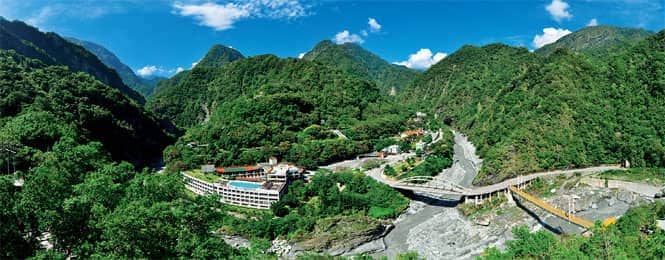
Some things, however, are distinctly Taiwanese. Like the breathtaking Taroko National Park, with its white marble gorge, river rapids gushing below and miles of tunnels hand-hewn by workers so as to not disturb the mountains. Put on your hard hat and walk, walk, walk – the quiet, the cliffsides and the sight of water’s slow triumph over rock are truly astounding.
At Sun Moon Lake in Nantou, two water bodies so named because one is circular and the other is crescent-shaped, newlyweds drop in from around the world for a photo op (often in full bridal costume) in the picturesque setting.
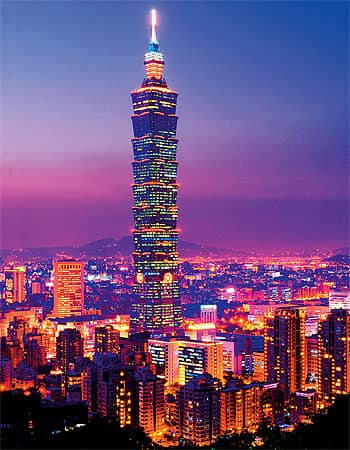
But Taiwan seems most distinctive when you’ve had some distance – say about half-a-kilometre into the sky. Ride 91 floors up in the world’s fastest elevator and look out from the observatory of Taipei 101, Taiwan’s best-known landmark and one of the world’s tallest buildings. The country below you is neither China nor Japan. It’s just a vast and wonderful nation going about its day, hoping not to be buried under a crumb of khari again.
The writer’s trip was sponsored by the Taiwan Tourism Authority.rachel.lopez@hindustantimes.com Follow @GreaterBombay on Twitter
| TAIWAN AT THE TABLE |
Taipei, New Taipei City, Taichung and Taoyuan have a few Indian restaurants and places serving halal-approved cuisine. Indian food is often at hotel buffets too. But if you have any dietary restrictions, it’s best to check with restaurants ahead of your visit. If you’re an omnivore, like me, Taiwan is pure delight. We didn’t have a single dull meal over our week-long stay. Much of the cuisine is that of Chinese Minnan immigrants. Expect lots of greens (stir-fried with meats and seafood, not as a vegetarian dish), brothy soups and stews and very little rice. Chicken dishes are widely available. 
|
From HT Brunch, April 27
Follow us on twitter.com/HTBrunch
Connect with us on facebook.com/hindustantimesbrunch


