
 E-Paper



Budget for ‘gaon, gareeb’: Fuel, gold to get costlier, sops for rural India
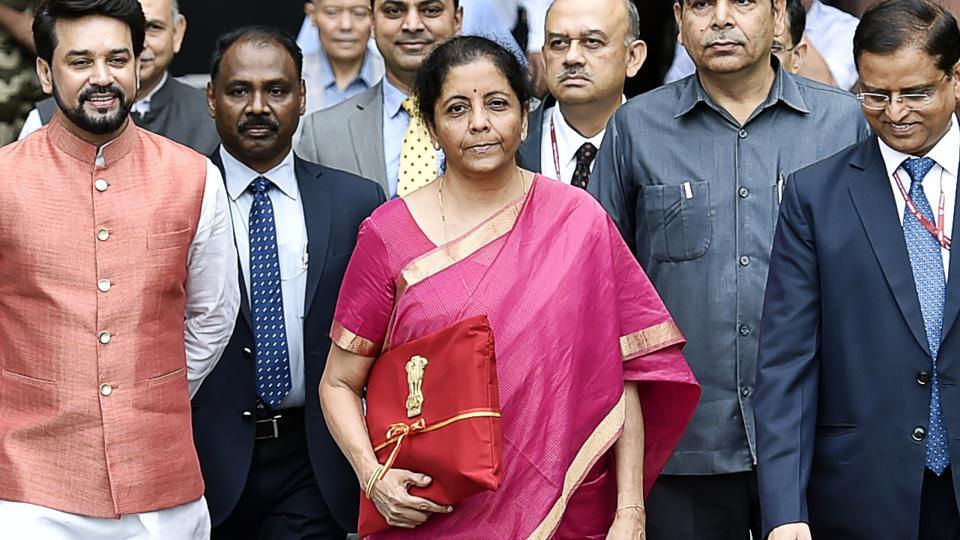
Budget 2019: Among the key announcements was the proposal to make PAN and Aadhaar interchangeable for the purpose of filing income tax returns.

 Prefer HTon Google


Finance Minister Nirmala Sitharaman, presenting Budget 2019 in Parliament on Friday, said India will become a $3 trillion economy this year. The budget aims to boost public-private partnership (PPP) for Railways, increase FDI in media and aviation, issue Aadhaar cards to NRIs on arrival in India without a waiting period of 180 days apart from schemes to provide power, water and clean cooking facilities for all.
The Finance Minister also hiked tax on petrol and diesel, raised import duty on gold and pushed the super-rich to contribute more towards, as she put it, “national development”. She proposed to enhance surcharge on individuals having a taxable income of ₹2 crore to ₹5 crore and ₹5 crore and above “so that effective tax rates for these two categories will increase by around 3 % and 7 % respectively”. The tax slabs for the middle class remained unchanged.
Nirmala Sitharaman also proposed to extend the 25 per cent corporate tax rate to all companies with a turnover of up to ₹400 crore, from ₹250 crore at present.
For updates on Budget 2019, click here
Presenting the maiden budget of Modi 2.0 government, Sitharaman proposed measures to ease liquidity crisis facing shadow banking sector (NBFCs) and providing ₹70,000 crore capital to public sector banks while seeking to raise additional resources through privatisation of some PSUs.
The Finance Minister also proposed giving foreign investors a bigger role in the country’s giant insurance and aviation sectors to help reverse weakening growth and investment.
Among the key announcements was the proposal to make PAN and Aadhaar interchangeable for the purpose of filing income tax returns.
Also Read | Budget 2019 highlights
For middle-class homebuyers, the Centre rolled out a number of schemes that are expected to entail net gains worth ₹7 lakh, in a big boost towards the goal of ‘Housing for All’. Sitharaman proposed additional deduction of ₹1.5 lakh for interest paid on loans borrowed up to March 31, 2020.
Addressing the angel tax issue faced by startups, she said startups and investors who file requisite declarations will not be subjected to any kind of scrutiny in respect of valuation of share premium.
Customs duty on gold and precious metals was raised from 10 per cent to 12.5 per cent to mobilise resources. Basic customs duty was raised on an array of products including tiles, cashew kernels, vinyl flooring, auto parts, some synthetic rubber, digital and video recorder and CCTV camera.
Excise duty of ₹5 per 1000 has been imposed on cigarettes of the length exceeding 65 mm, while 0.5 per cent duty has been levied on chewing tobacco, zarda and tobacco extracts and essence.
“I propose to levy TDS of 2 per cent on cash withdrawal exceeding ₹1 crore in a year from a bank account,” she said.
Sitharaman said the government will spend ₹100 lakh crores for infrastructure in next five years.
The disinvestment target for FY20 was raised to ₹1.05 lakh crore from ₹90,000 crore set in the interim budget and government will continue with disinvestment of PSUs in the non-financial space as well. The government proposed to allocate ₹70,000 crore for PSU Bank recapitalisation.
In a significant move, regulation of housing finance companies has been moved to the Reserve Bank of India (RBI) from the NHB.
Analysis | Will the Budget sustain Modi’s multi-class alliance?


