
 E-Paper



Missing your favourite foreign liquor? Blame it on new state policies
If you are staying anywhere in Punjab, Uttar Pradesh or Himachal Pradesh, chances are that your favourite foreign liquor brand might go missing from the neighbourhood shop. The reason: A new class of super distributors introduced by these states, who act as a middleman between wholesalers, retailers and manufacturers. In industry parlance, they are called super L1A licence holders.


If you are staying anywhere in Punjab, Uttar Pradesh or Himachal Pradesh, chances are that your favourite foreign liquor brand might go missing from the neighbourhood shop.

The reason: A new class of super distributors introduced by these states, who act as a middleman between wholesalers, retailers and manufacturers. In industry parlance, they are called super L1A licence holders.
Foreign liquor companies told HT on conditions of anonymity that they might have to rethink their business strategies in India.
“These new distributors, usually with political backing, have become the main decision-making authorities — from label registration to approvals for manufacturing to minimum retail prices of products,” an official in a leading liquor company said on the condition of anonymity.
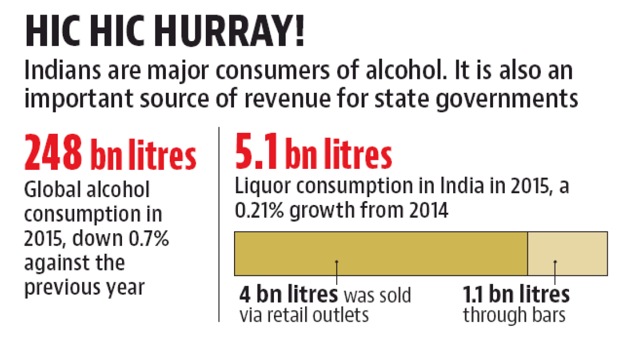
The three states together accounted for 17% of the total 5.1 billion litres of alcohol consumed in India in 2015.
According to representatives of foreign liquor companies, these distributors are forcing them to sell their products at a 10% to 20% discount over the existing procurement prices, to different wholesalers.
“If there are promotional offers during festivals, these distributors demand a bigger cut,” said the official quote earlier.
Governed by strict corporate governance rules, these liquor majors are not allowed to sell ‘discounted’ stuff to distributors. “So there’s a risk of abuse of “structural power” to decide the availability of brands and prices,” said Anil Kumar Bhushan, deputy secretary general of International Spirits & Wines Association of India (ISWAI). “Monopoly wholesalers also own a substantial number of retail outlets. So their ability to slip in spurious, illicit stuff into the market gets enhanced,” added Bhushan.
ISWAI echoes the concerns of global alcohol majors, including Bacardi (with brands including Grey goose and Martini), Pernod Ricard (Absolut Vodka, Ballantine’s and Chivas Regal), Diageo (Johnnie Walker and Smirnoff) and Moet Hennessy (Chandon Brut), among others.
These liquor companies have manufacturing units in most states. The Centre currently earns ₹20,000 crore in revenue from the liquor industry. In fact, most states derive around one fifth of their revenue from alcohol taxation, the second-largest source of income after sales tax.
“An over-regulated and complex business environment ultimately ‘hits’ revenues, and the loss is borne by liquor companies,” said Bhushan.
However, according to officials in the excise departments in these states, alcohol is completely a state subject, especially distribution and consumption. “The political class uses the alcohol beverage industry to make money. That is how it is in India. If these foreign companies do not like it they are free to leave,” said an officer in the excise department of a state with the new structure.
Sources in state excise departments also said that others, including Haryana and Chhattisgarh, are likely to follow soon.
A number of states, including Bihar, Gujarat, Nagaland and Manipur have banned the sale of country liquor and effected a drastic cut in the number of liquor stores.


