
 E-Paper



The Driver of Apple’s Exploding Valuation Is Under Threat. See What’s at Stake.
Payments from Google and App Store revenue are huge profit generators that could shrink.


 Prefer HTon Google


Apple sold the same number of iPhones in 2024 as it did in 2015, according to IDC. But Apple stock has jumped ninefold in that time.
One reason for the continued run in the shares has been the various services Apple sells to people living their digital lives in its ecosystem.
iCloud storage and other subscriptions, paid apps and app advertising, as well as payments related to web search, as a group, have quintupled since 2015, while device revenue has grown less than 40%.
And those services generate significantly higher gross profit margins: north of 70%, estimates Bank of America, compared with roughly 30% to 40% for hardware sales.
That means the services business has a greater impact on Apple’s profit than on its revenue.
Bank of America analyst Wamsi Mohan credits Apple’s choice to break out the rapidly growing, highly profitable services segment as a reason investors started paying a bigger earnings multiple for Apple shares.
Yet after a big boost during the pandemic, growth of services has moderated, and two clouds are visible on the horizon that could reduce or even eliminate key parts of the business.
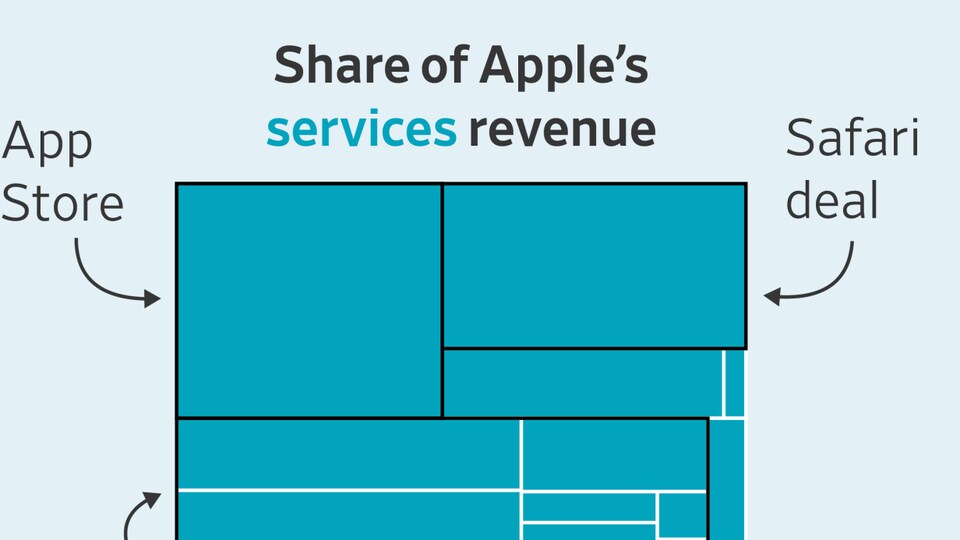
A primary component of Apple’s services business is the fees Apple collects on sales in its App Store, which drove almost a third of the total services revenue in the fiscal year that ended in September, according to Bank of America estimates.
Some developers say the fees are usurious and have appealed to regulators or sued Apple to force changes. A California judge ruled that Apple must allow app developers to sell their iPhone services from their own websites. In that scenario, she said, Apple can’t collect any fee at all.
In a worst-case scenario, Bank of America estimates that Apple could lose 10% of its net profit. But that assumes all large developers shift all of their app purchases outside the App Store, which is very unlikely, and Apple is appealing the ruling in the U.S.
In the European Union, a law called the Digital Markets Act requires similar changes to allow developers to avoid Apple’s fees.
Some experts have expressed concern that other countries could follow suit.
Apple disagreed with the California judge’s ruling, a spokeswoman said. It also appealed the ruling of the European Commission, saying the changes it is forcing the company to make go beyond what the law requires and are bad for users.
The next piece of Apple’s services business—and one of its most lucrative—is the money Google pays so it gets to be the default search provider in Apple’s Safari web browser.
It accounted for about 6% of Apple’s overall revenue in the 12 months through March, estimates Bank of America. But because it has essentially no costs associated with it, it falls straight to the bottom line, where it accounts for 19%, or nearly a fifth, of Apple’s total operating profit.
After the Justice Department won its antitrust case against Alphabet’s Google, it asked the judge to throw out the search giant’s Apple contract, which the judge is still considering. During trial testimony, the judge asked Apple executive Eddy Cue, who oversees the services business, if Apple has thought about what it would do if he cancels the contract. Cue testified: “I’ve lost a lot of sleep thinking about it.”
Advertising, particularly by apps in the App Store, is another big chunk of services revenue.
Subscriptions to iCloud storage, Apple Music, Apple TV and other services add even more to Apple’s services business.
News Corp, owner of The Wall Street Journal, has a commercial agreement to supply news through Apple services.
While Apple has bested expectations in many arenas of its services business outside of the App Store and Google payments, the company will still face an uphill battle in replacing lost revenue from those two areas, analysts say.
This explanatory article may be periodically updated.
Write to Rolfe Winkler at Rolfe.Winkler@wsj.com and Nate Rattner at nate.rattner@wsj.com


