
 E-Paper



Urban jobless rate falls below 7% for the first time in 2 years
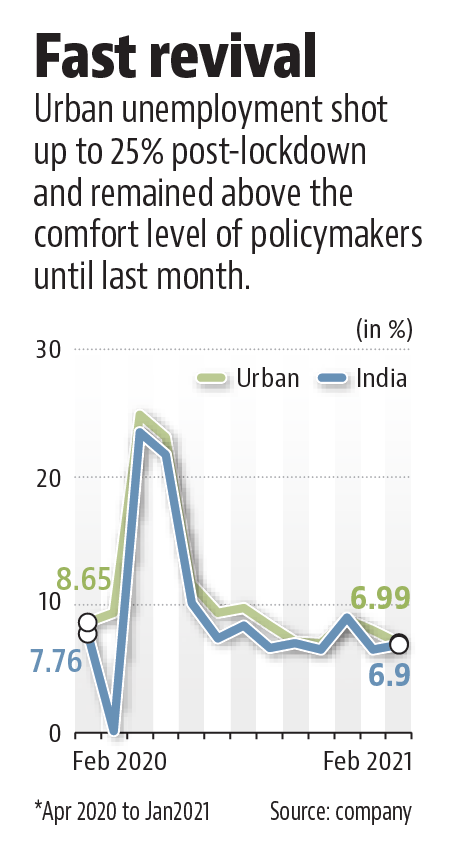
Urban joblessness fell to 6.99% in February from 8.08% in January, according to the Centre for Monitoring Indian Economy (CMIE), mirroring the gradual revival of the economy.


The demand for workers has snapped back faster than many economists expected, with India’s urban unemployment rate dropping below 7% in February, the lowest in more than two years.
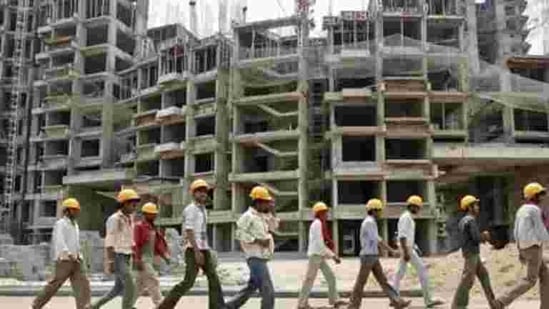
Urban joblessness fell to 6.99% in February from 8.08% in January, according to the Centre for Monitoring Indian Economy (CMIE), mirroring the gradual revival of the economy.
But economists warned the number overstates the health of the job market as the labour force participation rate, or the number of people who are either working or looking for work, has declined.
“Low unemployment rate and high labour force participation rate (LPR) are what the labour market desires, but we are far from there. People are back in urban centres doing sundry jobs due to financial constraints,” said Arup Mitra, a professor of economics at the Institute of Economic Growth in Delhi. “Only gainful employment will revive demand and aid the economy to grow faster.”
Urban unemployment shot up to as high as 25% after the lockdown was announced last March and remained considerably above the comfort level of policymakers until last month, even as joblessness in the rural areas recovered.
The rural unemployment rate, however, climbed a percentage point to 6.86% in February from 5.83% in the previous month.
Overall national joblessness also rose to 6.9% from 6.53% a month ago, indicating the jobs crisis in India is anything but over.
The revival in the urban job market is in sync with recent surveys that showed employment and business outlook have improved, and businesses are looking to the rest of 2021 positively. The Aon annual India salary survey in February showed 93.5% of organisations expect an improved or stabilised business outlook. And only 4.3% companies surveyed said they will retain a hiring freeze in 2021.
Economists said urban unemployment has declined as many workers who left cities after the lockdown, millions of them undertaking long journeys to their villages on foot in one of the largest internal migrations in India’s history, have not returned because of lack of jobs.
“Urban unemployment is down as city activities, including retail and real estate, have picked up. But data and ground analysis show labour force participation rate has gone down, meaning people are staying away from the labour market because of several reasons, including lack of gainful employment,” Mitra added.
CMIE data showed overall LPR in February 2021 was 40.5%, down from 40.6% in January. And a year ago, last February, the LPR was 42.6%. Similarly, urban LPR in February 2021 was 37.25% against 37.59% in January, and 40.48% in February 2020.
And if one takes the urban labour force participation rate into account, the trend is almost similar –urban LPR in February 2021 was 37.25 as against 37.59% in January. In February 2020, urban LPR was 40.48%.
“Temporary work, including the rural jobs guarantee scheme, cannot absorb a lot of people. All those who went during reverse migration have not returned and thus must be contributing to the unemployment scenario in rural India and partially also helping joblessness to come down in cities,” Mitra said.


