
 E-Paper



Your Money: The financial decision you should not delay
Postponing a Will can trigger disputes and administrative hurdles. Experts advise early estate planning, especially for substantial assets and family businesses

 Prefer HTon Google


A smooth transfer of assets is not just about inheritance; it also saves time and gives peace of mind to those left behind. Yet many affluent Indian families continue to manage their finances without a valid Will.

Earlier this year, 1 Finance surveyed 1,218 people aged 40-60 across 20 Indian cities and found that 84.8% did not have a Will. Nearly 47% had never discussed Wills or estate planning.
Despite the small sample, the findings are revealing. Many assume succession will take care of itself and treat estate planning as a passive exercise. Yet nearly 31% of respondents reported experiencing some form of inheritance-related family dispute, suggesting the consequences are anything but passive.
Data from AasaanWill, a digital-first estate and succession planning platform with around 20,000 subscribers, shows first-time Will makers are typically between 42 and 55 years old.
Contrary to popular belief, drafting a Will is neither complicated nor cumbersome.
Also Read: Your Money: Nail the middle path, stop chasing the highest return
Here is a quick guide to getting started:
Make a list
Start by listing everything you own. Record bank accounts with account numbers, balances and nominee details. Do the same for mutual funds, insurance policies, small savings, pension funds, EPF, fixed deposits and other financial or immovable assets. Also list outstanding loans from banks and finance companies.
This provides a clear picture of your net worth and makes it easier to decide how assets should be distributed. It also spares family members from searching through emails and paperwork to identify assets. Once everything is documented, priorities become easier to act on
Fix your nominees
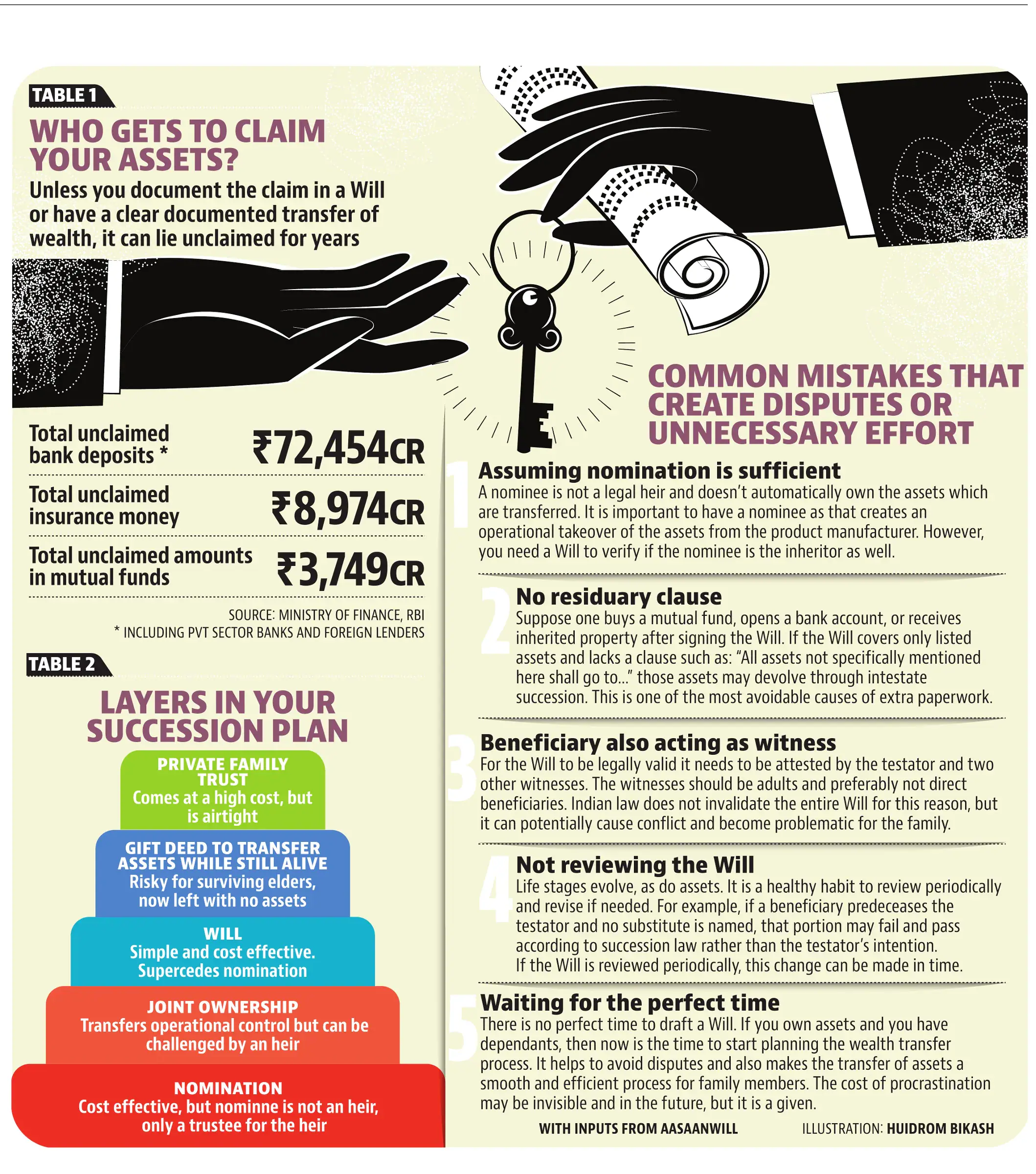
A common misconception is that a nominee automatically becomes the owner of an asset. In most cases, nominees merely receive the asset and hold it on behalf of the legal heirs.
Often a nominee may be a legal heir too, but to minimise confusion, clearly specify nominees for each asset individually and separately. Assuming everything will automatically pass to a spouse and children may seem reasonable, but that is not always how succession works. A clear succession plan ideally should have nominees plus a Will to define beneficiaries.
According to Sandeep Nerlekar, MD and founder, Terentia Consultants Pvt Ltd, an Estate Planning firm, “Writing a Will to safeguard wealth transfer is an easy task, unfortunately, it is also the last priority for many. In the absence of a Will assets are divided among Class 1 heirs which may include one’s mother, wife and dependent children. Who gets how much is now not in one’s control.”
Also Read: Your Money: How much life insurance is enough?
Nomination is a first step in operational clarity around succession. A will defines beneficiaries according to a personal assessment rather than a mathematically fair division of assets.
“When it is assumed that the children will divide equally, it is usually the beginning of future disputes. Avoiding vague suppositions and instead having a clearly worded and well defined Will is what helps,” says Vishnu Chundi, CEO, AasaanWill.
Write your Will
Once you have identified the assets and beneficiaries, draft the Will. It should clearly state who receives each asset, in what proportion, and who will carry out those instructions.
Deal with each asset individually. While financial assets can be divided in any proportion, physical assets are harder to split. Clear wording is essential to avoid procedural complications later.
For example, when an adult who is the family’s primary provider writes, “...all assets should go to my spouse on my demise...”, it leaves unanswered what happens if both spouses die in a common accident. In such cases, the family may need succession certificates, legal heir documents and multiple institutional approvals. A well-drafted Will can avoid much of this.
Once completed, the Will must be signed by the testator and two attesting witnesses. Without these signatures, it is not legally valid.
A Will does not need to be registered or probated at the time of drafting to be legally enforceable. Appointing an executor is optional but can be useful where multiple assets or income streams make administration more complex.
Also Read: Your Money: How can you climb out of a debt trap?
Anything that requires more than a Will?
“Anybody who has acquired certain assets should ideally define what will happen to those assets if something life threatening were to happen to them. While nominations are the easiest way to begin, nominees are not inheritors by default. A Will is what confirms who the assets devolve on to,” says Nerlekar.
A simple Will may not be enough where estates are large, dominated by indivisible physical assets, involve disabled or neurologically impaired heirs, or include family businesses.
It’s well known that Dhirubhai Ambani passed away suddenly without a formal, legally binding Will, ultimately causing a rift between his two sons over operational control of the group’s businesses.
More recently, after the sudden passing of industrialist Sanjay Kapur, a high-stakes legal battle worth tens of thousands of crores is ensuing between his widow from his second marriage and his children from his first marriage.
In such cases, experts recommend considering a Trust alongside a clearly worded Will.
Store it and inform someone
Once the Will is complete, ensure someone knows it exists.
“A Will hidden too well is almost as problematic as having no Will. Keep it in a secure but accessible location, keep a scanned copy and inform the Executor where its stored,” says Chundi.
While registration is not mandatory, Chundi says it may provide additional evidentiary comfort where there is significant immovable property or a higher risk of disputes.
It’s important that someone knows that the Will exists and if one fears disputes over the division of assets, registering the Will may help.
“A Will is one of the few financial decisions where the benefit is not fully enjoyed by the person making it — it is enjoyed by the family that does not have to suffer because it was missing. Yet, most people abandon the process for a very human reason: its important, but not urgent,” he says.
Procrastination is common because the costs of delaying estate planning often remain invisible until it is too late.
Nerlekar recalls that during the Covid pandemic, fear drove a surge in demand for succession planning. Prospective clients approached his firm in large numbers, creating a rush to put succession documents in place. That urgency has since faded. “Not planning means the family has to bear the cost of inaction given that inheritance and devolution is triggered post one’s lifetime,” he says
Drafting a plan for wealth transfer requires one to face the finite terms of life. It’s not the easiest thing to do and definitely not an action we may assign urgency to unless there is a life event which becomes a trigger. But uncertainty is a given and life threatening events don’t knock for permission before they arrive.
Precaution is always better than firefighting.
Lisa Pallavi Barbora is a freelance writer and author of Money & Her


