E-Paper



I Did a Real-World Mileage Test on the Tata Safari Petrol, and It Wasn’t What I Expected
Real roads, real traffic, no tricks. Here’s what the Tata Safari petrol actually returned in my mileage test.

 Prefer HTon Google


I spent a few hours driving the new petrol version of the Tata safari to answer a simple question a lot of prospective buyers have been asking: what kind of real-world mileage does this big petrol SUV actually deliver?
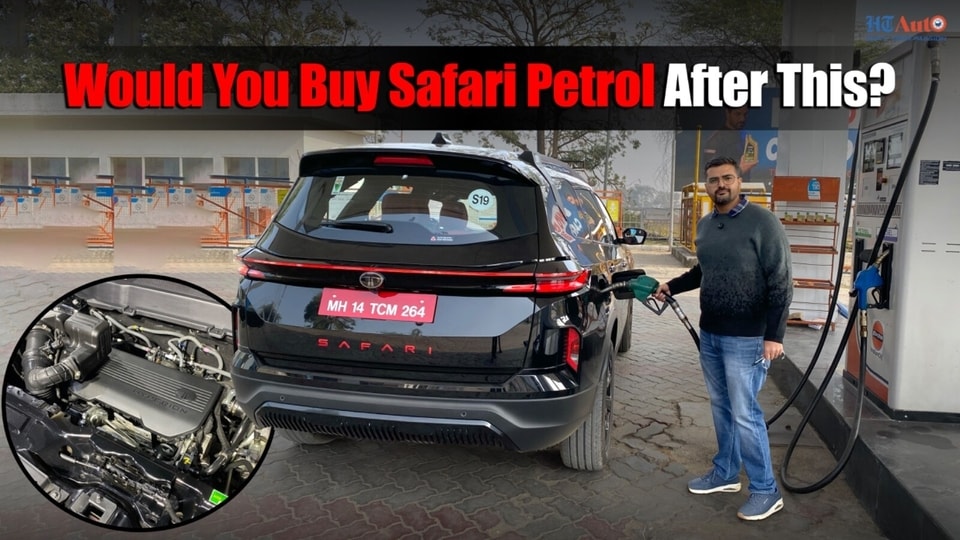
This was not a lab test or a claimed figure run. I took the car out on public roads, drove it the way I normally would, and measured fuel consumption using a proper tank-to-tank method.
How the test was done
We started the drive at around 7:45 am with a full tank. The plan was simple: drive for a few hours, cover a mix of city and highway conditions, then refill the tank and calculate consumption. I could not reset the trip meter because of a low battery alert on the instrument cluster, so I noted the odometer reading instead and worked from there.
The route included inner-city roads in Faridabad, followed by a longer highway stint on the Faridabad–Gurgaon stretch. This gave a fair mix of stop-go traffic and steady cruising.
I did not try to hypermile the car. I drove in normal mode, with a relaxed throttle input and my usual driving style. No sudden acceleration runs, no constant crawling either. Air-conditioning was on, and traffic was what you would expect on a weekday morning. The car was driven continuously for about two to three hours, covering just over 60 km in total.

The new Hyperion engine and how it feels
The petrol Safari uses Tata’s new 1.5-litre Hyperion turbo-petrol engine. It is the same motor you also get in the Tata Safari and Sierra petrol. Output figures are identical too: 167 hp and 280 Nm of torque.
In everyday driving, the engine feels smooth and refined. Power delivery is predictable, and there is enough torque low down to keep the SUV moving without frequent downshifts. The six-speed automatic gearbox is tuned more for comfort than aggression. It does take its time with shifts, but it never feels confused or jerky.
On the highway, the Safari petrol feels stable and planted, much like the diesel version. Cabin noise levels are well controlled, and the suspension setup works well on typical Indian road surfaces.
I also checked straight-line performance during the drive. The 0–100 kmph run took just under 10 seconds, which is respectable for an SUV of this size. Roll-on acceleration is decent, making overtakes on highways fairly stress-free.
(Also Read: Gurugram to Jaipur and Back: Real-World Range Test of the Maruti Suzuki eVitara EV)

Feature updates worth noting
Apart from the new petrol engine, Tata has quietly added a few updates to the Safari. Inside, you get the large 14.5-inch Samsung QLED touchscreen, updated mirrors with memory and auto-tilt, a sliding armrest, and a new interior colour theme. There is also a new IRVM with an embedded camera feed, and even automatic camera washers on the outside.
None of these directly affect fuel efficiency, but they do make the petrol Safari feel like a refreshed product rather than just an engine swap.

Tata Safari petrol mileage test result
At the end of the run, the odometer showed that I had covered 61 km. When I refilled the tank, it took 7.58 litres of petrol. That works out to a real-world fuel efficiency of around 8.04 kmpl.
This figure is based on my driving conditions and style, and it will vary depending on traffic, load, and how heavy your right foot is. But it gives a realistic idea of what you can expect from a petrol Safari in mixed usage, rather than relying on claimed or record-run numbers.
The petrol Safari is not about chasing big mileage numbers. What it offers instead is a smoother, quieter driving experience compared to the diesel, along with good refinement. If your usage is mostly city-based, or if you prefer petrol engines and lower NVH levels, this version makes sense.
As always, choosing between diesel, petrol, or electric will depend on how and where you drive. For me, this test answered one key question clearly: the real-world mileage is modest, but the overall driving experience is solid and predictable.