
 E-Paper



47% jump in cancer patients at PGIMER in 7 years
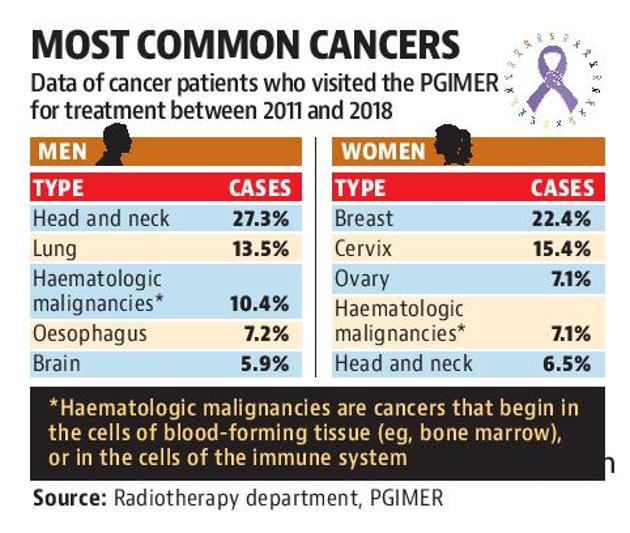
Around 53% patients registered for treatment were men, among whom the leading type of cancer was head and neck (27%)


The Post Graduate Institute of Medical Education and Research has witnessed 47% rise in the number of cancer patients in seven years.
Data shared by the department of radiotherapy shows that the annual number of patients at the Regional Cancer Centre of the institute increased to 8,024 in 2018 from 5,465 in 2011.
Around 53% patients registered for treatment were men, among whom the leading type of cancer was head and neck (27%). Experts relate it to the habit of consuming tobacco among men.
Dr Sushmita Ghosal, head of the radiotherapy department at the institute, said that alcohol and tobacco use (including smokeless tobacco, sometimes called chewing tobacco or snuff) are the two most important risk factors for head and neck cancers, especially cancers of the oral cavity, oropharynx, hypopharynx, and larynx.
“We want to urge people to know about the ill-effects of consuming tobacco. Lung cancer, which is the second most common (13.5%) among men can also be mostly related to smoking habits,” said Dr Navneet Singh, additional professor in the department of pulmonary medicine.
Meanwhile, breast (22.4%) and cervix (15.4%) cancer remain the two most common among women. In fact, the prevalence of breast cancer increased from 20.6% in 2011 to 21.2% in 2018.
However, the prevalence of cervix cancer went down from 18.2% to 13.4% in the same period. Dr Ghosal said that one of the reasons could be improvement in mensurational hygiene with increased awareness.
“Women and adolescent girls are using clean menstrual management materials and having access to facilities to dispose of the used materials,” she said, while adding that another reason could be the delay in the marriage age of women.
On the cases of breast cancer seeing a surge, doctors said it is due to change in the lifestyle and consumption patterns.
Women who start menstruating early in life, or have a late menopause, also have an increased risk of developing breast cancer, possibly because of the increased number of ovulatory cycles and exposure to estrogens and other breast tissue proliferative hormones. Extensive breast feeding reduces the risk of breast cancer, but due to late marriage that is not happening, said a doctor.


