
 E-Paper



Chandigarh admn faces criticism for declaring entire city containment zone
A containment zone is geographical area with high incidence of Covid-19 cases where no unchecked outward movement of population except for maintaining essential services and government business continuity is allowed


The Chandigarh administration’s move on Monday to notify the entire city as a containment zone to control the Covid-19 outbreak is being questioned in certain circles that prefer selective sealing of affected spots.
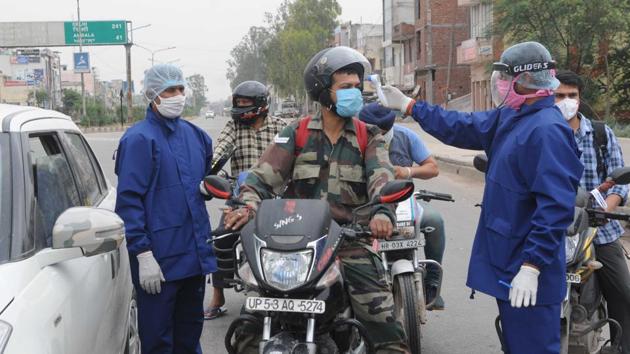
The Union health ministry had declared Chandigarh a Covid-19 hotspot (red zone) on April 15, leaving the Chandigarh administration to specify the geographical area of the containment zone in the city. A containment zone is geographical area with high incidence of Covid-19 positive cases where no unchecked outward movement of population except for maintaining essential services (including medical emergencies) and government business continuity is allowed.
The UT’s containment order dictates there will be no relaxation in curfew imposed from March 24 and industries as well as the IT sector will be closed up to May 3 even though they are facing heavy losses with layoffs as the curfew extends into the second month.
When the matter was raised with the UT authorities to seal select spots similar to what had been done by other states, including Haryana, the response was that cases were scattered around the city, because of which demarcating zones would have been difficult, says Dr JS Thakur, professor at department of community health of Postgraduate Institute of Medical Education and Research (PGIMER).
Services provided by self-employed persons, for instance electricians, IT engineers, plumbers, motor mechanics and carpenters, will remain prohibited.
Construction of roads, irrigation, buildings and all kinds of industrial projects including MSME in rural areas; construction of renewable projects; continuation of works in construction projects within MC limits; and private vehicles for emergency services could have been allowed if entire city wasn’t declared a containment zone.
Businesses ‘won’t survive’
“But now, no economic activity will be allowed in the city for a month. The administration should have done selective sealing of areas. The city’s economy cannot survive another month of complete lockdown. Some relaxations were warranted,” says Charanjiv Singh, chairman, Chandigarh Beopar Mandal,
Another major impact would be that people needing medical care from neighbouring areas will not be able to enter the city during medical emergencies, says Dr RS Bedi, former president, Chandigarh Chapter of the Indian Medical Association.
“The UT administration has allowed inter-state migration of officials for essential services, but has ignored patients who require better medical care here. There’s panic among medical professionals and also for the people who need medical care in Chandigarh. The authorities should allow this,” he added.
“Only time will tell how wise this decision is, but we are denying healthcare services provided by PGIMER to the patients in the region as they cannot visit the institute due to curbs imposed by the administration,” says Dr Neeraj Nagpal, convener, Medicos Legal Action Group.
Sporadic, non-contiguous spread
Technically, a containment zone is spread around three kilometers with a buffer zone of five and seven kilometers for urban and rural areas, respectively. “But, in case of Chandigarh it was not possible as the cases of outbreak of Covid-19 are scattered, non-contiguous and sporadic spread,” says Manoj Kumar Parida, UT adviser.
Under the red zone too no relaxation is allowed except for essential services, he adds.


