
 E-Paper



To revive Kangra art, serve it on a plate
Kangra administration takes initiative to create affordable objet d’art with prints of the art form at affordable costs

 Prefer HTon Google


Kangra or Pahari art is thought to have originated in the 18th century in Guler, a hill state in the Himalayas, after a family of Kashmiris trained in the Mughal art style settled there. Soon, as they mixed with other local artists, a new art form emerged. Portraits of royals of the Mughal court or love scenes were replaced by paintings of Radha and Krishna, immortalising their divine love.
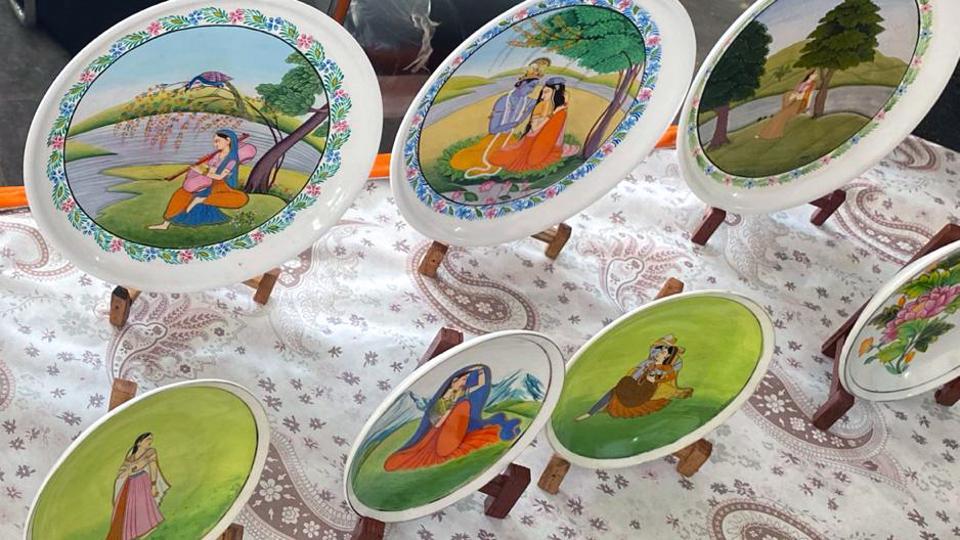
Today, the fading Kangra art form is being revived through Project Srijan, an initiative by the local administration, which was launched in the Rait block of Kangra district in October this year, to provide ideation and marketing support to artists of Kangra style.
Those specialising in the Guler and Basohli styles of painting and are known for their traditional black pottery, have been roped in to revive the era of Ras Nayikas and Krishna Ras.
“From the detailed vegetations depicted in Kangra style to the beautiful yellow backgrounds of the Basohli style, we have continually been working with artisans to develop new products with Kangra style paintings,” says Latika Sehajpal, block development officer, Rait.
The exorbitant costs of the paintings led to a disconnect between art and the masses. “Digital paintings have also taken over the market of hand-painted art forms,” adds Sehajpal.
Kangra administration takes initiative to create affordable objet d’art with prints of the art form at affordable costs. “We have developed the paintings on glass plates, wooden stands, slates, and small glass framed paintings in an affordable range of Rs 2,000 to Rs 3000 and do not compromise on the beauty and detailing of the paintings,”she says.
More innovations are being worked out. Earthen clay plates are being created in collaboration with experts in black pottery from Dharamkot village near Dharamshala.
These plates are then painted in Basohli and Guler styles.
Black pottery is an ancient technique of pottery and is done in only a few pockets of India, including Nizamabad (Uttar Pradesh) and Longpi (Manipur).
“More products are being developed to revive painting styles and are being procured by government offices as ideal gifting options. A new marketplace in Dharamshala is also being finalised for providing brick and mortar outlets to these products,” says Sehajpal.
The project now covers bamboo and cloth painting artisans to develop products such as bamboo fruit trays, outdoor decor and wall with traditional bamboo products.
“In 2021, all these products will be sold online through Instagram,” said Sehajpal.
The products are on display at an exhibition in Shimla.
For financial assistance to artisans under this project, Sehajpal says two schemes, the Mukhya Mantri Gram Kaushal Yojana (MMGKY) and National Rural Livelihood Mission, have been dovetailed.
Under MMGKY, a batch of five students learning each art form – Basholi, Guler and black pottery – has been started this year. The master trainers and the trainees are both getting financial assistance to preserve and propagate the painting styles


