
 E-Paper



Wildbuzz: Mr Besra Sparrowhawk and her hubby
The word, Besra, itself is derived from Baaz (female Northern goshawk) and denotes the latter’s smaller version while her diminutive hubby, the Dharti, means just about a handful!


A few Besra sparrowhawks have been photographed in the Sukhna Lake jungles in winter when the bird resorts to altitudinal migration from its summer breeding grounds in the Himalayas. A comparatively rare migratory hawk, the bird derives its common English name from Hindi, where Besra is used only for the female of this species. In Hindi, the male is known as Dhotee/Dhooti/Dharti. However, in English both the sexes go by the common name, Besra. The choice of English name underlines the female’s precedence over the male because in raptors or birds of prey, the females are larger and pack more power than males. They are thus preferred by falconers. The word, Besra, itself is derived from Baaz (female Northern goshawk) and denotes the latter’s smaller version while her diminutive hubby, the Dharti, means just about a handful!
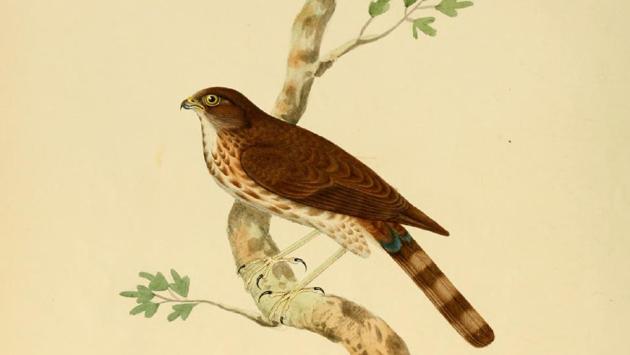
Since a Besra (Accipiter virgatus) resembles the Shikra, it is confused and mistaken for the latter, a common and very visible hawk of tricity gardens.The Besra’s reticent nature and preference for lofty, dense forests renders it elusive to easy observation. All of this serves to enhance the enigma of this shikari on an annual winter safari to the Sukhna.
To fill the void on the Besra, we shall dwell on aspects of its behaviour and character. Once upon a time, the Besra was a well known and understood raptor, especially by native falconers of yore. When it comes to knowledge of raptor behaviour and their distinctive character, there are no better observers than falconers and austringers. While the Besra outwardly resembles a Shikra, the former’s expertise and speed at dodging and twisting through trees/branches, obstacles and dense undergrowth are more allied to the reputed qualities of the Eurasian sparrowhawk. These qualities render the Besra a favourite to trap and train, and thence flown to hunt small birds. A section of falconers were so besotted with the Besra – due to her tenacity/speed – that they even preferred her to the female Eurasian sparrowhawk.
Adding to our knowledge of the Besra’s capabilities to hunt down the most twisty of small birds, the distinguished raptor specialist, Rishad Naoroji, wrote: “Capable of rapid aerial manoeuvres and recorded capturing an Asian Palm swift.” Some falconers would train Besras and Shikras to kill small birds and serve these to larger, trained raptors in their mews such as Northern goshawks and Peregrine falcons. The energy of larger raptors was reserved for bigger shikar such as of gazelles, bustards, geese and hares.
The most detailed account of the Besra’s prowess – as gleaned from native falconers – was provided by TC Jerdon in his book, Illustrations of Indian Ornithology, published in 1847. “The Besra is said to be somewhat more difficult to train than most of the hawks, and is a delicate bird, and requires great care and attention, especially during the hot season. It is highly esteemed among native falconers, and sells for a considerable price. It is very speedy, and particularly active and clever in the jungle, which its habits, as a denizen of the forests in its wild state, peculiarly fit it for. It is chiefly flown at partridge, which it seizes in general with great ease and certainty; also occasionally at quails, snipes and doves. The male or ‘Dhotee’ (which is smaller than the female) is but seldom trained and is then flown at sparrows, Brahminy mynas etc,” the book stated.
Armed with an astute grasp of a wild raptor’s character, falconers would employ cunning methods to outwit these wary, strong birds. “The Besra, and other short-winged hawks, as well as occasionally the Luggur and some of the falcons, are usually caught by what is called among falconers the ‘Do Guz’. This is a small, thin net from four to five feet long, and about three feet broad, stained of a dark colour, and fixed between two thin pieces of bamboo, by a cord on which it runs. The bamboos are fixed lightly in the ground, and a living bird is picketed about the middle of the net and not quite a foot distant from it. The hawk makes a dash at the bird, which it sees struggling at its tether, and in the keenness of its rush, either not observing the net from its dark colour, or not heeding it, dashes into it, the two side sticks give way, and the net folds round the bird (Besra) so effectually as to keep it almost from fluttering,” wrote Jerdon.
vjswild1@gmail.com


