
 E-Paper



43 hectares of Pune hill-side swept clean of invasive tree species
Gliricidia Sepium tree was planted on barren hill slopes in the city years ago, but has turned out to be an invasive, not allowing native species to grow


Gliricidia Sepium is the species of tree that is currently a blooming headache for the forest department in Pune.
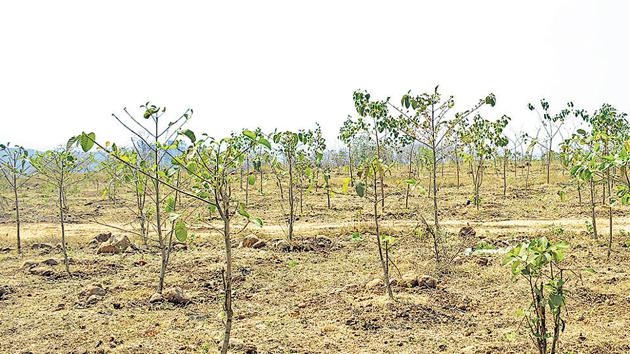
As much as 43 hectares of hill slopes in various areas of Pune, currently with a dense Gliricidia plantation, are being cleared of the tree from the roots up
Deepak Pawar, range forest officer, Pune district, says, “The species (Gliricidia) has slowly destroyed the soil on the tekdis with leaves becoming acidic. It does not allow any other species to grow, hence, we took the decision to clear it completely.”
The Gliricidia trees cover 14 hectares on the Arai tekdi, 25 hectares on the Panchgaon-Parvati tekdi, and four hectares on the Mohammadwadi tekdi.
Pawar explains, “Gliricidia were planted on the hills of Pune in 1990 as part of the ‘Harit Yojna’ of Maharashtra. The then forest department planted these trees on barren stretches of the tekdi to help reduce nitrogen levels in the atmosphere, and also to preserve the land from land grabbers.”
“The department took to plantation of the exotic species which grew rapidly, but over the years, the same species has also slowly destroyed the soil on the tekdi. Hence, we took the decision to clear it completely and plant indigenous species, which we began in February 2020. The re-planting will be a four-year project.”
The forest department has, as of March 8, cleared 15 hectares of the offending tree.
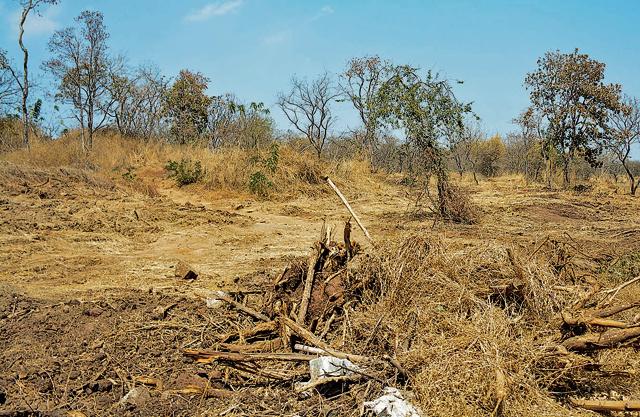
Besides the targeted tekdi slopes, the total area of plantation with the Gliricidia tree in Pune, counting the small pockets, is 50 hectares.
“It will take us at least five months to clear it all,” Pawar said.
What species will replace the Gliricidia on the Pune tekdis?
“The forest department has begun planting on the Arai tekdi six hectares of bamboo, in 16 varieties, apart from eight hectares of a mixed plantation,” says Pawar , “including tamarind (chinch), Emblic Myrobalan (awla), and Bael (wood apple)”
Kill the Gliricidia? Yes, but, slowly and systematically: botanist
Botanists are in agreement with the kill-the- Gliricidia plan, but urge a systematic removal.
“Gliricidia is a legume tree, therefore, the root nodules fix nitrogen and enhance fertility of the soil. Probably, with this intention it was planted on the barren hillocks,” said Dr Milind M Sardesai, professor, department of Botany, Savitribai Phule Pune University (SPPU).
“Glericidia doesn’t allow a majority of the native species to grow. The removal should go in systematic way. Immediate and complete removal of Gliricidia plantations will expose soil which has been covered for years, resulting in negative effects on local ecology. It will allow more invasive weeds to invade. Therefore, native tree species should be promoted replacing Gliricidia slowly and systematically,” said
Dry planting: survival of the toughest
The forest department is employing a “dry planting” technique for trees it is replanting on Pune’s tekdis. Plant trees in summer, but no water until the monsoons.
“The plants that survive are checked for immunity power. We are experimenting on one patch and if it succeeds then we present this model to be replicated across the department,” said Pawar.
Urban forestry scheme
Under the Maharashtra government’s “Urban Forestry Scheme”, the forest department is aiming to create an “urban jungle” of 80 acres in Pune.
“This can serve a range of purposes and it takes many forms, covering natural, and planted forests, forests maintained in watersheds or in dry lands, wooded areas, green spaces and street trees, as well as trees in urban and peri-urban gardens,” said A Shreelaxmi, deputy conservator of forests.
The Pune department cites the Bhamurda forest, also known as the Mafco garden, as the example of an urban forest.
The Panchgaon-Parvati and Arai tekdis, apart from Mohammadwadi and Bavdhan, will all come under the same plan.
Pune’s forest areas
The forest area in the city is divided into three ranges — Bhamburda, Pune and Paud.
The forest area in Parvati, Kothrud, Bhamburda, Bavdhan Khurd, Khadaki, Hingne Budhruk and Warje comes under Bhamburda range.
While the forest cover in Wanowrie, Hadapsar, Pisoli, Kharadi, Vadgaonsheri, Undri, Kondhwa, Mohammadwadi, Dhayari, Kondhwa Budhruk, and Katraj, fall under the Pune range.
The forest cover in Mhalunge comes in the Paud range.
Peri, peri forest
According to the Food and Agriculture Organisation of the United Nations, peri-urban forestry is the practice of managing forests, groups of trees and individual trees in and around urban areas to maximize economic, livelihood, social, cultural, environmental and biodiversity values.


