E-Paper



MP CM Shivraj Chouhan cautions schools against forcing girls to wear headscarves
Madhya Pradesh chief minister Shivraj Singh Chouhan took cognizance of a case against a private school in Damoh, which allegedly forced girls, irrespective of their religion, to wear headscarves in the campus and made students sing Urdu poems in assemblies

 Prefer HTon Google


Madhya Pradesh chief minister Shivraj Singh Chouhan on Friday cautioned schools against forcing girls to wear headscarves and making students sing Urdu poems in morning assemblies.
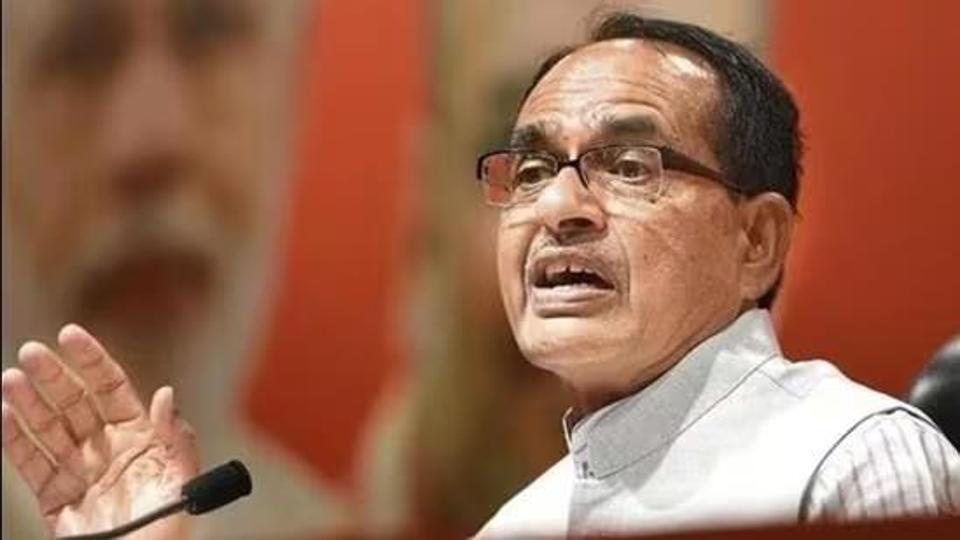
Taking cognizance of a case against a private school in Damoh, which allegedly forced girls, irrespective of their religion, to wear headscarves in the campus and made students sing Urdu poems in assemblies, the chief minister said that the government will not allow such activities in the state and such schools will not be allowed to run.
“I came to know in a school in Damoh, daughters should come with something tied on their heads. The poem was being recited on the name of the person, who was behind the partition of India. I want to caution that such activities will not be allowed on the land of Madhya Pradesh,” the chief minister said, addressing a programme in Chhatarapur on Friday.
“The new education policy has been implemented by the Prime Minister. Only that education policy will be applicable in MP. If someone teaches something else in school or asks daughters to come by tying a scarf or something else on her head, the school will not be able to run in Madhya Pradesh. The students will sing only the national anthem in the morning prayer,” he said.
Earlier, Chouhan had ordered an inquiry into the matter and asked the district collector to end the compulsion of wearing hijab and scarves as dress code by the school, said an officer of the chief minister’s office (CMO).
The issue came to light after a poster of the Ganga Jamuna Higher Secondary School in Damoh congratulating 18 students for their performance in the board examination courted a controversy on social media on Tuesday. The poster showed girl students, irrespective of their religion, wearing headscarves.
National Commission for Protection of Child Rights (NCPCR) chairman Priyank Kanoongo was among those who flagged the case on Twitter. He said NCPCR had received a complaint that the school was forcing Hindu and other non-Muslim female students to wear burka and hijab.
He had also written to the Madhya Pradesh government to take action against the school.
Meanwhile, the Madya Pradesh school education department suspended the recognition of the school in question on Friday with immediate effect. The department’s Sagar division joint director Manish Verma said the suspension was imposed on the school for failing to have infrastructure as per the recognition rules.
The department’s order stated that in the inspection of a district education officer, it was found that the school, which has 1,208 students, didn’t have library, laboratories, sports equipment, and toilets.
“The school was not following the recognition rules 2017 of the state government so its recognition is going to be suspended from immediate effect,” the order said.
Damoh district collector Mayank Agrawal said that the school administration has discontinued the dress code that has been in place since 2012. It has also decided to discontinue the recitation of Urdu poem ‘Lab pe ati hai Dua Banake’, written by Muhammad Iqbal in 1902, in morning assemblies.
“In the initial inquiry conducted by the district education officer, it was found that the students were not forced for any kind of conversion and wearing scarves as alleged by many. After the chief minister took cognizance of the matter, a detailed inquiry is going into the matter as the school receives financial aid as a minority school from the central government and why come up with this dress code,” the collector said.
The school’s administrator Hazi Mohammad Idris said, “This is wrong to say that we forced anyone to wear scarves. It was a part of a dress code. We put the poster of the students after they outperformed in the exam. But if the poster of girl students in scarves hurt anyone, we apologise for that. Our intention was just to give the best education to students.”
The saffron organisations in MP staged protests demanding a first information report (FIR) over the incident and derecognition of the school.
Damoh superintendent of police (SP) Rakesh Kumar Singh said that action will be taken against the school on the basis of a probe report.
In January 2022, a Hijab row erupted in Karnataka after six Muslim girls were not allowed to take pre-university exams in Udupi. The matter escalated when the then Bharatiya Janata Party (BJP)-led state government banned hijab and asked education institutions to follow a uniform policy.