
 E-Paper



Amid stubble trouble, these Punjab farmers set the eco-friendly example
Kuljit Singh, 43, who owns eight acres in Fatehgarh Channa village of Sangrur but has not burnt stubble since 2018. Instead, he has been turning the crop residue into a natural fertiliser, which is not just environment friendly but also helps improve soil health.

 Prefer HTon Google


Even as the paddy harvest season is nearing its end, Punjab continues to grapple with the problem of stubble burning with over 3,000 cases so far. But a few farmers in the state are setting the right example by finding sustainable alternatives to burning stubble.
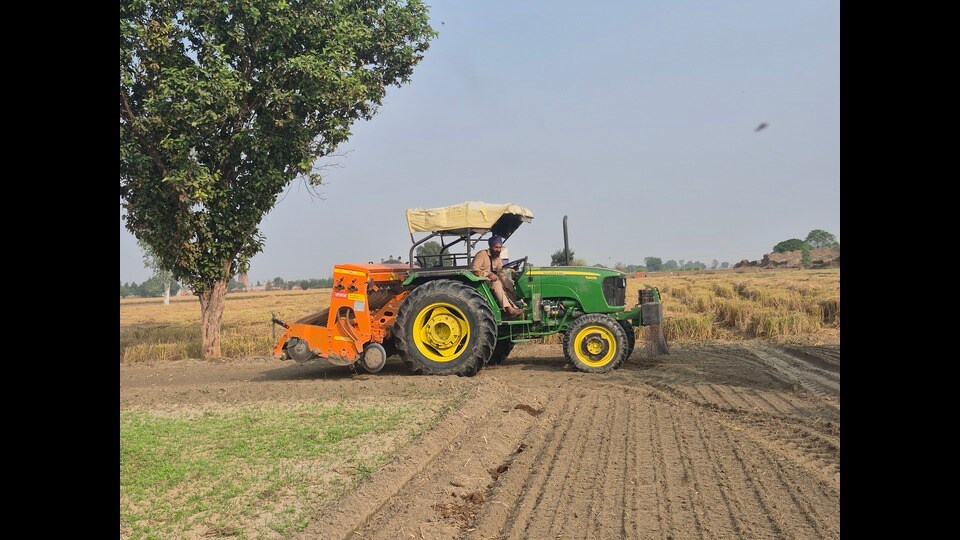
Turning crop waste into soil wealth
Among them is Kuljit Singh, 43, who owns eight acres in Fatehgarh Channa village of Sangrur but has not burnt stubble since 2018. Instead, he has been turning the crop residue into a natural fertiliser, which is not just environment friendly but also helps improve soil health. “I initially used the Happy Seeder (2018-2019) and then shifted to the super seeder till 2024, before switching to mulcher and MB reversible plough. The mulcher cuts the crop residue (straw) into fine pieces, which is then mixed with soil using a reversible mould board plough,” he said.
Kuljit said the practice reduces the requirement for Urea and DAP, and eliminates the need for Muriate of Potash (MOP). Overall, the process costs him ₹70,000 but he ends up making over ₹1 lakh in profit.
For this farmer, spray is the way
Another progressive farmer, Gurinderpal Singh from Bhawanigarh, Sangrur, has also not burnt stubble since the past five years. His family owns 52 acres. “I use the free PUSA decomposer spray, which is provided by the Krishi Vigyan Kendra. It breaks down the crop residue within 15 to 20 days,” he says.
He also owns a Super Seeder and takes the mulcher on rent, with the overall expenditure coming to ₹5,000 per acre. “The yield I get with this process is higher than what I had with the traditional practice of burning residue,” he says.
When personal tragedy became the catalyst
In Mansa district, Sukhjit Singh, 38, of Biroke Kalan village has transformed his eight-acre farm into a model of sustainable agriculture. He and his brother adopted stubble management and natural farming practices in 2013 after a personal tragedy.
“My brother’s son was diagnosed with a congenital disease. When we took him to the Post Graduate Institute of Medical Education and Research (PGIMER), Chandigarh, doctors told us that his condition was due to nutrient-deficient soil and exposure to excessive agrochemicals,” said Sukhjit. Besides, the sight of animals dying in fields due to stubble burning also left him disturbed.
The brothers now incorporate the crop residue back into the soil and also grow crops in rotation. Instead of sticking to the wheat-paddy cycle, they grow gram, pulses, sugarcane, and turmeric as well. “Mulching has dramatically increased the yield, especially for turmeric,” he reveals while adding that their cultivation costs have also dropped by 40–50%.
Incorporating stubble back into the soil
In Barnala district, brothers Sukhpal Singh and Tarsem Singh from Kothe Surjitpura village, who own 100 acres, have been managing paddy stubble without burning for the past five years.
“Earlier, we made bales of stubble, but since 2024, we’ve started mixing it directly into the soil. It has helped us increase our potato yield from around 250 to 300 bags per acre to nearly 350 bags,” Sukhpal said.
Similarly, Hoshiar Singh from Ranwan village in Malerkotla has initiated a bed-planting system on 10 acres – his family owns 20 acres in all. He cultivates wheat varieties like Sona Moti, Sharbati, Chapati, PBW 872, and PBW 826, along with chickpea and mustard – all free of chemical fertilizers, herbicides, and pesticides. “All types of cereals, pulses, vegetables, fodder, and fruits can be grown this way. It allows the crop residue to be mixed back into the soil, returning the organic matter to the soil,” he said.
An official privy to the matter said while the practice of incorporating soil back into the fields is good, it also increases the risk of pink stem borer infestation in the next crop. “I have seen the issue during our field visits. There is no subsidy for that,” he said.
Sangrur chief agriculture officer Dharminderjit lauded the farmers’ effort and said that others should also follow these practices.
Malerkotla deputy commissioner Viraj S Tidke said, “The efforts are sustainable and inspiring for other farmers. New solutions like these will give a new direction to Punjab’s agriculture and the administration will provide every possible support to such new ventures.”
Mansa deputy commissioner Navjot Kaur said, “Despite being a small farmer, Sukhjit has pioneered stubble management and organic farming using technologies like bed planting and super seeders. He is not just a successful farmer but a thriving entrepreneur in organic farming and a guiding light for others. The district administration has honoured him – he is a role model for Mansa farmers.”
Despite repeated attempts, director agriculture Jaswant Singh was not available for comments.


