
 E-Paper



Wildbuzz: Words burn, art sears the soul
The death of a labourer’s child in a jhuggi due to an adjoining field of stubble being set on fire deeply pained a sensitive artist

 Prefer HTon Google


Gurpreet, a young artist from Bathinda, has protested the ecological inferno arising from wheat stubble burning with an evocative painting. The death of a labourer’s child in a jhuggi due to an adjoining field of stubble being set on fire deeply pained the sensitive artist. The image of an innocent, sobbing child turned into the central symbol of Gurpreet’s artwork and presaged the darkness looming over future generations.
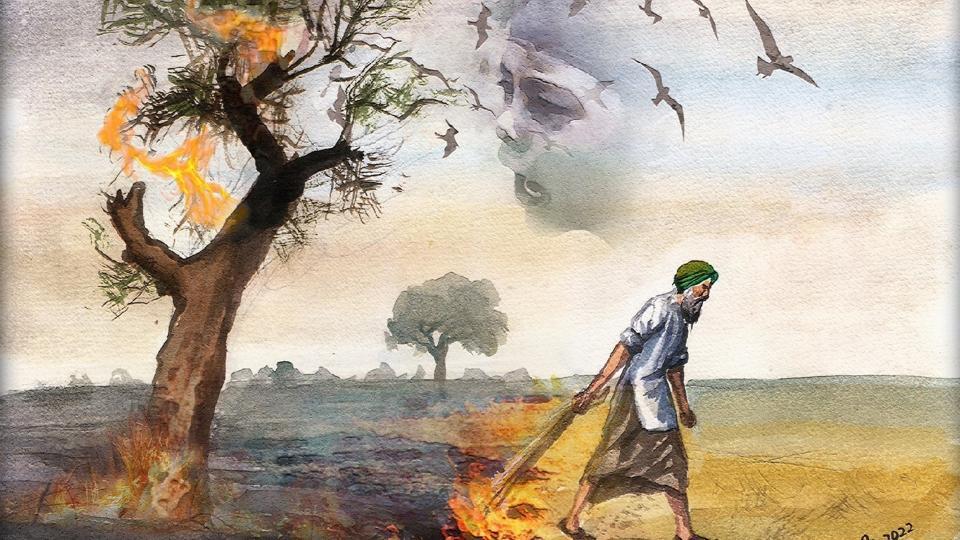
The plight of birds circling over their burnt homes and wailing like banshees in dark swirls of stubble smoke evoked the plight of sobbing refugees and mass pyres of communal pogroms. Drawing attention to the prescient ecological messages of Guru Nanak Dev, Gurpreet implored farmers to spare a thought for agrarian-friendly insects, shady trees and moisture losses to the nurturing, mother-like soil.
Gurpreet supplemented his painting with commentary that engaged his detractors with searing words. Translated from Punjabi by Prof Gurpartap Singh, Gurpreet wrote: “Brothers, I have no direct connection with agriculture, yet I stood up for farmers and forcefully spoke against the government. However, when I gave my views about farm fires, many people cursed me in uncivilised language. Some argued that if factory owners can cause pollution and there are stray animals on roads, then farmers, too, are justified in burning stubble.”
“Please don’t point out the mistakes of others to hide your own. Factories release smoke in the same manner as a tractor ploughing fields. But there are fines for factories that cause pollution. Sometimes, fines are imposed but, yes, many times corrupt systems let off culprits. It is dairy farmers themselves who abandon cattle when they stop producing milk or turn unfit for work,” argued Gurpreet.
Gurpreet signed off with words true to an artist’s soul: “I have a habit of not keeping quiet; it is my duty to give a clarion call. Save the situation (O farmers), in your court is the ball!”
The mother of all battles
The best-laid plans of mice and men can often go awry. But Nature can, in a queer twist of fate, spring a welcome surprise for the dejected soul.
A keen field naturalist and wildlife photographer from Chandigarh, Jatinder Vijh, had driven down to Thapli jungles (Panchkula) to ascertain the arrival of the enigmatic Pied cuckoo, a migrant from Africa that flies to India to cunningly lay eggs in nests of other birds. The first disappointment that fell Vijh’s way was that it started raining and he returned home. But he received a call from a friend in Thapli that the sky had since cleared.
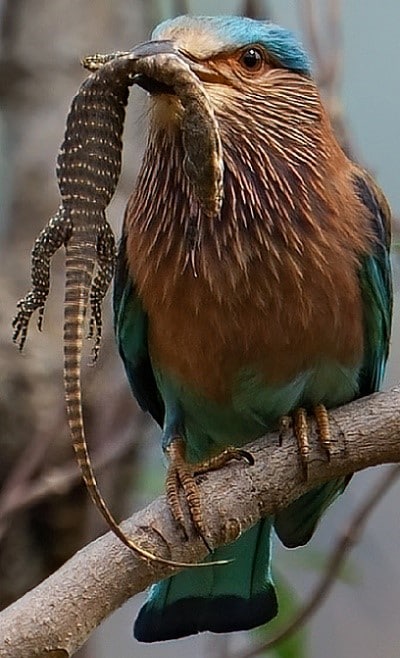
A memorable event unfolded as Vijh sat rueing the serial whammies that had befallen his cuckoo odyssey: “I drove back to Thapli, as my instincts told me a surprise awaited me. I was still in search of the cuckoo and walked up a small hillock with an uneven. I slipped and fell. I was tired as my energies had dissipated by now and I did not feel like getting up. Sitting there, very still, for fifteen minutes, I glanced upon a colourful Indian roller (Neelkanth) on a treetop. The roller would fly down making a hissing, threatening sound and return to the perch. The roller had a nest in a hole in that tree. A huge Bengal Monitor lizard (Goh) was clawing her way up the tree and the roller was trying to deter the threat.”
“The besieged roller turned the tables. She flew into the undergrowth and a commotion followed. The roller returned to the perch and in its beak was a juvenile of the Goh. I had never seen a roller — known for its aerobatics — hunting a Goh. The roller, sporting a determined killer look in her eyes, ate the little Goh. The female roller would go to any length to save her chicks, like any mother would. In the clash of mothers, the roller had triumphed by bagging her opponent’s offspring. I felt sad for the adult Goh who had lost her little one. The mother Goh retreated and disappeared from sight. My energies recouped and I walked away with a novel photo and observation of a thrilling encounter,” Vijh recounted.
vjswild1@gmail.com


