
 E-Paper



Big relief for farmers as Centre agrees to shift fence closer to int’l border: Punjab CM Mann
The move that will clear the way for unhindered cultivation of thousands of acres of farmland currently trapped beyond the fencing, Punjab chief minister Bhagwant Mann said


Following his meeting with Union home minister Amit Shah in the national capital on Saturday, Punjab chief minister Bhagwant Mann announced that the central government had agreed in principle to shift the security fence closer to the International Border, a major relief for farmers in the state’s border belt.
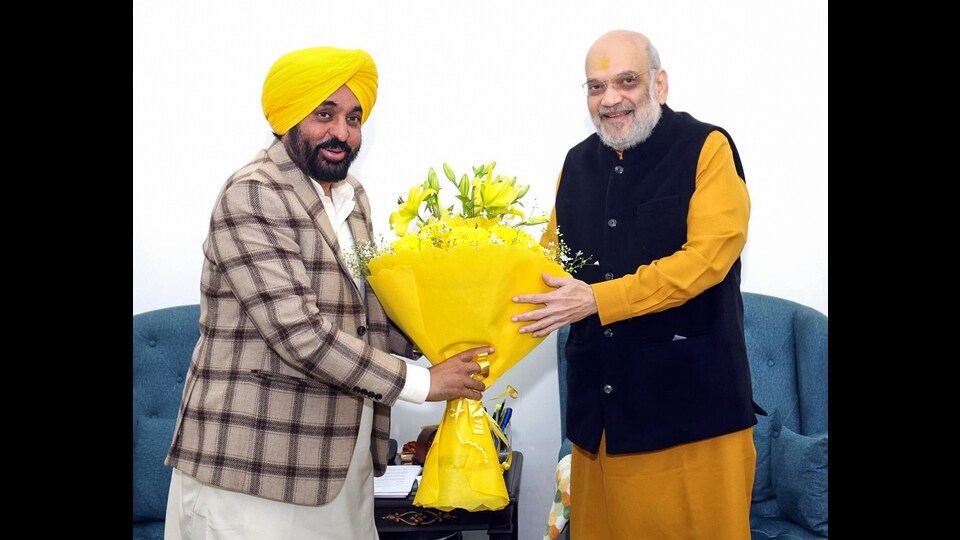
The move that will clear the way for unhindered cultivation of thousands of acres of farmland currently trapped beyond the fencing, Mann said.
Barbed wire fencing was installed along the International Border with Pakistan between 1988 and 1991 to stop arms smuggling during the Khalistan insurgency, with construction extending to 1993 for floodlighting, restricting access to 21,300 acres of farmland.
The chief minister said farmers for long had been forced to cross the fence with identity cards and under BSF escort to reach their own fields, facing daily hardship and uncertainty along the 532-km India-Pakistan border where fencing lay deep inside Punjab’s territory.
“As per international norms, construction should be beyond 150 metres of the Zero Line, but in several areas of Punjab, the security fence is located two to three kilometres inside,” said Mann.
He said if the fence was realigned closer to the International Border, large tracts of Indian land will come this side of the fence, allowing farmers to cultivate without fear and daily restrictions, without compromising national security.
He said the home minister informed him during the meeting that the issue was under active consideration and that the fencing will be shifted towards the border.
Punjab’s interests sidelined in proposed Seed Act: Mann to Shah
During his meeting with the home minister, Mann also conveyed the state government’s opposition to the proposed Seed Act, which the Centre plans to table in the upcoming Budget Session to replace the existing 1966 legislation.
Raising serious objections to the proposed act, Mann said Punjab was an agrarian state and one of the largest grain producing states of the country, yet the draft Seed Bill did not assure representation of the state as per schedule under the relevant section.
“The zone-based system introduced in the bill does not guarantee Punjab’s representation in the Central Seed Committee, unlike the existing system, thereby limiting the state’s voice in decisions that directly affect the seed sector,” he said.
“The proposed bill also curtails the existing powers of the State Seed Committee, as there is no role envisaged for the state-level committee in seed registration, and the draft is silent on a robust compensation framework for farmers who suffer losses when registered seed fails to perform as claimed,” he said, urging that the bill not be brought before Parliament in its present form.
The chief minister pointed out that seed varieties tested and released in foreign countries had been allowed for import and sale in Punjab and other states without compulsory multi-location testing under state specific agro climatic conditions, posing serious risks to farmers.
CM flags slow movement of foodgrain
The chief minister also highlighted the problem of foodgrain movement and storage, stating that for the last five months, the Food Corporation of India (FCI) had been moving only about 4 to 5 lakh metric tonnes (LMT) of wheat and 5 to 6 LMT of rice from Punjab.
“Against 95 LMT of pending rice of Kharif Marketing Season 2025-26 to be delivered, only 20 LMT of storage space is currently available,” Mann informed Shah.
On the issue of commission paid to arhtiyas, the chief minister said the commission had been frozen since the 2019-20 procurement season, contrary to the provisions of the Punjab Agriculture Produce and Marketing Act, and was currently capped at ₹46 per quintal for wheat and ₹45.88 per quintal for paddy.
He pointed out that the commission at silos had been reduced to half of that in regular mandis and that the committee constituted in January 2024 to revise the amount had not taken a decision so far.
“Arhtiyas are not agents, they provide essential services, and they deserve their rightful share. Delay in revising the commission can disrupt the smooth procurement process, and the rates should be finalised at the earliest,” he said.
According to a state government spokesperson, Mann was assured by the Union home minister that the concerns would be examined.
Seeks urgent release of Rural Development Fund dues
Flagging the non-payment of Rural Development Fund (RDF) dues, the chief minister said, “Despite clear statutory provisions under the relevant Punjab Acts, RDF has not been reimbursed to the state government. Even after amending the Punjab Rural Development Act in compliance with Government of India instructions, RDF has not been released since Kharif Marketing Season 2021-22.”
He pointed out that ₹9,030.91 crore of RDF and ₹2,267.83 crore of Market Fees remain unpaid, severely impacting rural infrastructure development, including roads and mandis.
“RDF is not a charity. It is Punjab’s rightful share, and we are demanding our due,” he said, adding that the Union home minister assured him that a priority meeting would be convened to consider release of the first instalment.
‘Maintain 60:40 ratio of Punjab, Haryana officers in Chandigarh’
Mann also raised the issue of maintaining 60:40 ratio of Punjab and Haryana officers in the Union Territory of Chandigarh, calling it the need of the hour.
He expressed concern over IAS and PCS officers being excluded from key positions and the opening of crucial departments such as excise, education, finance and health to other cadres, which dilutes Punjab’s role in the UT administration. He said the Union home minister assured him that the existing ratio would be maintained.
The chief minister also took up the issue of appointing a Punjab cadre officer as general manager, FCI Punjab, saying that Punjab cadre officers possessed critical familiarity with procurement, mandis, storage and movement of foodgrains.


