
 E-Paper



Pre-monsoon showers in Punjab good for paddy: Agri experts
The intermittent rainfall during the past one week in Punjab has become a cause of boon for the paddy crop as it helps in lesser requirement of water for irrigation and supports saplings and seeds take roots easily

 Prefer HTon Google


The cloudy weather and intermittent rainfall during the past one week in Punjab that has led to fall in temperatures has become a cause of boon for the paddy crop as it helps in lesser requirement of water for irrigation and supports saplings and seeds take roots easily.
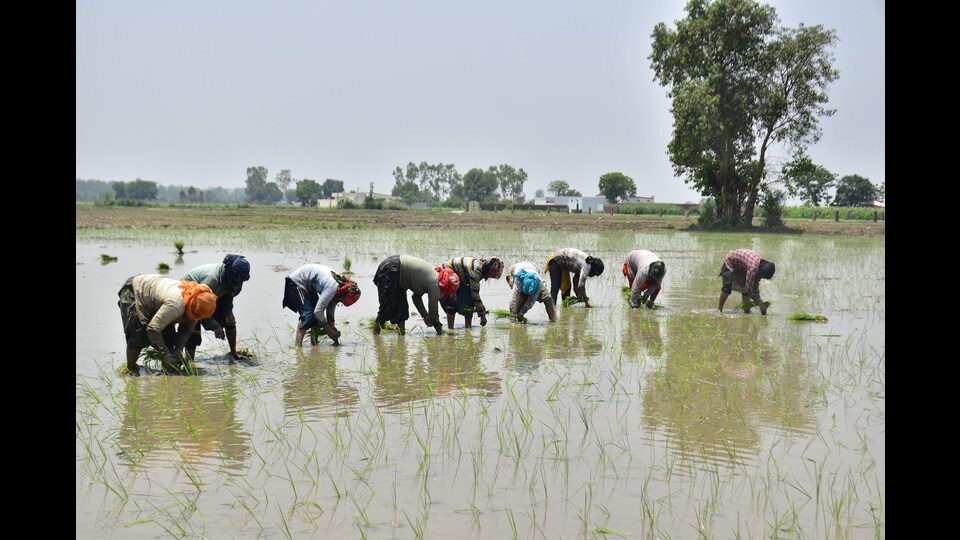
On a contrary, the ongoing climatic phenomenon is not ideal for maize and cotton crop as it causes pests to multiply faster on the two crops. According to the Punjab Agriculture University, Ludhiana, if water is not allowed to accumulate in cotton fields, it will make a good crop. He said that the maize and cotton crop, which is already sown will grow faster in the current spell and advised farmers to make sure the water doesn’t accumulate in the fields.
Paddy sowing in the state began on June 10 covering the belt across the International Border fence, followed by other parts of the state from June 16, June 19 and June 21.
“All across the state at least 10% paddy sowing by transplant and direct seeded rice (DSR) method has been reported to be complete. With DSR method for which a target of 5 lakh acres has been set, 1.17 lakh acre area has been sown so far,” said director agriculture Gurvinder Singh. Paddy sowing in Punjab is expected to complete in a week to ten days time, subsequent to which basmati sowing will begin, he informed.
In the current kharif season, paddy is expected to be sown over 30 lakh hectares (73.5 lakh acres), out of which a target of 5 lakh hectares (12 lakh acres) has been set for aromatic premium basmati.
The meteorology department has predicted that the phenomenon of intermittent rainfall and overcast skies will continue for about a week which would make temperature continues to be low. “This is best weather we could have for paddy cultivation, as it would lead to lesser irrigation owing to lesser evapotranspiration and the plants become robust to fight pests and vagaries of the weather. During the past one week, 10-20 mm rainfall was witnessed in different parts of the state,” said a PAU expert.
The current weather conditions have led to fall in temperature by 5-10 degrees Celsius, which according to the experts is also beneficial for the paddy crop. During these days the maximum temperature touches 45 degrees Celsius but it currently hovers around 30-35 degrees Celsius.
The weather department has predicted monsoon to arrive during the next week. “This will further support the crop and cut down irrigation needs and usage of electricity to run 14 lakh plus tube-wells,” said PAU’s agronomy department head Makhan Singh Bhullar.
Power demand expected to fall
The demand for power that touched a new peak of 15,325 megawatts on Friday, according to a top engineer of the Punjab State Power Corporation Limited (PSPCL) has come down on Saturday to less than 15,000 megawatts. “We expected the demand to fall further in case the favourable weather conditions continue and monsoons sets in, by the next week,” he added.


