
 E-Paper



Chandigarh feels the chill under season’s first dense fog
Visibility in Chandigarh drops to 50 metres; day temperature plunges to 15.3°C, six notches below normal and season’s lowest so far

 Prefer HTon Google


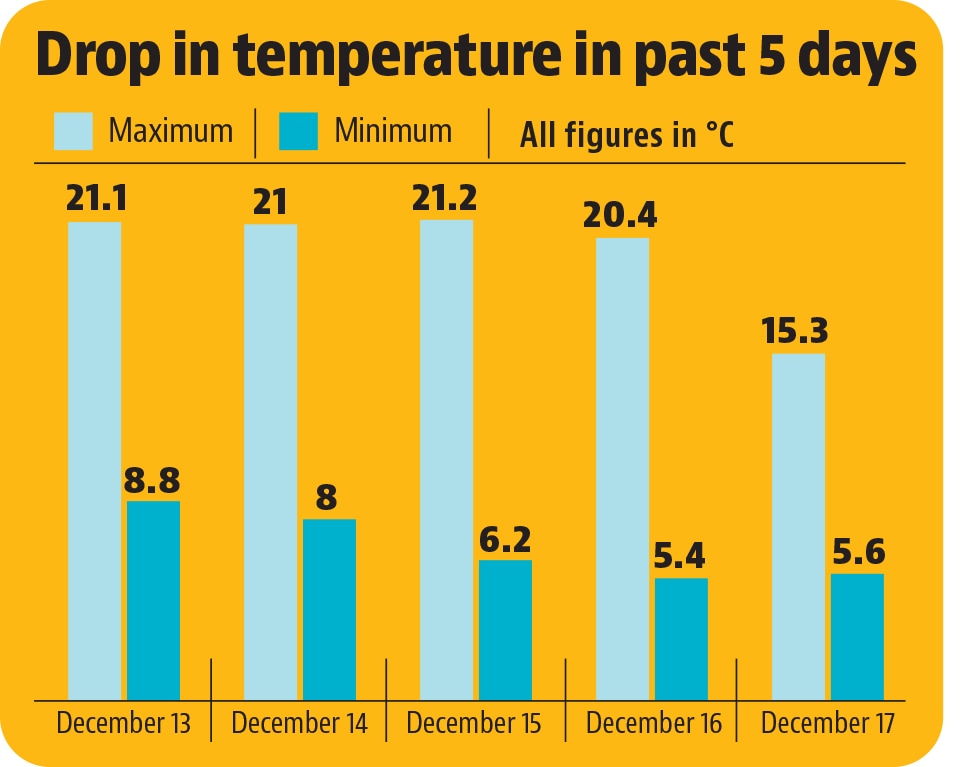
Even though the minimum temperature went up from 5.4°C on Thursday to 5.6°C on Friday, the day felt chillier due to dense fog in the morning that dropped the visibility to just 50 metres.
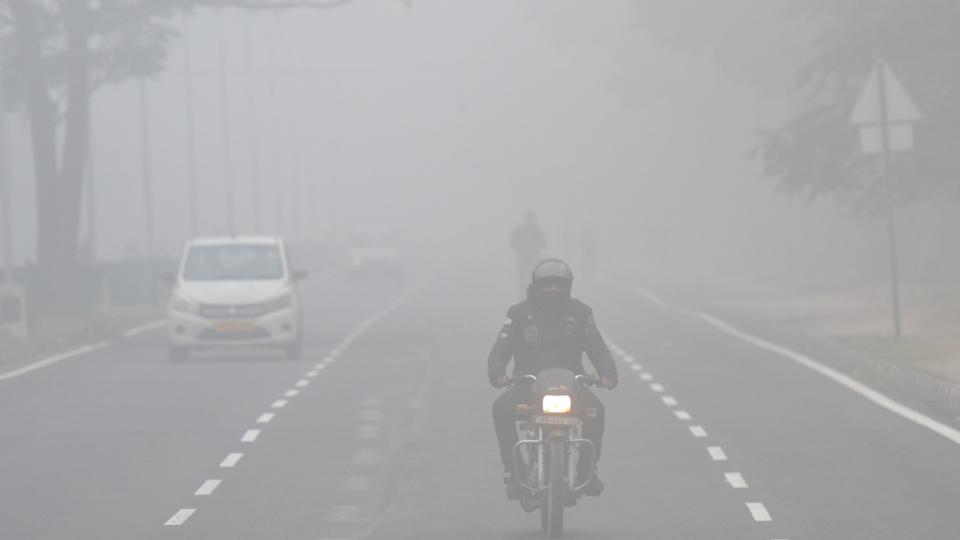
This was the first dense fog of the season and similar conditions will continue in the coming days as well, according to the India Meteorological Department (IMD).
At 15.3°C, the maximum temperature was also the lowest so far this season and six degrees below normal. It had gone down lower only on January 24 earlier this year, when it was recorded at 14.5°C.
Friday was also the first “cold day” of the season. A cold day is defined by IMD as a day when the minimum temperature goes below 10°C and maximum temperature falls 4.5°C to 6.4°C below normal.
Speaking about this, IMD Chandigarh director Manmohan Singh said, “Earlier a western disturbance was keeping the city warm, but as it has passed, the temperature is now going down. Mercury can drop further by 2-3 degrees in the coming days, when moderate to dense fog is also expected.”
Yellow alert for cold wave
IMD has also sounded a yellow alert for chances of cold wave on Saturday and Sunday. The second of the four-level alert system used by IMD, yellow alert is used to ask people to “be updated”.
A cold wave occurs in the plains when the minimum temperature is 10°C or below and/or is 4.5 notches lesser than the season’s normal for two consecutive days. Cold wave is also declared when the minimum temperature is less than 4°C in the plains.
Over the next three days, the maximum temperature is likely to rise to 20°C, while the minimum temperature will remain around 5°C.
Air quality deteriorates
The Air Quality Index (AQI) of the city also remained between 200 and 300 for most part of the day and went up to 302 at 6pm at the Continuous Ambient Air Quality Monitoring Station (CAAQMS) in Sector 22.
Between 300-400, AQI is described as “very poor” and can cause respiratory illnesses on prolonged exposure. Between 200-300, it is classified as “poor” and can cause breathing discomfort in most people on prolonged exposure. Meanwhile, AQI stayed between 100-200 at the Sector 25 station, which is described as “moderate”.
“The main reason for this increase is the change in weather conditions. Fall in temperature leads to temperature inversion and causes AQI to rise. Further, fog also increases AQI, as seen on Thursday,” said Debendra Dalai, secretary of the Chandigarh Pollution Control Committee.
As per IMD, there are chances of light rain in the city around December 24, following which the air quality is expected to improve.
Delay at source cities affects departure of nine flights
Due to delayed departure from their source cities amid unfavourable weather, nine flights left and arrived late at the Chandigarh International Airport, where visibility was within permissible limits on Friday.
Air India Express’ Sharjah flight arrived at 5.05pm against the scheduled time of 4.45pm. The airline’s airport manager said the flight left Sharjah late at 12.39pm against the scheduled departure of 12pm. Therefore, it also took off late by 1 hour from Chandigarh.
Due to fog in Delhi, the arrival of three domestic flights here was also affected.
Besides, Indigo’s Jaipur flight left after a delay of 47 minutes, Go First’s flight to Srinagar departed late by 30 minutes, while Indigo’s to Ahmedabad, Go First’s to Ahmedabad and Vistara’s to Delhi were delayed by 15 minutes each.


