
 E-Paper



Chandigarh MC to propose citywide monthly parking pass at ₹500
Currently, MC issues around 5,000 parking passes every month at ₹420 each, but those are valid only for a single parking lot. As per MC’s estimates, nearly five lakh four-wheelers and one lakh two-wheelers use paid-parking facilities across the city each month


In a move aimed at easing parking woes and boosting civic revenue, the Chandigarh municipal corporation (MC) is set to table a proposal for a citywide monthly car parking pass priced at ₹500, and two-wheeler parking pass at ₹250 in its General House meeting today (Tuesday).
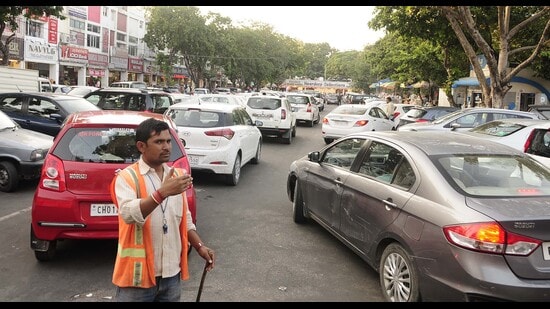
The proposed pass, valid across all 89 paid parking sites under the MC’s jurisdiction, would allow unlimited entries and exits, offering a convenient and cost-effective option for regular car users. At present, the civic body charges ₹14 per entry for four-wheelers and ₹7 for two-wheelers.
Currently, MC issues around 5,000 parking passes every month at ₹420 each, but those are valid only for a single parking lot. As per MC’s estimates, nearly five lakh four-wheelers and one lakh two-wheelers use paid-parking facilities across the city each month. Officials say that even if 50,000 commuters opt for the new pass, the civic body could earn ₹30 crore annually — a significant jump from the current profit of ₹50–80 lakh per month. The overall target is to raise at least ₹50 crore annually from the parking project.
MC commissioner Amit Kumar had earlier directed that public opinion be sought on the plan through a questionnaire floated on social media. According to officials, nearly 70% of respondents supported the proposal, leading to its placement before the House for approval. If approved, the scheme will remain in effect until the much-delayed smart parking project is implemented in Chandigarh. Conceived in August 2022, the smart parking project aimed to introduce a FASTag-enabled parking system across all 89 paid parking lots in Chandigarh. At present, attendants issue parking slips and collect payments manually.
Decision likely on fire Act
The MC will again table its proposal for adopting provisions of the ‘Haryana Fire Safety Act’ for Chandigarh, which, if approved, will lower the threshold for mandatory fire safety clearance from 15 metres to 9 metres. Currently, the Delhi Fire Prevention and Fire Safety Act, 1986, which mandates fire safety certificates (FSC) only for buildings taller than 15 metres (high-rises), is applicable in Chandigarh. However, MC officials pointed out that even the Delhi government has repealed this legislation and replaced it with the Delhi Fire Service Act, 2007.
Given Chandigarh’s unique character, with its many heritage buildings, the stringent provisions under the current Act have often resulted in non-compliance with fire safety norms. Recognising the need for a more tailored law, the civic body’s committee conducted a detailed review of fire safety legislation in neighbouring states, including Punjab and Haryana. After extensive deliberations and suggestions from committee members, the MC is now proposing to adopt the Haryana Fire and Emergency Service Act, 2022, (Extension to Chandigarh) Act, 2025.
Under the proposed Act, fire safety certificates or no-objection certificates (NOCs) will also be compulsory for all high-rise buildings—except residential buildings up to a height of 16.5 metres—and for special buildings such as hotels, business centres, mercantile buildings, industrial units, storage facilities, hazardous buildings, and mixed-occupancy structures with a floor area exceeding 200 square metres on any one or more floors. Additionally, educational and institutional buildings taller than 9 metres, all assembly buildings with an incidental assembly area exceeding 300 square metres on any floor, and buildings with two or more basements—or a single basement larger than 100 square metres—will require fire safety clearances, unless otherwise specifically exempted. At present, buildings with an area exceeding 500 square metres are mandated to get the NOCs. Also, to ensure strict compliance with the proposed law, violations could attract penalties, including imprisonment for up to three months, a fine of up to ₹50,000, or both.


