
 E-Paper



Revisit call to halt need-based changes policy: Kataria to CHB
The policy was put on hold after the Supreme Court, in an order dated January 10, 2023, prohibited the conversion of residential units into floor-wise apartments in Sectors 1 to 30, stating that these sectors carried the heritage status of Le Corbusier zone

 Prefer HTon Google


Nearly three years after the need-based changes policy was put on hold in January 2023, UT administrator Gulab Chand Kataria has directed the Chandigarh Housing Board (CHB) to review its decision and explore ways to operationalise the policy.
The need-based changes policy was first announced on March 23, 2010, followed by subsequent notifications on July 7, 2015; February 18, 2016; February 15, 2019; and finally on January 3, 2023.
However, the policy was put on hold after the Supreme Court, in an order dated January 10, 2023, prohibited the conversion of residential units into floor-wise apartments in Sectors 1 to 30, stating that these sectors carried the heritage status of Le Corbusier zone.
The court had also ordered a freeze on increase in floor area ratio (FAR) in the northern sectors and restricted the number of floors in the area to three.
Further, the apex court had said the Chandigarh Heritage Conservation Committee will consider the issue of redensification in these sectors. After that the UT administration will consider amending the Chandigarh Master Plan-2031 and the 2017 apartment rules in accordance with the recommendations of the committee.
Over the past four decades, CHB has constructed around 68,000 flats under various categories, including those for economically weaker section (EWS), lower income group (LIG), middle income group (MIG) and higher income group (HIG).
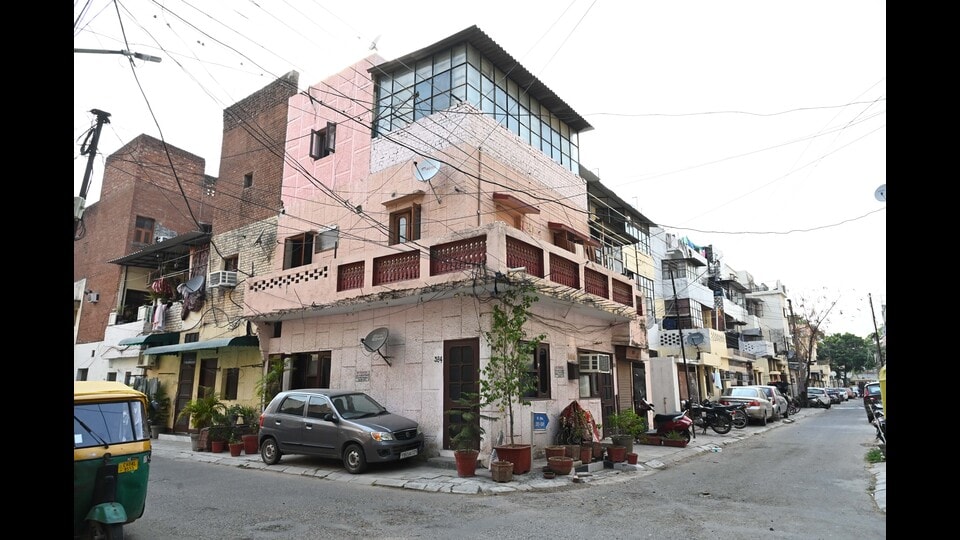
Most of these flats exhibit some form of violation, including additional rooms and toilets, conversion of balconies into rooms, covering of courtyards and even construction of stairs on government land.
In the absence of a need-based changes policy, the board has not legalised any alterations.
During a meeting held last week, Kataria instructed CHB officials to consider ways to make the policy operational in light of the Supreme Court’s directions.
A senior CHB official said that following the administrator’s directive, UT chief secretary H Rajesh Prasad was expected to convene a review meeting soon. “The administrator has emphasised that implementing the policy will bring relief to thousands of CHB allottees,” the official added.
Meanwhile, Nirmal Dutt, chairman of the CHB Residents’ Federation, said even if the 2023 policy was brought back, it may not adequately address allottees’ issues. “As per the board’s own records, more than 90% flats have violations. Since these deviations do not follow any architectural pattern, we request a one-time solution on the lines of the 1999 Delhi policy, which has now been implemented in seven states,” he said.
What’s allowed in the 2023 policy
Internal changes in dwelling units, only if certified to be structurally safe and in line with Chandigarh Building Rules, 2017
One additional door, subject to structural stability certificate. The door should not open onto public space, right berm/pavement, outside the plotted area, open/green space or reserved area
Additional coverage was increased from 50% to 75%, subject to maximum of 150 square feet
Additional construction should be only to the extent provided for in the type-wise drawings available on CHB website
Additional windows were allowed in end walls of dwelling units, only as per sizes and locations indicated in two dimensional drawings posted on CHB’s website
All changes should be within the building boundary and skyline, without any increase in the total covered area
No prior written consent needed from all adjacent allottees for making internal changes in a house, additional door, facade painting or construction of elevators, but additional construction will require mutual consent of the allottees of the adjoining floor abutting the additional construction.
What’s not allowed
Any structural change to the building’s facade
Constructions that block light and ventilation
Additional floors
Extension of kitchen
Creation of additional balconies
Cantilever projections on government land
Construction of balcony/stairs/toilets on such projected cantilevers.


