
 E-Paper



Chandigarh’s air quality turns ‘severe’ again
Even on Lohri night, the average AQI at 9 pm had spiked to 430 at the CAAQMS in Sector 53, followed by 423 at the Sector 22 CAAQMS, both in the “severe” category; the AQI at the Sector 25 CAAQMS was 330, considered “very poor”


The city’s Air Quality Index (AQI) plunged back into the “severe” category on Saturday after similar conditions on Lohri night.
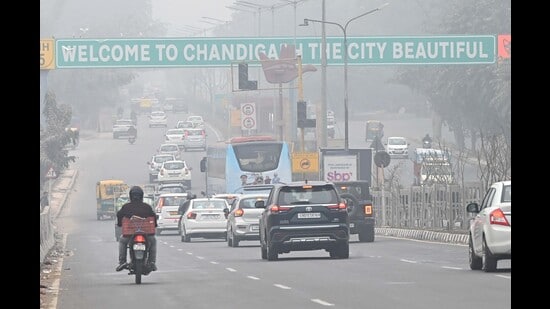
The city’s air quality was even worse than some of Delhi’s stations.
The average AQI at 7 pm reached 401 at the Continuous Ambient Air Quality Monitoring Station (CAAQMS) in Sector 53, categorised as “severe” (401-500). Additionally, the AQI at the Sector 22 CAAQMS was 399, and 321 at the Sector 25 CAAQMS, both classified as “very poor” (301-400).
On Lohri night, the average AQI at 9 pm had spiked to 430 at the CAAQMS in Sector 53, followed by 423 at the Sector 22 CAAQMS, both in the “severe” category. The AQI at the Sector 25 CAAQMS was 330, considered “very poor”.
No rain behind rise in pollutants
India Meteorological Department (IMD) officials said in previous years, rain during the second week of January had contributed to improving air quality. However, this season, no rain has been recorded since December 1.
According to IMD, with no anticipated rain in the upcoming days and persistent foggy weather, the air quality of Chandigarh, which typically fares better than Delhi, is expected to remain on the poorer side.
On Saturday, Punjabi Bagh in Delhi reported an average AQI of 351. Dwarka recorded an index of 355 and Okhla 340, all better than most of Chandigarh.
Even in Panchkula, the AQI stood at 280 at the Haryana State Pollution Control Board station in Sector 6, categorised as “poor” (201-300).
IMD has issued an orange alert for Chandigarh, Punjab and Haryana, indicating the likelihood of dense to very dense fog and cold day to severe cold day conditions at a few places, following a red alert on Saturday.
On Saturday, cold day conditions persisted, with the maximum temperature rising slightly to 14.1°C, compared to Friday’s 12.6°C, but was still four degrees below normal. The minimum temperature also increased from 8.5°C to 9.7°C on Saturday, surpassing the normal range by two degrees.
Take steps to improve air quality: Pollution panel to Chandigarh MC
Taking note of the air quality remaining “very poor” for several days, the Chandigarh Pollution Control Committee (CPCC) has written to the municipal corporation (MC) to take steps to limit pollutants in the air.
As a result, the civic body has decided to stop construction of roads and other buildings in the city. Besides, it will double water sprinkling on the roadsides to prevent dust suspension.
In its letter to MC, the committee said there was no meteorological forecast for any relief from the “very poor” air quality. Hence, steps should be taken to improve the air quality.
CPCC had asked MC to intensify water sprinkling, and stop open burning using firewood or coal, and all construction activities. The committee had also asked the civic body to increase frequency of mechanised road cleaning, cover carriage of construction material and municipal solid waste, and strictly enforce proper disposal of construction and demolition waste.
It was also asked to recognise roads with high dust generation, so that mechanised cleaning and water sprinkling can be ensured. Also, strict vigilance of the Dadumajra dumping ground should be ensured.
Municipal commissioner Anindita Mitra said, “We are committed to taking all steps to improve air quality. Therefore, we will double water sprinkling on roadsides. Apart from that, no major construction activities by MC are going on.”


