
 E-Paper



Explainer: A closer look at newly laid creamy layer criteria for BCs
Social sector experts believe the exclusion of salary and income from agricultural land for determining gross annual income may make the entire exercise a farce as many deserving candidates may have to compete with those who have more resources and thus more opportunities.


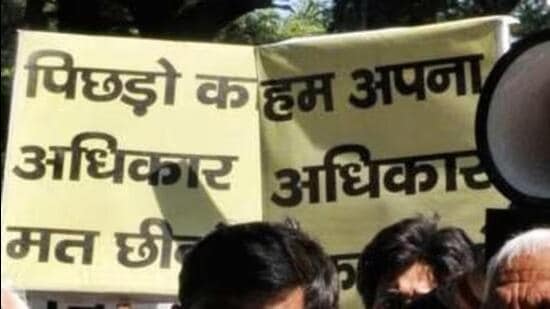
With an eye on the upcoming assembly polls, the BJP government in Haryana on Tuesday notified fresh criteria for identifying persons in the creamy layer among the backward classes (BCs) for the purpose of reservation in public employment and educational institutions. Hitender Rao takes a closer look at the newly laid criteria aimed at wooing about 33% BCs and its import.
What is the creamy layer in terms of reservation for BCs?
Creamy layer means a class of persons within the BCs who are socially and economically advanced and are excluded from the benefit of reservation in government jobs and admission to educational institutions.
How is the creamy layer among the BCs identified?
As per the Haryana Backward Classes (Reservation in Services and Admission in Educational Institutions) Act 2016, the government will have to take into consideration social, economic and factors deemed appropriate to specify the criteria for exclusion and identification of creamy layer among the BCs every three years. This was also upheld by the Supreme Court.
What is the newly notified creamy layer criteria?
The fresh income and wealth criteria stipulated that children whose parent’s gross annual income is ₹8 lakh or more or who possess wealth above the exemption limit prescribed in the Wealth Tax Act, 1957 for three successive years would be disentitled for BC reservation. More importantly, the new criteria is generous as it bars clubbing of income from salaries or agricultural land for arriving at the gross annual income. The new criteria is modelled on the lines of central government norms.
How is the 2021 creamy layer criteria different from the 2024?
The 2021 criteria stipulated that children whose parents have a gross annual income of ₹6 lakh or more or who possessed wealth above ₹1 crore for the last three consecutive years would be disentitled for BC reservation. To make it stringent, it also stipulated that income from all sources will be clubbed to arrive at the gross annual income.
Will officials of a certain rank or level be considered a part of creamy layer?
Children of direct recruits in class I and II/groups A and B of all India central and state services will not be eligible for the benefit of reservation. However, they will be entitled to reservation if either of their parents dies or suffers permanent incapacitation subject to conditions. Also, a woman belonging to the BC category who gets married to a class I officer will be entitled to reservation. Children of armed forces and paramilitary personnel in the rank of Colonel and above in the Army and equivalent posts in the Air Force, Navy, and paramilitary forces will be disentitled for reservation.
What about those holding constitutional posts?
Children of persons holding constitutional posts—high court, Supreme Court judges, members of Public Service Commissions, etc.—will be considered in the creamy layer. However, compared to the 2021 criteria, the new criteria do not mention members of parliament (MP) and members of the legislative assembly (MLA) in the exclusions.
What about those in public, private sector jobs and professionals?
Persons working in public sector undertakings holding posts comparable to class I and II officials in banks, insurance organisations and universities; similar positions in the private sector, professionals like doctors, lawyers, sportspersons, media persons, etc. will be excluded from the benefit of reservation subject to the income and wealth criteria.
What about those having farmland or property in urban areas?
Families owning irrigated land equal to or more than 85% of the statutory area or both irrigated and unirrigated land subject to conditions will be excluded from the reservation. The rule of exclusion will not apply if the land holding is exclusively unirrigated. For those owning property in urban areas, the income and wealth criteria will be applicable to determine the creamy layer.
What are likely implications of the watered-down criteria?
Social sector experts are of the view that the exclusion of salary and income from agricultural land for determining the gross annual income may make the entire exercise a farce as many deserving candidates may have to compete with those who have more resources and thus more opportunities. They say that it could open floodgates and deserving BCs may suffer.
The Supreme Court in its landmark Indira Sawhney judgement had also held that those holding higher levels of agricultural holdings or getting income from property beyond a limit have to be excluded from the BCs.


