E-Paper



Faced with swords, Chandigarh police use drones to drop tear gas shells
After initially trying to break through the barricades, a few protesters reached the spot with swords around 2pm. It was then that the Chandigarh police were forced to make use of their new arsenal – the drone carrying tear gas.

 Prefer HTon Google


Having learnt it the hard way, the Chandigarh police upped its ante during Qaumi Insaaf Morcha’s march to the city on Independence Day, deploying a drone capable of dropping tear gas shells to control the mob.
The Morcha’s previous protests in the city have largely ended in violence, leaving multiple police personnel injured.
On Saturday as the protesters reached the YPS Chowk to enter the city – to further march towards the governor’s residence – they were met with a three-layer barricading. After initially trying to break through the barricades – some were seen tying the barricades to tractors and pulling these away – a few protesters reached the spot with swords around 2pm. It was then that the Chandigarh police were forced to make use of their new arsenal – the drone carrying tear gas.
Chandigarh police claim they are only the second police force in the country to have used this technology to control protesters. The first instance was in Haryana during the farmers’ protest along the Shambhu border in February 2024. “In fact, we got the idea to use drones from the Haryana protests,” revealed UT senior superintendent of police (SSP) Kanwardeep Kaur.
“But we will only be deploying these only in exceptional cases where there is a risk of injury to personnel,” said UT inspector general of police (IGP) Pushpendra Kumar. At least eight police personnel were injured due to stone-pelting by the mob during Saturday’s protest.
How it works
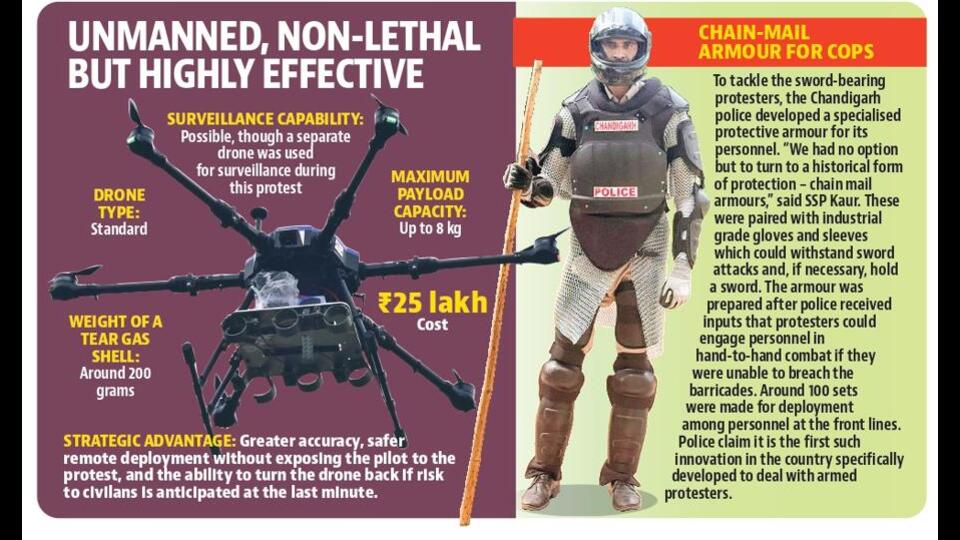
Senior police officials explained that the drone used during the I-Day protests was capable of carrying a payload of up to 7-8 kg. A tear gas grenade weighs around 200 grams.
“A special clamp is fitted to the drone to hold the shell. Before loading the tear gas shell, its pin is pulled. It works on the same principle as a hand grenade, and the shell remains secure as long as the clamp holds it. After the clamp is released, the shell has about four seconds before it bursts,” said an official.
A drone operator remains positioned at a safe vantage point, away from the crowds but with a clear view of the site.
The IGP said drones allow greater accuracy in the deployment of tear gas shells. “We also have the option of turning back the drone if we feel civilians may be harmed,” he said, adding that remote deployment also makes it safer for the police as it also does away with factors such as opposing wind direction which may backfire for the personnel hurling it.
In all, 100 tear gas shells were used during Saturday’s protest, most of these hurled by hand.
Besides the drone used for launching the tear gas shells, police also used one for surveillance and another for mobile announcements. The mobile announcement drone was flown to the protesters to communicate and negotiate with them.