
 E-Paper



Five new wheat varieties developed by IIWBR- Karnal get ICAR recommendation
The scientists at the ICAR-Indian Institute of Wheat and Barley Research (IIWBR) have claimed that the varieties are climate resilient and have a yielding capacity of up to 75 quintals per hectare


: The scientists at the wheat and barley research institute in Karnal have developed five new high-yielding varieties of wheat which have been approved by the Indian Council of Agricultural Research (ICAR) and would be made available to farmers from the coming sowing season in October.
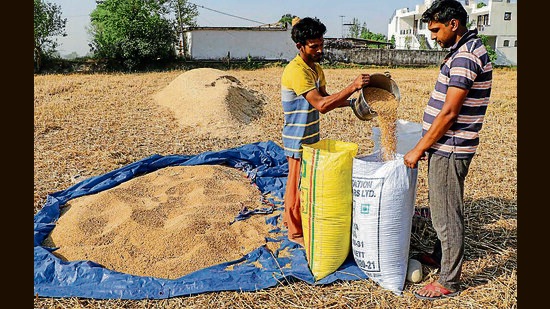
The scientists at the ICAR-Indian Institute of Wheat and Barley Research (IIWBR) have claimed that the varieties are climate resilient and have a yielding capacity of up to 75 quintals per hectare, helping the farmers to reap 5-10 quintals more than the average produce of 20-22 quintals per acre.
These new varieties, which have been named as DBW-316, DBW-55 (d), DBW-370, DBW-371 and DBW-372, have been approved by the varietal identification committee of wheat and barley of the Indian Council of Agricultural Research (ICAR).
Director ICAR- IIWBR Gyanendra Pratap Singh, who is also member secretary of the varietal identification committee meeting, said these new five varieties will help to increase the income of farmers as all the varieties are high yielding and the seed will be made available to farmers from the coming sowing season beginning in October.
Three varieties, including DBW-370, DBW-371 and DBW-372, have been considered based on yield superiority and high yield potential. These varieties have been recommended for early sowing as these varieties have a yield capacity of 75 quintals.
While the DBW-316- a lateral variety has been identified based on its superior quality and it has been recommended for north-eastern plains zone (NEPZ)- Eastern Uttar Pradesh, Orissa, West Bengal, Bihar and Jharkhand.
Similarly, DBW -55 (D) has been identified based on its yield advantage and resistance to black and brown rusts. Even, earlier developed DBW-303 variety has been recommended for area extension in Madhya Pradesh, Gujarat, Rajasthan, Chhattisgarh.
The officials associated with the research said that out of the total 27 wheat varieties proposals submitted for identification and area extension by the different research institutes of the country, 22 new wheat varieties have been identified and recommended during the annual meeting of the All-India Coordinated Research Project (AICRP) on wheat and barley held from August 29 to 31 in Gwalior.
On what steps are being taken to protect the farmers from losses as last year the wheat yield declined to 30 to 50 per cent due to unfavourable weather conditions and early heat-wave due to climate change, Singh said, “for the past couple of years, the scientists were working on it as out of total 22 recommended varieties, 10 are climate resilient. Even last year, these weather resilient and high-yielding varieties helped to counter the yield loss as the total production came down to only 2 million tonnes against 109.6 million tonnes than the previous year”.


