
 E-Paper



Grow veggies at home, PAU introduces compact kitchen garden in Ludhiana
The target audience for the kitchen garden model were those who were short on space and still wanted to grow their own organic vegetables


Building on the rising trend of use of organic vegetables by masses, Punjab Agricultural University (PAU) has come up with a compact kitchen garden model of 6 m by 6 m dimensions.
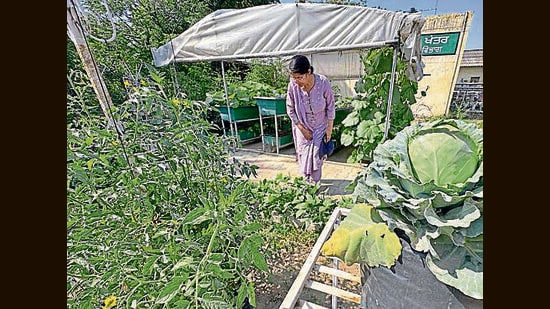
Departement of vegetable sciences assistant professor Dr Ruma Devi said the garden was aimed primarily at those who were short on space and still wanted to grow their own vegetables.
The garden can provide around 1 kg of vegetables per day, which is in lines with the recommended quantity of 250 gm for an individual, added Devi.
Devi said the objective was to make sure that most of the vegetable needs of a nuclear family could be met with the model. She emphasised that only vegetables like potatoes and onions which are grown in bigger piece of lands, couldn’t be effectively grown in this model.
The model could be used to grow 27 varieties of vegetables. The land is divided into 12 beds and vegetables could be grown in beds measuring 3 m, 2 m and 1 m, depending on the plant. The arrangement could also be altered as per the requirements and availability of space, she added.
Besides this, the department has also developed a terrace kitchen garden. It uses big pots adjusted on grills to protect the roof while producing around 230 to 240 kg of vegetables in a year. Devi said, “It’s very important that these pots be kept on the grills, as to maintain a gap between them and the roof surface to ensure that the roof is not damaged.” The models were a success as we sell the seed kits worth lakhs every year,” she added.
PAU calls upon farmers to grow mung bean this summer
To promote crop diversification in the state, Punjab Agricultural University (PAU) has developed short-duration improved varieties of mung bean for summers.
Vice-chancellor Satbir Singh Gosal said, “Pulses are the best option for crop diversification in the state as they improve soil health and are rich sources of protein. Mung bean could be successfully grown as an additional catch crop after potato and wheat under assured irrigation facilities.”
V-C added the varsity aims to popularise pulse production in Indo-Gangetic plains, while urging the farmers to grow variety SML 1827 as it provides high yield. Also, it is more resistant to yellow mosaic disease.
Seeds associate director Rajinder Singh, said PAU has developed a high-yielding and short-duration mung variety SML 1827 with an average yield of 5 quintals per acre and is resistant to yellow mosaic disease. It has an erect plant type with medium stature. It bears pods in clusters and has synchronous maturity in about 62 days. Each pod contains about 10 seeds. Grains are shining green, medium-sized with good culinary properties,” he added.
The seed of SML 1827 is available at various Krishi Vigyan Kendras, Farm Advisory Service Centres, Regional Research Stations and PAU’s seed farms.


