
 E-Paper



Half way into May, Chandigarh tricity’s Covid cases already higher than March, April
While advising residents to exercise caution, health experts say the rising cases may not be another pandemic wave but a seasonal fluctuation

 Prefer HTon Google


Amid fluctuations in tricity’s daily Covid-19 cases, the infection tally in May so far has already surpassed that in March and April.

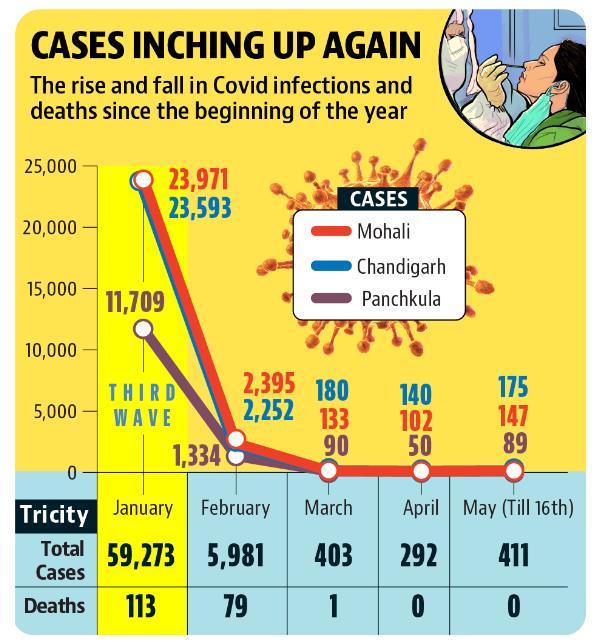
Only half way through May, tricity’s Covid infections have shot up to 411, a 40% spike from the 292 cases in April and also higher than 403 cases in March.
In March, 180 cases were reported in Chandigarh, followed by 133 in Mohali and 90 in Panchkula. Subsequently, in April, the figures had dipped to 140 in Chandigarh, 102 in Mohali and 50 in Panchkula, before climbing again in May.
But even as the cases have shown an uptick this month, health experts across the tricity believe that their number is still significantly low as compared to the surge in January this year, when the tricity was hit by the pandemic’s third wave.
Rising number of cases in May might not be another pandemic wave, but a seasonal fluctuation, the health experts say.
So far in May, Chandigarh has been the worst-hit with 175 cases in just 16 days, followed by 147 cases in Mohali and 89 in Panchkula.
In a breather, no Covid-related death has been reported in the tricity after March. The last fatality was reported by Mohali on March 2.
‘Cases fluctuating, can again rise in June’
Dr PVM Lakshmi, professor of epidemiology, PGIMER, said, “Though cases are inching up, there is a fluctuation in the daily numbers and no constant spike has been witnessed. So, the uptick cannot be termed a wave, but can be considered a seasonal rise, primarily due to lifting of pandemic-related restrictions. However, if we go by previous experiences, Covid cases peak after every six months, as community’s immunity gets low and new variants start transmitting. If the rising trend remains steady or new variants become dominant in India, another wave will be witnessed in June or July.”
Dr Suman Singh, director, health services, Chandigarh, also said, “Currently, patients infected with Covid have minor flu-like symptoms, primarily due to the wide vaccination coverage among adults, which helped in reducing the severity of the infection. People must get vaccinated at the earliest and also get the booster dose when eligible, as it will improve their immunity to fight the infection.”
In Mohali, civil surgeon Dr Adarshpal Kaur said though cases were on the rise even in the district, the situation was not alarming. “But with no restrictions on travel, the spike in cases in Delhi has resulted in more cases in Mohali as well,” she said.
Panchkula civil surgeon Dr Mukta Kumar said despite the increase in cases, the hospitalisations in the district were zero. “As the infection is not as severe as experienced in the past waves, people are able to recover at home. But the virus is unpredictable, so we must remain alert. People must adhere to Covid-appropriate behaviour in public.”
Few takers for booster dose in Chandigarh
Even though Chandigarh is witnessing the biggest spike in cases in the tricity, not many adults in the city are coming forward for the precautionary third dose of vaccine.
So far, only 44,295 adults, including healthcare workers, frontline workers, have taken the third dose, significantly lower that the city’s 8.43-lakh adult population.
Chandigarh had fully vaccinated all eligible people in August last year.
Among the younger beneficiaries, in the 12-15 age group category, the target population is 45,000 children and 31,466 (70%) have gotten the first dose, while those fully vaccinated are only 8,212 (19%).
Vaccination coverage is much better in the 15-18 age group, where of the 72,000 eligible children, 72,659 (101%) have taken the first dose and 44,582 (62%) have been completely immunised.
Six new cases detected
Tricity’s daily cases dropped to single digit on Monday, amid low testing over the weekend.
A total of six people were found infected, out of the 765 sampled in the tricity, relatively lower than over 2,500 tests conducted daily. The daily cases had remained over 10 for the past 26 days, even crossing 30 seven times.
Mohali reported three cases, Panchkula two and Chandigarh one. With this, tricity’s active cases dropped from 182 to 168 in the past 24 hours. Now, 79 people are recovering in the UT, 64 in Mohali and 25 in Panchkula.


