
 E-Paper



Haryana assembly passes bill to regularise unauthorised industrial units
Speaking on the Bill, Congress MLA from Kaithal, Aditya Surjewala, said the government wants to use a residential Act for industrial use


The Haryana assembly on Monday passed Haryana Management of Civic Amenities and Infrastructure Deficient Areas outside Municipal Area (Special provision) amendment Bill 2025 for regularisation of unauthorized industrial establishments in the state.
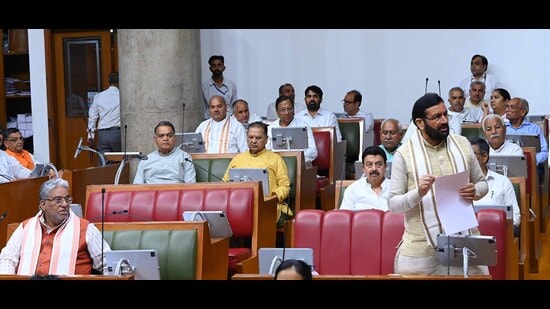
Speaking on the Bill, Congress MLA from Kaithal, Aditya Surjewala, said the government wants to use a residential Act for industrial use. “In the original Bill, the government had excluded the industrial areas because industries have to be regulated separately as compared to residential colonies. However, this Bill removes this exclusion and Section 6A is being introduced,’’ the Congress MLA said.
Surjewala said that the definition of enterprise as per the amendment Bill included manufacturing and processing, which meant that a chemical plant or a heavy industry can be regularised. “There are no environment safeguards in the Bill and it does not provide for environment impact assessment to assess the air pollution, water contamination and hazardous waste originating from the industrial units. Just by doing self-certification on a web portal, an applicant can tear apart the environmental laws with full immunity from the government,’’ the Congress MLA said.
He argued that the amendment Bill was discriminatory as those entrepreneurs who went by the book and followed proper procedure – purchased an industrial plot, took all the relevant approvals for setting up an industrial unit, paid fees etc, would feel frustrated. “But those who flouted rules and ran illegal industrial units will get amnesty. This sends a wrong message to the business community – that operates an industrial unit illegally and then applies for regularization. The moment one presses the submit button on the web portal all the punitive actions will be suspended. A legislation which was enacted for residential areas cannot be used for legitimising industrial lawlessness. We cannot put at stake public health, environmental safety and rule of law for misguided business promotion,’’ Surjewala said.
The first-time MLA demanded that regulatory safeguard in the Bill should be incorporated and it should be sent to a select committee of the assembly.
Congress MLA from Jhajjar, Geeta Bhukkal, said that it would have been better if the government had stopped the mushrooming of unauthorised industrial colonies at first. “How far these industrial units should be away from the municipal areas and what kind of industries would be regularised,’’ Bhukkal asked.
Urban local bodies minister, Vipul Goel, however, said that the criticism of the amendment Bill by the Congress MLAs was unwarranted as the government was only regularising those units which were unauthorisedly allowed during the Congress rule. “These are the seeds sown by you which we are trying to regularise. They played with the lives of lakhs of people. They were the ones who had allowed these units to come up. We are only trying to regularise them,’’ Goel said.
The minister also clarified that the government was only inviting applications initially. “A scrutiny will be done with regards to various aspects. The pollution norms will not be overlooked,’’ the minister assured the House.
The Congress benches protested over Goel’s remarks with Bhukkal stating that it is the BJP which has been in power in the state for 10 years “So who has sown these seeds,’’ Bhukkal said. Goel then said that everyone has a right to express his views but no one can intimidate him.
The amendment Bill says that in case of regularisation of unauthorised industrial establishment, an online portal for receiving applications from entrepreneur or enterprise shall be created and all punitive action initiated against the applicants shall be deemed to have been suspended from the date of submission of the application on the portal until the government takes a final decision, except in cases forwarded to or pending before any court of law.
As per the statement of objects and reasons of the Bill, the Haryana Management of Civic Amenities and Infrastructure Deficient Areas outside Municipal Area (Special provision) Act, 2021, was enacted with an objective to provide essential services in the civic amenities deficient areas situated outside the municipal areas of the state. The object of the said enactment was to improve the living conditions of the inhabitants of Haryana. A total of 684 unauthorised residential colonies were considered for regularisation. The CM in his 2025-26 budget speech made an announcement for regularisation of unauthorised industrial colonies. “It has been stated that in the last ten year about 2,145 unauthorised residential colonies have been regularised. Now, the time has come that we should pay attention to the unauthorised industrial colonies in the same way. Therefore, we have decided that if at least 50 entrepreneurs, whose units are located on at least 10 acres of contiguous land, collectively apply on a portal, then all such industrial units will be considered as legal industrial units by all department till the government takes a final decision on the application of the group,” the CM had announced. Accordingly, the state government wants to pay attention to the unauthorised industrial establishments developed in the state, so that the basic civic amenities and infrastructure could be provided to these establishments. On humanitarian grounds, it is the primary objective of the government to provide minimum infrastructure to ensure the healthy environment in such areas, said the objectives of the Bill.
Two more bills passed
The Haryana assembly also passed the Haryana Backward Classes Commission (amendment) Bill, 2025, and Haryana Legislative Assembly (Salary, Allowances and Pension of Members) amendment Bill, 2025.
The Haryana Backward Classes Commission (amendment) Bill was tabled in the House with an objective to expand the scope of functions of the commission which required substantial amendments to strengthen it in discharge of its functions to safeguards the interest of the Backward Classes (BCs).
The amendment Bill proposed that the commission will have the power to investigate and examine the working of various safeguards provided in the Constitution or under any other law or any order of the state government for the welfare and protection of the BCs. As of now the Commission is mandated only to examine the request for inclusion or exclusion of any class of citizens as a backward class and hear complaints of over-inclusion or under- inclusion of any BC and tender such advice to the state government as it deems appropriate.
The proposed amendment will also empower the commission to enquire into specific complaints with respect to the deprivation of the rights and safeguards of the BCs and to take up such matter with the appropriate authorities, to participate and advice on the planning process of socio-economic development of the BCs and to evaluate the progress of their development and to make recommendations for the effective implementation of safeguards, welfare and socio-economic development of the BCs.
The amendment Bill also proposed a provision to protect chairman, members, officials of the commission against any suit, persecution or other legal proceedings for anything done by them in good faith or intended to be done under the Haryana Backward Classes Commission Act, 2016.
The House also passed the Haryana Legislative Assembly (Salary, Allowances and Pension of Members) amendment Bill, 2025. As per the statement of objects and reasons of the Bill, MLAs are entitled to a special travelling allowance not exceeding ₹10,000 per month that would make the sum of monthly pension, dearness relief and the said amount equal to ₹1 lakh for journey by himself or his family members anywhere in India. During the recent past, various members have individually and collectively approached the speaker and stated that the existing provision does not adequately reflect the current inflationary trends and suggested that the cap of ₹1 lakh be removed and special travelling allowances of a maximum of ₹10,000 per month be retained.


