
 E-Paper



Haryana’s sex ratio at birth touches 5-year low, shows data
Officials say 906 girls were born per 1,000 boys this year till September against 915 in the corresponding period in 2020; this is the first time that the sex ratio at birth has dropped by nine points after the launch of the ‘Beti Bachao, Beti Padhao’ programme in 2015


Haryana has registered an alarming dip in the sex ratio at birth as per the data collated between January and September. The figures recorded are the lowest since 2016.

Officials say 906 girls were born per 1,000 boys this year till September. This is the first time that the sex ratio at birth (SRB) has dropped by nine points after the launch of the ‘Beti Bachao, Beti Padhao’ programme in 2015.
The cumulative SRB up to September 2015 was 868 and it rose to 911 in 2016-17 during the first nine months. In 2018, the SRB came down to 909 (Jan-Sept cycle) and rose to 919 in first nine months of 2019. The cumulative SRB of Haryana in September last year was 915.
The dip in the SRB, considered to be a critical indicator of gender equality, has set the alarm bells ringing in the state government, which has swung into action to keep the flagship programme firmly on track.
Officials monitoring the programme say a series of meetings were held last week, after the SRB data was finalised, and instructions were issued to the concerned authorities to intensify surveillance and catch touts involved in gender determination to arrest this slide.
Additional principal secretary to the chief minister Dr Amit Kumar Agrawal says the latest dip “is a matter of grave concern.” He said one of the primary reasons for the dip could be “variation in data.”
The first signs of touts outwitting the government machinery and carrying out gender determination had emerged when the cumulative SRB till June 2021 had dipped to 911, from 920 in the corresponding period till June 2020.
“The issue is linked to Haryana’s reputation. Necessary directions have been issued to the concerned authorities to take strict action. Those violating the law and opting for illegal gender determination tests will not be spared,” Dr Agrawal said.
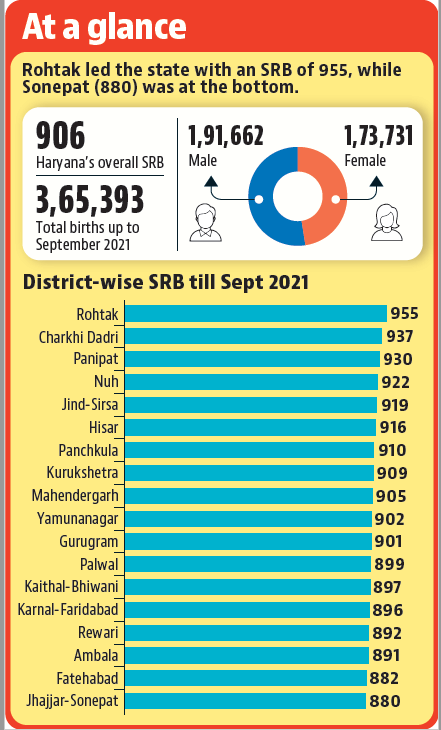
Rohtak leads, Sonepat lagging
Rohtak led the state with an SRB of 955, followed by Charkhi Dadri 937, Panipat 930, Nuh 922, Jind and Sirsa 919 each, Hisar 916, Panchkula 910, Kurukshetra 909, Mahendergarh 905, Yamunanagar 902, and Gurugram 901.
While the SRB of seven districts was between 916 and 955, the SRB of five districts ranged between 901 and 910. The SRB of 10 districts of 22 districts slipped below 900 against five districts during the same period last year.
There was a difference of 21,355 births (10,267 male and 11,088 female) registered till September this year as compared to the corresponding period last year. The total births registered till September last year were 3,86,748 (2,01,929 male, 1,84,819 female) against 3,65,393 (1,91,662 male, 1,73,731 female) this year during the same period.
The worst-performing 10 districts with the SRB hovering between 880 and 899 in the first nine months of 2021 are Palwal (899), Kaithal and Bhiwani (897), Karnal and Faridabad (896), Rewari (892), Ambala (891), Fatehabad (882), Jhajjar and Sonepat (880).
Dr Agarwal said that he has already held meetings to sensitise the departments involved in this programme. “I have personally spoken to deputy commissioners of the districts where this dip in the SRB has been registered,” Dr Agarwal said.
He urged the doctors of the Indian Medical Association (IMA) to not shield those violating the PNDT (Pre-Natal Diagnostic Techniques) Act and the MTP (Medical Termination of Pregnancy) Act.
Dip in annual SRB likely
Haryana had registered 922 female births per 1,000 males in 2020 despite the Covid pandemic posing challenges. The annual SRB was 923 in 2019, the highest Haryana had recorded in at least a decade.
From 833 in 2011, the annual SRB of the state had improved to 876 in 2015. It rose to 900 in 2016 and after remaining static at 914 in 2017 and 2018, it jumped to 923 in 2019.
“The latest SRB figures are disappointing. We may barely hit 915-916 annual SRB this year. This is a wake up call because districts such as Sonepat that were earlier performing well are slipping. We must fix the gaps fast. There are multiple factors behind this slide,” said a key expert involved in the programme, cautioning that it will be wrong to blame Covid pandemic for this dip in the SRB.
-kMNB-U1021018938041uE-250x250%40HT-Web.jpg)


