
 E-Paper



HC clears decks for Tribune Flyover in Chandigarh
High court vacates 2019 stay imposed on cutting of trees; allows Chandigarh administration to proceed with the project, but after addressing all environmental issues


Nearly eight years after the central government approved the Tribune flyover in 2016, work on the mega project is finally set to see the light of the day as the Punjab and Haryana high court has vacated the 2019 stay imposed on cutting of trees for the project.
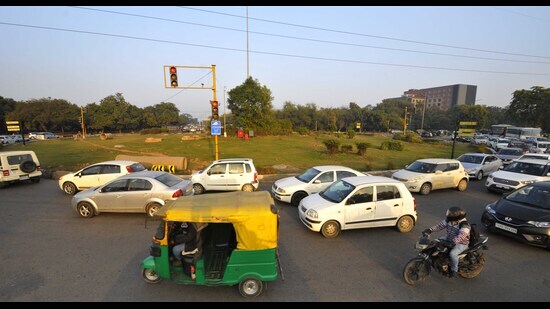
The 1.6 km-long flyover is to be built from near the GMCH-32 roundabout up to the railway overbridge on Dakshin Marg after passing over Tribune Chowk. Then UT administrator VP Singh Badnore had laid the foundation stone of the ₹137-crore project on March 3, 2019.
It was being touted as a solution to the traffic mess in the vicinity of the busy Tribune Chowk. More than 1.43 lakh vehicles, including 1.35 lakh passenger car units (PCUs) cross Tribune Chowk — the rotary on the intersection of Dakshin Marg and Purva Marg — on a daily basis, as per traffic projections quoted then.
Initially, the UT administration had planned a 7-km flyover, but the Centre reduced the length to 3.5 km. Later, the Union ministry of road transport and highways further reduced the length to 1.6 km.
However, on November 20, 2019, the high court had stayed cutting of trees, acting on the plea of a local NGO, The Run Club, that had challenged the UT administration’s proposal to cut trees for the project.
Over four years later, the HC bench of acting chief justice GS Sandhawalia and justice Lapita Banerji has now allowed UT to proceed with the project in the manner in which it deems fit, and whether to associate the earlier contractor or to call for fresh bids.
“The city was built up and conceptualised in 1950, and cannot continue to remain like that. Development as such is an ever going process...the town was planned for 5 lakh people. Today, we are dealing with the tricity, which is now bound by Panchkula, Mohali and New Chandigarh, having a population of over 15 lakh. The issue of access and travel to Chandigarh on account of being the capital of two states as such has to be taken into consideration,” the court held while rejecting arguments for preserving city’s original character.
It did add that all environmental issues that need to be redressed will be duly obtained and complied with before start of the project. “..the administration shall not rush forth to cut the trees till the project is finalised as such and the construction is liable to be started,” it said.
As per the proceedings, UT had secured permission for axing 472 trees. Exact details are yet to come in the public domain, but as per UT’s statement in 2020, in place of 2,700, now only 700 trees would be axed.
Infrastructure would ease the situation: HC
Rejecting the contention that the project will harm the city’s “original character”, the court remarked, “The authorities, as such, are planning Metro to ease the traffic situation. In such circumstances, we are of the considered opinion that the infrastructural projects, which will only ease the situation, are the need of the day, rather than fall back on the times not to use the vehicles....”
“The need as such is to ease the traffic in such situation, rather than to block the development. The stay…has taken Chandigarh back by a decade. In such circumstances, we are of the considered opinion that it has led not only to cost overruns but also ensured that the town has not progressed and developed which is the need of the hour,” the court said discussing problems due to traffic from Panchkula and Zirakpur.
It further recorded that traffic coming from Delhi/Dera Bassi into the city was held up for 90 minutes due to traffic jams.
Zirakpur with one lakh population has flourished due to high cost of living in Chandigarh and a large number of residents from there visit the city on a daily basis for various purposes. “Thus, all residents also flow continuously in and out of Chandigarh. The need as such is to ease the traffic in such situation rather than to block the development,” it said, while referring to an apex court judgment, which said courts should be reluctant in interfering with infra projects and contracts involving technical issues as there was a requirement of the necessary expertise to adjudicate upon such issues.
UT considered objections, but decided on flyover in 2020
As directed by the HC in November 2019 order, the administration had constituted a technical committee to examine various suggestions on alternatives to the flyover project submitted by the petitioners, and other city residents and groups. As many as seven models were submitted to the committee.
After scrutinising all models, the committee had termed the alternatives unviable. However, the flyover project remained held up due to the Covid-19 pandemic thereafter. On April 2, HC had asked the UT administration to apprise it whether it wanted to invite fresh bids or continue with the same contractor. As per UT, the contractor is willing to carry out the work at ₹137 crore as decided in 2019 against UT’s reserve price of ₹184 crore.


