
 E-Paper



Himachal: ₹1,400-crore project to restore Bilaspur’s submerged temples
Of the 28 temples, built between sixth and 17th centuries, that disappeared in Gobind Sagar when Bhakra-Nangal dam was built on the Sutlej, eight have withstood the test of time


The drive from Chandigarh to Manali on National Highway 21 in winter and spring opens up to a magnificent sight of dome-shaped, stone-built rooftops in the middle of Gobind Sagar down the valley near Bilaspur. When the water level recedes in summer, the edifices stand tall on the bare sandy lake bed, leaving passers-by spellbound with their beauty and grandeur before they disappear under water in monsoon.
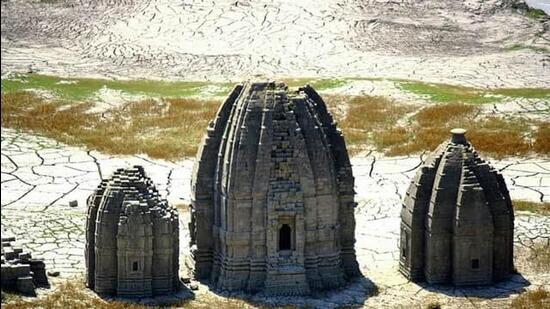
These structures are what is left of the 28 temples of old Bilaspur, built between the sixth and 17th centuries, that got submerged in the Gobind Sagar Lake and literally made way for the “temple of modern India”, as then Prime Minister Jawaharlal Nehru called the Bhakra-Nangal dam.
Of the 28 temples that disappeared in the deluge, eight have withstood the test of time and emerge out of the water every year.
The Himachal Pradesh government has envisaged a ₹1,400-crore project to conserve and relocate these temples.
The Himachal Pradesh Road and Infrastructure Development Corporation Ltd has conducted a pre-feasibility study and has engaged construction giant Larsen and Tourbo as the detailed project report (DPR) consultant.
Three temples to be restored in Phase 1
Sharing details, Bilaspur deputy commissioner Pankaj Rai says phase 1, for which a DPR of ₹105 crore has been prepared, envisages in situ restoration of three main temples of Ranganath, Khaneshwar and Nardeshwar.
Ranganath temple, comprises a group of five temples, that was once located at the heart of old Bilaspur. The primary temple is dedicated to Lord Shiva and Parvati, while the four other shrines are dedicated to Sati, Kali, Ganesh, Hanuman, Shitala Devi and Chhadol Rani.
Khaneshwar, also called Khanmukeshwara or Shanmukeshwara, comprises two temples that stand side by side, one dedicated to Lord Shiva and the other to his son Kartikeya.
Nardeshwar temple is also dedicated to Lord Shiva.
Two artificial islands to be built
Rai said that the temples will be restored by building two artificial islands by dredging and reclaiming the backwaters of Gobind Sagar near Nale-Ka-Naun and Sandu-Ka-Maidan.
The two-acre island, proposed at Nale-Ka-Naun in the first phase, will be built by dredging and reclaiming material from the riverbed.
All three temples will be restored at Nale-Ka-Naun. The island will be connected with cable-stayed bridges. The temples will be lifted on the artificial island to a level that they don’t get submerged and will be accessible through the year.
The project envisages building four boat jetties at Nale-Ka-Naun, Luhnu Ghat, Rishikesh Ghat and Mandi Bharari besides a comprehensive riverfront development. Walkways, approach roads, parking areas, water, power and solid waste facilities will also be built.
Himachal Pradesh Road and Infrastructure Development Corporation Ltd chief engineer Pawan Sharma says the first phase will take two years to be completed.
In the second phase, he says, an artificial island of five acres will be created at Sandu-Ka-Maidan by dredging and reclamation.
Apart from the restoration of temples, new tourist attractions will be built, including architectural works with focus on Vedic culture and spirituality.
Spiritual and research centre and bridges connecting the two islands are also proposed.
Weir on Sutlej in third phase
In the third phase or Module C, a submersible weir connecting the banks of the Sutlej river will be built at Mandi Bharari. The top of the weir will be 505 metres high.
Ferry facilities will be developed downstream of the weir, besides pathways connecting these ferry facilities.
The Bhakra Beas Management Board (BBMB) has raised observations related to Module C and these are being looked into by the consultant firm.
The project has been submitted to the state tourism department for its comments after which it is forwarded for funding.
The project will not only restore Bilaspur’s legacy but also establish it as a tourist destination.
PROJECT AT A GLANCE
*In first phase, three temples of Ranganath, Khaneshwar and Nardeshwar will be restored at Nale-Ka-Naun by creating a two-acre island by reclamation.
*A ₹105-crore detailed project report (DPR) for the first phase is ready.
*A five-acre island will be created at Sandu-Ka-Maidan in the second phase.
*Four temples will be restored at Sandu-Ka-Maidan.
*Tourist spots to be built on these islands with architectural features, boat jetties, riverfront development, Vedic centres, handicraft shops, and statues of deities.
*Submersible weir (low head dam) to be built on Sutlej with ferry facility.
*Islands to be connected with cable-stayed bridges.


